Jiribam
Jiribam has emerged as the newest hotspot of ethnic violence in Manipur.
To know the history of Insurgency in Manipur Click Here.
- Jiribam district is situated on the westernmost side of Manipur.
- It is surrounded on the east and south by the Tamenglong and Churachandpur districts, respectively, and on the west and north by the Cachar district of Assam.
- NH-37 passes through Jiribam, connects Silchar in Assam and Imphal in Manipur, and is important for transporting essentials to the valley areas of the State.
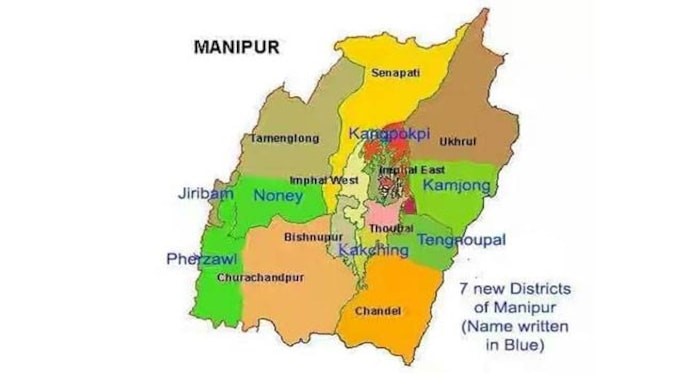
- Population—The district has a population of 13 communities, including a large number of Hindu and Muslim Bengalis and Nagas.
- Ethnic communities - The Kuki-Zo-Hmar and Meitei are 2 ethnic communities primarily in the state of Manipur.
The Kuki Inpi Manipur is the apex body of the Kuki tribes.
- Soil- It varies from sandy to loam and clay to loam having variety of colours from yellowish to bluish grey.
- Drainage- Jiri River flows from the north to the south. Jiri river forms the boundary between Assam and Manipur from its source to its termination in the Barak.
- The confluence point of Jiri and Barak Rivers is known as Jirimukh.
- Flora- It is covered by green vegetation, include bamboo, cane, teak, orchids, rubber, tea, agar, cashew nut, litchi, jack fruit, betel nut, pineapple, Eiranthus procerus etc.
- Fauna- There are various wild lives found in the area including wild dog, wild pig, barking deer, sabu, moirang sathibi, samarak ngamarak, etc.
References
- The Hindu | Jiribam
- Government of Manipur | Jiribam
Striped Caecilian
For the first time herpetologists have discovered a new species of striped caecilian in Kaziranga National Park and Tiger Reserve.
- About - It is a new limbless amphibian discovered recently in Kaziranga National Park and Tiger Reserve in Assam.
- Scientific Name – Ichthyophis spp.
- Appearance - Striped caecilians have long, cylindrical bodies with annular grooves that give a segmented appearance.
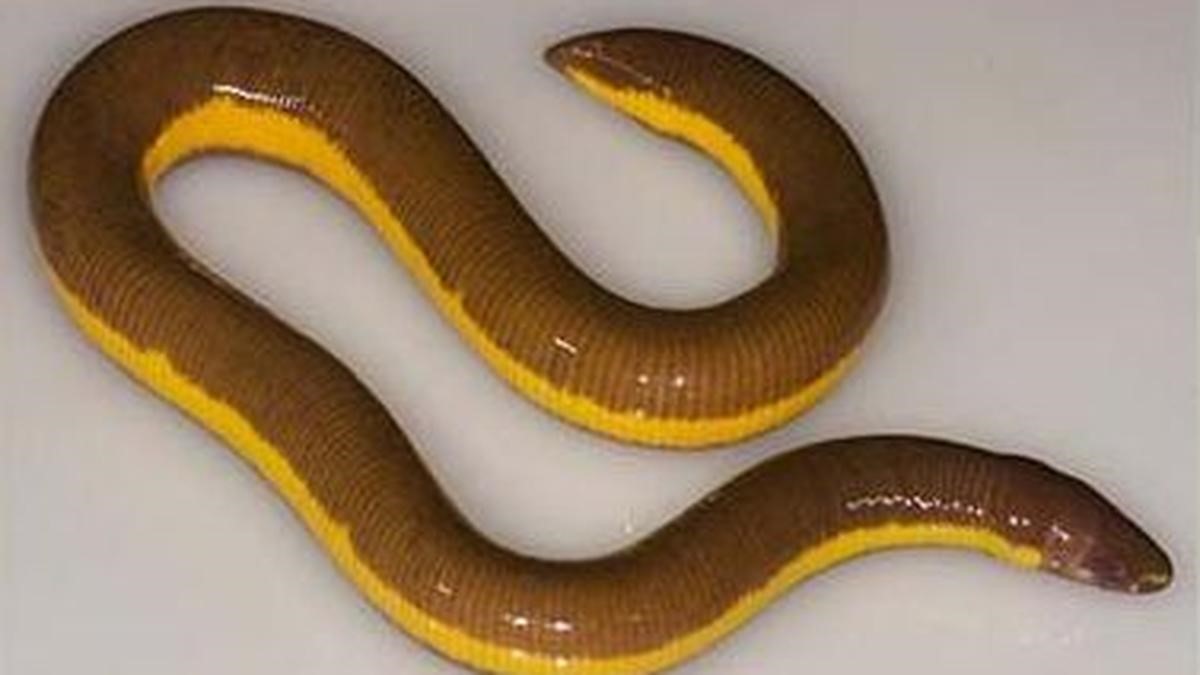
- Motion - They lack limbs and have a smooth, slimy skin that aids in movement through soil and water.
- Habitat- Striped caecilians are primarily fossorial, meaning they live underground.
- They inhabit moist soil in tropical rainforests, plantations, and occasionally in agricultural areas.
- Striped caecilians are mostly nocturnal, coming to the surface or near-surface only during the night or in heavy rains.
- Diet- Their diet consists mainly of small invertebrates such as earthworms, termites, and other soil-dwelling organisms.
|
Kaziranga National Park
|
- It is located in Golaghat and Nagaon districts of Assam.
- Formed- 1904.
- It was declared as a National Park in 1974 and a tiger reserve in 2007.
- It is also a UNESCO World Heritage Site and houses 2/3rds of the total world population of greater one-horned rhinoceros.
- Vegetation- It is a mix of eastern wet alluvial grasslands, semi evergreen forests and tropical moist deciduous forests.
- Flora- Indian gooseberry, cotton tree, and elephant apple are amongst the famous trees that can be seen in the park.
- Fauna- Along with the iconic Greater one-horned rhinoceros, the park is the breeding ground of elephants, wild water buffalo, and swamp deer.
|
References
- The Hindu | Striped Caecilian
- Ecologyasia | Striped Caecilian
Electromagnet
An electromagnet is a type of magnet in which the magnetic field is produced by an electric current.
- Invented by- William Sturgeon in 1824.
- Principle- Electromagnets are temporary magnets that form a magnetic field when an electric current is passed through them.
- Working - An electromagnet consists of a wire coil through which an electric current passes. This current generates a magnetic field around the wire.
- Influencing Factors - The strength of its magnetic field depends upon various factors like
- Number of times the wire is wound.
- The electricity flowing through it, and
- The material of the core.
- Magnetic Core- A ferromagnetic core is often placed inside the coil to amplify the magnetic field produced by the current.
|
Ampere’s Circuital Law
|
- It states that the line integral of a magnetic field around a closed loop is equal to μ° times the algebraic sum of the current passing through it.
|
- Applications - Electromagnets are widely used in numerous applications due to their ability to provide strong magnetic fields that can be turned on and off as needed.
- In electric motors and generators, they convert electrical energy to mechanical energy and vice versa.
- Example - Motors, electric bells, solenoids, MRI Machine, Card Reader, Electric Generators.
Reference
The Hindu | Electromagnet
Super-Absorbent Polymer
Super-absorbent polymers (SAPs) play a crucial role in modern diapers, enhancing their absorbency and effectiveness.
- A superabsorbent polymer (SAP) is a water-absorbing hydrophilic homopolymers or copolymers that can absorb and retain extremely large amounts of a liquid relative to its own mass
- Microscopic Forces behind Water Absorption- Water's ability to be absorbed or repelled by materials is influenced by microscopic forces and the material's nature.
- A water molecule, composed of two hydrogen atoms and one oxygen atom, exhibits unique properties.
- Although each atom is charge neutral, the hydrogen electrons shift slightly toward the larger oxygen atom due to its pull.
- Cotton vs Super-Absorbent Polymers (SAPs) - Cotton is effective for absorbing small amounts of water.
- However, for absorbing large volumes of fluids, such as those produced by a baby overnight, a more advanced material is needed super-absorbent polymer (SAP).
|
Feature
|
Polymer
|
Super-absorbent polymer
|
|
Definition
|
Large molecules composed of repeating units
|
Polymers that can absorb and retain large amounts of liquid
|
|
Water Absorption Capacity
|
Low to moderate
|
Extremely high
|
|
Chemical Structure
|
Linear, branched, or cross-linked chains
|
Cross-linked network structure
|
|
Physical State
|
Solid at room temperature
|
Gel-like when swollen with water
|
|
Degradability
|
Varies, many are non-biodegradable
|
Often non-biodegradable, but some are designed to be environmentally friendly
|
- Sodium and Water Interact in Super-Absorbent Polymers (SAPs) - Sodium and water have a strong affinity for each other, much like how salt (sodium chloride) dissolves in water as sodium ions separate from chlorine ions and bond with water molecules.
- In super-absorbent polymers (SAPs), water molecules attach to sodium ions within the polymer structure.
- These water molecules then link together, forming a rigid network that traps the water and swells, creating a gel.
- This gel formation is what allows SAPs to absorb and retain large amounts of liquid.
Reference
The Hindu | Super-Absorbent Polymer
Juneteenth
Recently, Juneteenth was observed on June 19, in the United States of America.
- About- Juneteenth, derived from "June" and "nineteenth," commemorates the abolition of slavery in the United States.
- History - The day was first commemorated in 1865 after the Confederate state surrendered to end the Civil War.
- The enslaved African Americans informed of their freedom under President Abraham Lincoln's 1863 Emancipation Proclamation.
- The day is celebrated with community events such as parades, cookouts, prayer gatherings, and musical performances.
- Symbol of Freedom- It symbolizes freedom and the end of slavery in the United States.
- It signifies the triumph of the human spirit over slavery's brutal legacy and the ongoing struggle for civil rights and equality.
- It is also known as Freedom Day or Emancipation Day, is an American holiday celebrated annually.
- However, not all state governments recognise the holiday, which means state employees in those states will report to work.
- The legislature would have to pass bills to make it a permanent holiday.
- Recognition- Over the years, Juneteenth celebrations have grown in prominence across the United States.
Reference
The Indian Express | Juneteenth



