Long-range glide bomb (LRGB) Gaurav
Recently, India has successfully conducted the maiden flight test of the long-range glide bomb (LRGB) 'Gaurav' from Long Wheeler’s Island coast, Odisha.
- Gaurav- It is an air launched 1,000 kg class glide bomb capable of hitting targets at long distance.
- Designed by - The GAURAV glide bomb was indigenously designed and developed by the Research Centre Imarat (RCI) in Hyderabad.
- The glide bomb steers towards its target using a highly accurate hybrid navigation system that combines INS and GPS data.
Long-Range Glide Bomb
- A Long-Range Glide Bomb (LRGB) is a precision-guided weapon that combines the characteristics of a bomb and a missile.
- It is designed to be released from an aircraft and glide over long distances towards its target.
- The bomb is equipped with guidance systems that allow it to accurately hit its target without the need for a powered flight, making it a cost-effective and versatile option for air-to-ground strikes.
- Glide Capability- The bomb is released from a high altitude, allowing it to glide towards the target using aerodynamic surfaces such as wings or fins.
- This capability enables the bomb to cover long distances without requiring propulsion, extending the reach of the aircraft delivering it.
- Payload- LRGBs can carry various types of warheads, including high-explosive, penetrating, or cluster munitions.
- Strategic strikes- LRGBs are used for strategic strikes against high-value targets such as enemy command centers, radar installations, and airfields.
References
- The Hindu | Long range glide bomb
- India Today | Long range glide bomb
109 New crop varieties
Recently 109 varieties of 61 Field and Horticultural crops were released in the trial sites of PUSA, New Delhi.
- Aim - Enhancing farm productivity and improving farmers' incomes.
- Developed by – Various research institutes of Indian Council for Agricultural Research (ICAR) and state agriculture universities.
- Field Trial - The seeds of the new varieties were introduced at three experimental agriculture plots at Delhi's Pusa Campus.
- PUSA - Indian Agricultural Research Institute (IARI) Delhi.
- 109 Crop Varieties – These are climate resilient, bio fortified and nutrient rich varieties of 61 Crops.
- Types - 34 field crops and 27 horticultural crops.
- Field Crops (69)
- Cereals (23): Rice-9; Wheat-2; Barley 1; Maize-6, Sorghum-1, Pearl millet-1; Finger millet-1; Proso millet-1; Barnyard millet-1;
- Pulses (11): Chickpea -2, Pigeon pea – 2, Lentil -3, Field pea – 1; Fababean -1; Mungbean -2;
- Oilseeds (7): Safflower – 2, Soybean – 2, Groundnut – 2, Sesame -1;
- Forage crops (7): Forage pearl millet-1; Berseem–1, Oats–2; Forage maize-2, Forage sorghum–1,
- Sugar crops (4): Sugarcane - 4;
- Fibre crops (6): Cotton - 5; Jute -1;
- Potential crops (11): Buckwheat-1, Amaranth-4, Winged bean-1, Adzuki bean-1, Pillipesara-1, Kalingda-1, Perilla-2
- Horticultural Crops (40)
- Fruits (8): Mango –3, Pomegranate – 1; Guava – 2; Bael – 1; Pummelo – 1;
- Vegetable crops (8): Tomato -2; Bottle gourd -1; Okra – 1; Indian beans – 2; Muskmelan – 1; Water melan – 1;
- Tuber crops (3): Potato – 3;
- Spices (6): Netmug – 1, Small cardamom -2; Fennel – 1; Ajwain – 01; Mango ginger – 1;
- Plantation crops (6): Cocoa -2, Cashew – 2; Coconut – 2;
- Flowers (5): Merigold – 1; Tuberose – 1; Crossandra – 1; Gladiolus – 2;
- Medicinal plants (4): Velvet Bean – 2; Ashwagandha -1; Mandukaparni – 1
References
PIB | 109 new crop varieties
The UK-India TSI
Recently, India has begun negotiations with the UK to enhance collaboration on critical minerals under the new UK-India Technology Security Initiative (TSI).
- Critical minerals- these are natural resources that are essential to the economy and crucial to produce a wide range of high-tech devices, clean energy technologies, and defense systems.
- These minerals are considered "critical" due to their economic importance and the risk of supply chain disruptions.
- Examples of Critical Minerals-
- Rare Earth Elements (REEs)- Used in electronics, magnets, and renewable energy technologies.
- Lithium- Essential for batteries in electric vehicles (EVs) and energy storage systems.
- Cobalt- Used in battery production, particularly for EVs.
- Nickel- Vital for stainless steel production and batteries.
- Platinum Group Metals (PGMs)- Used in catalytic converters, electronics, and medical devices.
- Graphite- Key component in batteries and fuel cells.
UK-India Technology Security Initiative (TSI)
- It is a collaborative framework established between the United Kingdom and India to enhance technological security and cooperation between the two nations.
- Purpose- Strategic framework for collaboration in critical minerals, semiconductors, AI, quantum technologies, biotechnology, and advanced materials.
- Objective- To reduce dependency on China and lead the global critical minerals supply chain.
- Focus areas- Developing economically viable and environmentally sustainable technologies for extracting and recycling critical minerals.
- Joint initiative- Possible establishment of a Critical Minerals Recycling Centre in India focusing on advanced military waste recycling.
- UK-India “Critical Minerals” community- To foster knowledge exchange among academics, innovators, and industry leaders.
- Geological collaboration- Partnership between the British Geological Survey (BGS) and the Geological Survey of India (GSI) to enhance exploration methods and offshore mining technology development.
- Collaboration on recycling critical minerals- Exploration of launching a joint Critical Minerals Recycling Centre in India, including advanced military waste recycling.
- Offshore Mining and Scientific Collaboration- Opportunities for co-developing technologies and exchanging scientific knowledge in offshore mining will be explored.
- India’s international partnerships-
- US-led Mineral Security Partnership (MSP) for securing critical mineral supply chains.
- India-Australia Critical Minerals Investment Partnership focusing on exploration and development.
- With the UK, marking the third major international partnership in the critical minerals sector.
References
- Business Standard | The UK-India TSI
- Ministry of External Affairs | UK-India Technology Security Initiative
Tungabhadra Dam & River
A flood alert has been issued in Karnataka’s Koppal district after one of the 33 crest gates of the Tungabhadra dam was washed away.
- About- It is a major river in the south Indian peninsula and is a major tributary of the Krishna River.
- Origin- It is formed at the confluence of two streams, Tunga and Bhadra, near Shimoga, Karnataka.
- Course- River starts and flows through the state of Karnataka, during most of its course, Andhra Pradesh and ultimately joining the Krishna River near Murvakonda in Andhra Pradesh.
- Boundary- It forms part of the boundary between Karnataka and Andhra Pradesh.
- Tributaries- Varada and Hagari River.
- Length and catchment area- The river has a total length of approximately 531 km and a catchment area of about 70,000 sq km.
- It is influenced mainly by the South-West monsoon and is a perennial river.
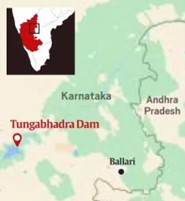
o The reservoir covers an area of 378 sq km, primarily in Karnataka’s Vijayanagar district.
o It is one of the major reservoirs in South India, supplying water for irrigation, industrial use, and drinking water to Karnataka and Andhra Pradesh.
- Tungabhadra board- Established by a presidential order in 1953.
- The Board consists of a chairman appointed by the Union government and 4 members representing the Union government, Karnataka, Andhra Pradesh, and Telangana.
Tungabhadra Dam
- Historical background- The dam was first conceived in 1860 to address recurrent famines in Rayalaseema.
- Construction- The construction began in 1945 under the governments of Hyderabad and Madras and was completed in 1953.
- Location- The Tungabhadra Dam is located near the town of Hospet in Karnataka’s Vijayanagar district.
- It is constructed across the Tungabhadra River.
- Reservoir- The Tungabhadra reservoi has a storage capacity of about 101 TMC (Thousand Million Cubic feet).
- Purpose- The dam plays a critical role in water management for irrigation, providing water to farmlands.
- It also supplies drinking water and supports industrial activities in the region.
- Hydroelectric power- It is also a source of hydroelectric power, generating electricity that supports the energy needs of the surrounding regions.
References
- The Indian Express | Tungabhadra
- Tungabhadra Board | Tungabhadra




