Project PARI (Public Art of India)
Recently, the Ministry of Culture launched Project PARI at the 46th Session of the World Heritage Committee Meeting in Delhi.
- Aim - It seeks to bring forth public art that draws inspiration from millennia of artistic heritage (lok kala/lok sanskriti) while incorporating modern themes and techniques.
- Nodal Ministry - Ministry of Culture.
- Executed by – The Lalit Kala Akademi and the National Gallery of Modern Art.
- The first intervention under Project PARI is taking place in Delhi.
- The project aims to provide a platform to uplift the aesthetic and cultural outlook of Delhi while adding grandeur to the rich historical legacy of our national capital.
- The artworks and sculptures draw inspiration from World Heritage Sites such as Bhimbetka and the 7 natural World Heritage Sites in India find a special place in the proposed artworks.
- Traditional art forms as well as sculptures, murals, and installations have been created under this beautification project.
- More than 150 visual artists from all over the country have come together to create the various wall paintings, murals, sculptures, and installations being prepared under this project.
- Women artists have been an integral part of Project PARI and their participation in large numbers is a testimony of Bharat’s NARI SHAKTI.

|
World Heritage Committee (WHC)
|
- The WHC decides on inscription of new sites into the UNESCO World Heritage List.
- India will be hosting the meeting for the first time in July, 2024.
- The number of UNESCO World Heritage Sites in India grew to 42 with the ‘Sacred Ensembles of the Hoysala’ added recently.
- These sites include 34 in the cultural category, seven in the natural category and one mixed property.
- Currently, India has the 6th largest number of (UNESCO) sites in the world.
- The countries that have 42 or more world heritage sites are Italy, Spain, Germany, China and France.
|
References
PIB | Project PARI
Lalit Kala Akademi | Project PARI
Anand Marriage Act
Recently, the National Commission of Minorities held a meeting with states and Union Territories to discuss the implementation of the Anand Marriage Act.
- About- The Anand Marriage or Sikh Marriage Act is legally recognizing and protects Sikh marriages conducted through the Anand Karaj ceremony.
- Emergence – It dates back to 1909 when the British Imperial Legislative Council passed a legislation for the recognition of the Sikh wedding ceremony Anand Karaj.
- Legal Recognition- In 2012, the Parliament passed the Anand Marriage (Amendment) Bill, bringing Sikh traditional marriages under the purview of legal recognition.
- While the central government approved the amendments, it was left for individual states and Union territories to frame respective rules for the registration of Anand marriages.
- It also protects the rights and responsibilities of Sikh couples within the framework of legal marriage.
- Objective- To address concerns from the Sikh community regarding the validity of their marriages under existing Hindu marriage laws.
- Implementation- States including Jharkhand, Maharashtra, and Meghalaya have reported implementing the Anand Marriage Act.
|
National Commission for Minorities
|
- The National Commission for Minorities (NCM) is a statutory body established to safeguard and protect the rights of religious and linguistic minorities in the country.
- It was set up under the National Commission for Minorities Act, 1992.
- Functions and Powers- It ensure that the constitutional and legal safeguards for the protection of minorities are implemented effectively.
- It evaluates the progress of the development of minorities under the Union and States.
- It makes recommendations for the effective implementation of safeguards and measures for the protection of minorities.
- It advises the central government on minority-related issues.
- Civil Court Powers- The NCM has the powers of a civil court while investigating any matters related to deprivation of rights of minorities.
- Notified minority communities (6) – Muslims, Christians, Sikhs, Buddhists, Zoroastrians (Parsis), Jains.
- As per the 2011 Census, The 6 religious minority communities constitute around 20% of the country’s population.
|
References
- PIB | Anand Marriage Act
- Indiacode | ANAND MARRIAGE ACT
Astrophysical jets
Recently, a team of scientists have traced the effect of plasma composition on dynamics of astrophysical jets from celestial bodies.
- About- An astrophysical jet is an astronomical phenomenon where outflows of ionised matter are emitted as extended beams along the axis of rotation.
- Formation- They are believed to form due to complex interactions involving magnetic fields and the accretion disks around compact objects.
- Composition- It consist of charged particles (plasma), which can include electrons, protons, and other atomic nuclei.
- These particles are accelerated to relativistic speeds, approaching the speed of light.
- Velocity- Jets associated with stars are composed of ionized gas moving away from the star with velocities of a few hundred kilometres per second.
- Findings of the recent study- Scientists have studied how the plasma composition of astrophysical jets are streams of ionized matter from celestial objects like black holes, neutron stars, and pulsars affects their behaviour.
- The study demonstrated that altering plasma composition affects jet propagation velocities, despite identical initial parameters.
Reference
PIB | Astrophysical jets
Biodiversity Beyond National Jurisdiction (BBNJ) Agreement
Recently, the Union Cabinet of India approves to sign of the Biodiversity beyond National Jurisdiction (BBNJ) Agreement.
- The BBNJ Agreement, or the ‘High Seas Treaty’, is an international treaty under the United Nations Convention on the Law of the Sea (UNCLOS).
- Aim- To address the growing concerns over the long-term protection of marine biodiversity in the high seas.
- It sets precise mechanisms for the sustainable use of marine biological diversity through international cooperation and coordination.
- SDG Goal- It contribute to achieving SDG14 (Life below Water).
- Pillars- The BBNJ Agreement consists of the following 4 pillars:
- Marine genetic resources, including the fair and equitable sharing of benefits
- Measures such as area-based management tools, including marine protected areas
- Environmental impact assessments
- Capacity-building and the transfer of marine technology.
- Members - As of now, 91 countries have signed the BBNJ Agreement, and eight Parties have ratified it.
- It aims to protect biodiversity and achieving the objective to protect at least 30% of the planet by 2030.
|
United Nations Convention on the Law of the Sea (UNCLOS)
|
- It is crucial for the environmental protection of the seas and addressing maritime boundaries, rights to marine resources, and dispute resolution.
- It is also known as Law of the Sea.
- It is the only international convention which stipulates a framework for state jurisdiction in maritime spaces.
- It provides the backbone for offshore governance by coastal states and those navigating the oceans.
- It divides marine areas into 5 main zones namely- Internal Waters, Territorial Sea, Contiguous Zone, Exclusive Economic Zone (EEZ) and the High Seas.
- Operation- UNCLOS was adopted on 1982 and came into force on 1994.
- Mining regulation- It establishes the International Seabed Authority to regulate mining and related activities on the ocean floor beyond national jurisdiction.
- Members- Presently, more than 160 countries have ratified UNCLOS.
- India is a state party to the UNCLOS.
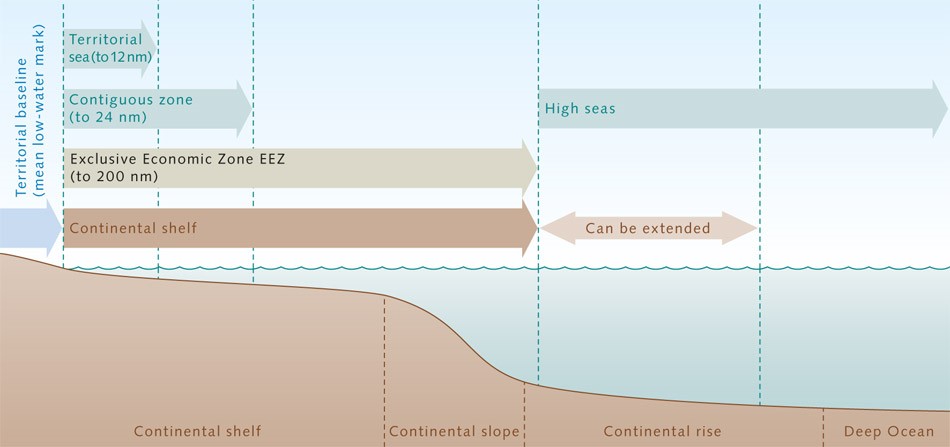
|
References
- PIB | BBNJ Agreement
- GEF | BBNJ Agreement



