Ramon Magsaysay Award 2024
Japanese filmmaker Hayao Miyazaki has won the 2024 Ramon Magsaysay Award.
- Ramon Magsaysay Award – It is Asia’s premier prize and highest honor that recognizes greatness of spirit shown in selfless service to the peoples of Asia regardless of race, gender, or religion.
- It is awarded to outstanding individuals and organizations whose selfless service has offered solutions to some of the most intractable problems of human development.
- It is also known as the "Nobel Prize of Asia."
- Ramon Magsaysay – 7th Philippine President whose ideals inspired the Award’s creation.
- Award Instituted In – 1957.
- Announcement - Recipients of the Award are announced annually on August 31st.
- Award Presentation - The Award medallion and certificate are presented in a formal ceremony in Manila, Philippines, every November of the same year.
- Categories - Award was given in six categories annually.
|
Government Service
|
To recognize outstanding service in the public interest in any branch of government, including the executive, judicial, legislative, or military.
|
|
Public Service
|
To recognize outstanding service for the public good by a private citizen.
|
|
Community Leadership
|
To recognize leadership of a community toward helping the disadvantaged have fuller opportunities and a better life.
|
|
Journalism, Literature, and Creative Communication Arts
|
To recognize effective writing, publishing, or photography or the use of radio, television, cinema, or the performing arts as a power for the public good.
|
|
Peace and International Understanding
|
To recognize effective writing, publishing, or photography or the use of radio, television, cinema, or the performing arts as a power for the public good.
|
|
Emergent Leadership
|
To recognize an individual, forty years of age or younger, for outstanding work on issues of social change in his or her community.
|
|
Hayao Miyazaki
|
- Hayao Miyazaki is the Japanese filmmaker, considered one of the greatest animators and directors.
- His Major Works - My Neighbour Totoro, Kiki’s Delivery Service, World Masterpiece Theater, Future Boy Conan, The Wonderful World of Puss ‘n Boots, Castle in the Sky, Spirited Away
- Books written - Starting Point: 1979 to 1996
- Studio Ghibli - He along with director Isao Takahata and producer Toshio Suzuki, founded Studio Ghibli in 1985.
- Themes - Pacifism, Environmentalism.
- Miyazaki’s work was heavily steeped in the changing lives of Japanese people post-World War II.
|
Reference
Indian Express | Magsaysay Award
Zombie fungus
Recently, A field researcher found a dead tarantula that was infected by zombie fungus.
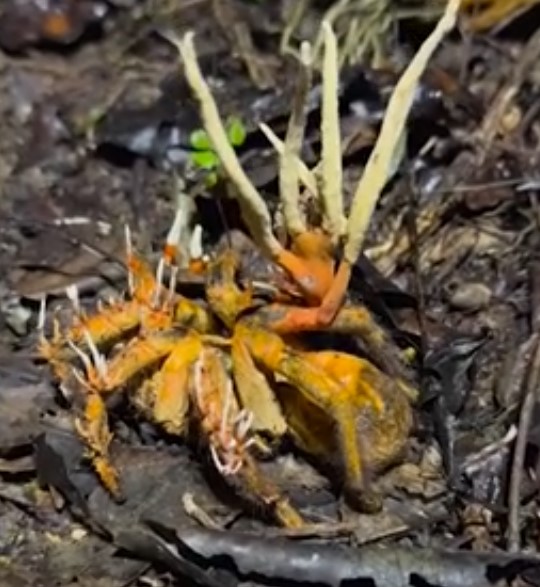
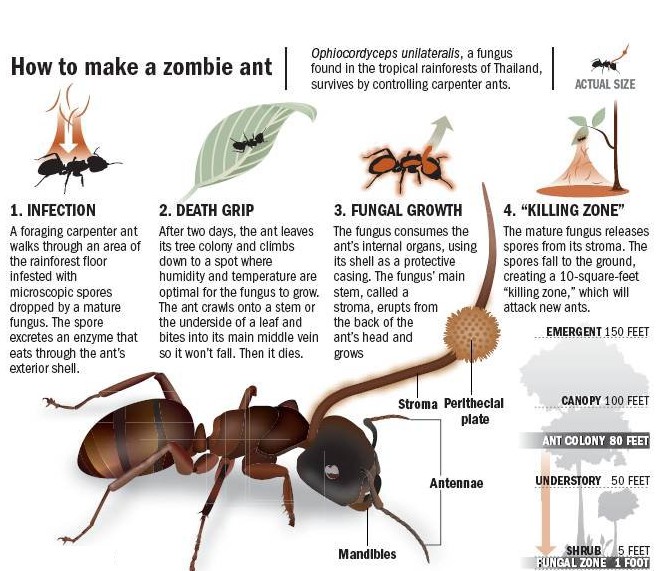
- Zombie Fungus – It is a species of parasitic fungus that generally infects ants and alters their behaviour before killing them.
- It is the first time it has infected a tarantula.
- It does not infect humans.
- Scientific name - Ophiocordyceps unilateralis.
- It is referred to simply as “cordyceps”.
- Taxonomy
- Kingdom: Fungi
- Order: Hypocreales
- Family: Ophiocordycipitaceae
- Domain: Eukaryota
- Prevalence – They currently found predominantly in tropical forest ecosystems.
- Lifecycle - The fungus begins its life cycle as a sticky spore on the forest floor.
- Infection - The Spore attaches to the body of a passing carpenter ant and germinates infective hyphae (threadlike strands) to breach the insect’s exoskeleton.
- Growth - Once successfully inside the ant body, the fungus grows and manipulates the ant’s behaviour.
- It makes the ant position itself in a warm, humid location near the ground that will best serve to distribute a new crop of fungal spores.
- Death - After the ant dies, the fungus finishes digesting the cadaver from the inside out and erects a triumphant stalk from the base of its conquest’s head.
- Spread - The stalk releases spores from characteristic lateral cushions, and the cycle continues.
References
- CNN | Tarantula infected by 'zombie fungus'
- Brittanica | Zombie Ant Fungus
Arabian wolf & Indian wolf
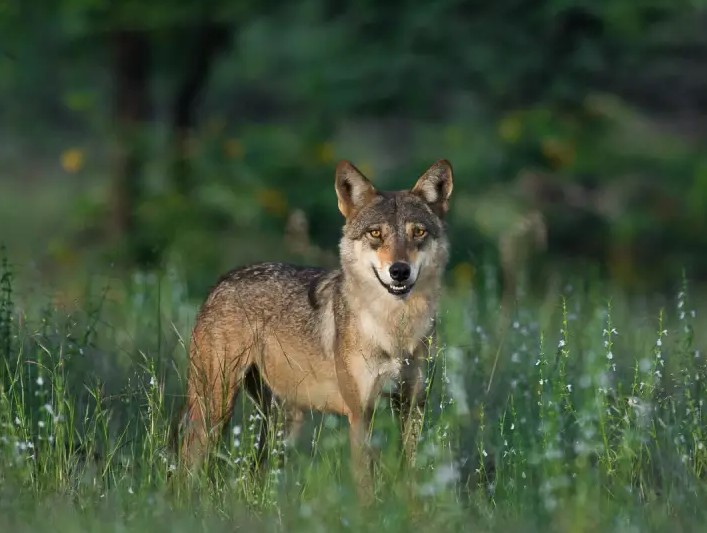
Recently about 9 deaths in the riverine plains of Bachrach, Uttarpradesh is suspected to be caused by Indian Wolves.
- Wolf (Canis lupus) – It is a wide ranging and highly adaptive species.
- Habitats - With almost 40 subspecies, the wolf lives in a wide variety of habitats
- High mountains like the Himalayas
- Plains like the Indo-Gangetic Plain of South Asia
- The Deccan Plateau
- The icy tundra of the Arctic
- Deserts like the Thar
- The taiga.
- Southern Wolves – Indian and Arabian Wolves are southern subspecies of grey wolf species.
- They inhabit mostly arid landscapes.
- The Arabian wolf is the smallest grey wolf in the world and is Endangered due to human persecution.
|
Characteristics
|
Indian Wolf
|
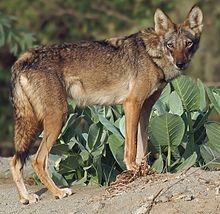
Arbian Wolf
|
|
|
 |
 |
|
Scientific Name
|
Canis lupus pallipes
|
Canis lupus arabs
|
|
IUCN Status
|
Endangered
|
Endangered
|
|
CITES
|
Appendix I
|
Appendix II
|
|
WPA Status
|
Schedule I
|
Not Available
|
|
Size
|
Medium in size
|
Smallest
|
|
Distribution
|
India, Pakistan, Afghanistan, Nepal, Bhutan, Israel, Turkey, Iran, and Syria
|
Arabian Peninsula, the Negev Desert, the Sinai Peninsula, and Jordan
|
|
Habitat
|
Open grasslands, thorn forests, and scrublands
|
Desert-adapted subspecies
|
|
Hunting
|
Indian wolves are territorial and hunt during the night
|
Nocturnal and Hunt during Night
|
References
DownToEarth | Indian wolf brings hope for its Arabian cousin
Lothal dockyard of Harappan Civilisation
Recently a new study by the Indian Institute of Technology-Gandhinagar has found evidence for Lothal dockyard of Harappan Civilization.
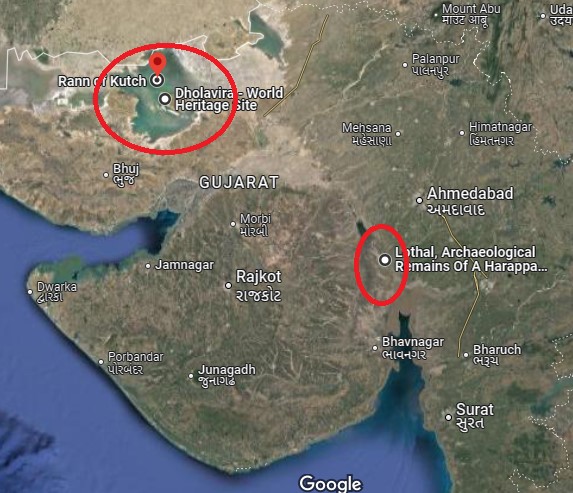
- Lothal – It is situated approximately 30 km inland from the Gulf of Khambhat on the western coast of India in Gujarat.
- It served as a bustling port during the Bronze Age Harappan period (2600 BCE to 1900 BCE)
- It was connected to a series of Harappan production and distribution centres along the Gulf of Kachchh and the Rann of Kachchh.
- Significance - Lothal is renowned for its well-preserved brick-walled dockyard and warehouse.
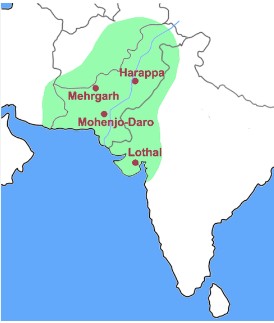
- Study findings - The Lothal dockyard theory is reevaluated using multi-sensor data, cloud computing, and multiple platforms.
- Path of Sabarmati River - Sabarmati river used to flow by Lothal during the Harappan Civilisation.
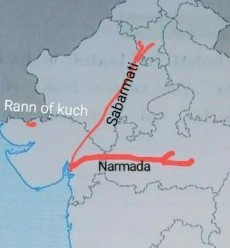
- Currently, it flows 20 km east of Lothal.
- The lower reaches of the River Sabarmati underwent significant migration during the late Holocene period.
- It was discovered by the satellite images of the old channels of the River Sabarmati.
- Travel Route - There was also a travel route connecting Ahmedabad, through Lothal, the Nal Sarovar wetland, and the Little Rann, to Dholavira.
References
- Indian Express | Lothal Dockyard
- ScienceDirect | Sabarmati and its connection with Lothal
Indian Ocean Biodiversity Ocean Information System (IndOBIS)
Recently Centre for Marine Living Resources and Ecology (CMLRE) organised a national-level workshop on IndOBIS.
- IndOBIS – It is the Indian regional node of the global Ocean Biodiversity Information System (OBIS).
- Developed by - Centre for Marine Living Resources and Ecology (CMLRE)
CMLRE is a premier research institution under the Ministry of Earth Sciences, established in 1998 at Kochi.
- Function - IndOBIS collects data of taxonomically resolved marine species occurrence records from the Indian Ocean.
- It accepts several categories of marine biodiversity data types, including literature and occurrence, abundance records, DNA-derived or genomic profiles, etc.
- Use of IndOBIS - It can be used in innovative studies such as tracking species distribution, identifying biodiversity hotspots, and accessing climate change impacts.
|
Ocean Biodiversity Information System (OBIS)
|
- OBIS is one of the largest global repositories of information on marine species, marine science, conservation, and education.
- It emanated from the Census of Marine Life (2000-2010).
- Established by - Intergovernmental Oceanographic Commission (IOC) of UNESCO.
- It is now an integral component of the International Oceanographic Data and Information Exchange (IODE) of IOC.
- Features - It is supported by a network of nearly 30 regional nodes contributing data.
- It contains millions of records from thousands of datasets contributed by researchers, governments, and organisations worldwide.
- It provides detailed information on species distribution across the world's oceans, including data on their occurrence, habitats, and environmental parameters.
- It provides free and open access to, and application of, biodiversity and biogeographic data and information on marine life.
- It offers tools and services that allow users to search, visualise, and download biodiversity data.
|
|
Ocean Eyes
|
- It is a citizen-centric mobile app for community-engagement approach to data collection, sharing, and analysis in marine biodiversity monitoring and research.
- Developed by - Centre for Marine Living Resources and Ecology
- Citizens and users can record sightings of marine species, log environmental conditions, and upload geotagged photos directly through the mobile.
|
References
- PIB | Indian Ocean Biodiversity Information System
- IndOBIS | Indian Ocean Biodiversity Information System



