Bent-toed geckos
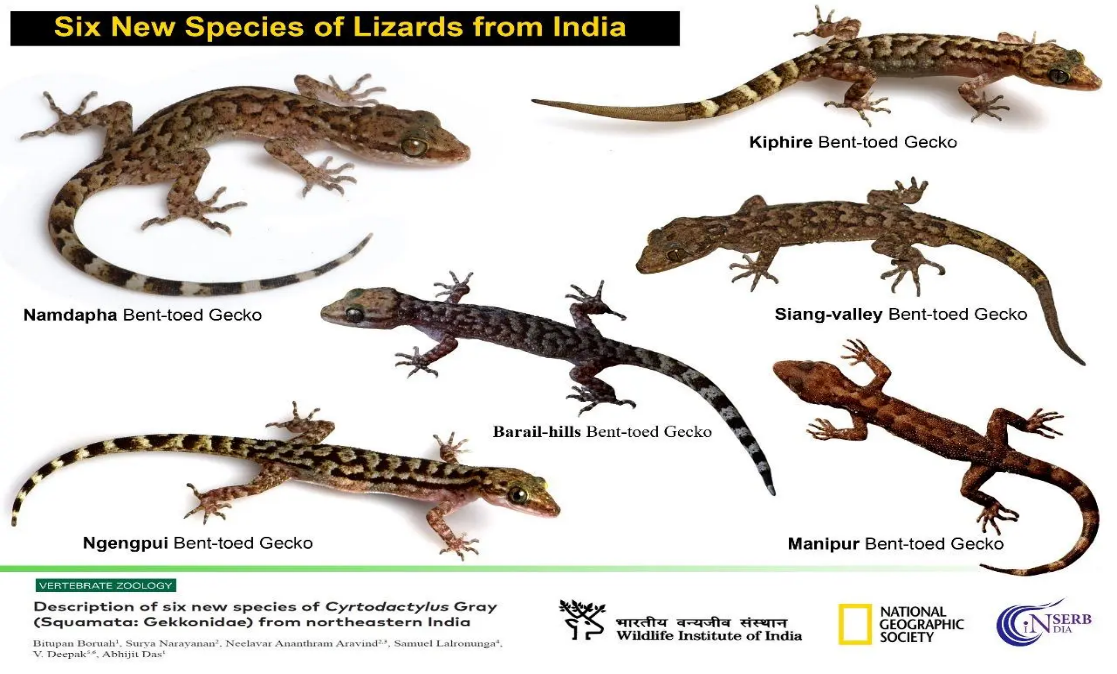
Scientists from India and the UK have recently discovered 6 new species of bent-toed geckos in Northeast India.
- Bent-toed geckos are a diverse group of geckos known for their distinctive bent or curved toes.
- Genus- Cyrtodactylus.
- Size- Typically small to medium-size.
- Body- Their toes are notably bent, which aids in their climbing abilities.
- Habitat- They inhabit a variety of environments including forests, rocky areas, and sometimes urban areas.
- Diversity- They are predominantly found in Southeast Asia, including countries like India, Sri Lanka, Thailand, and Malaysia.
- Behaviour- Most are nocturnal, meaning they are active during the night.
- Diet- They are insectivorous, feeding on small insects and other invertebrates.
- Reproduction- Bent-toed geckos lay eggs, with the number and size of eggs varying by species.
- They typically lay them in hidden or secure locations.
|
Details of the discoveries
|
|
Namdapha Bent-Toed Gecko (Arunachal Pradesh)
|
- Found in Namdapha and Kamlang Tiger Reserves, inhabit lowland evergreen forests and are seen near forest streams.
|
|
Siang Valley Bent-Toed Gecko (Arunachal Pradesh)
|
- Named after Siang Valley, this species is notable for its distinct biodiversity.
|
|
Nengpui Bent-Toed Gecko (Mizoram)
|
- Located in Ngengpui Wildlife Sanctuary, characterized by tropical semi-evergreen forests with Dipterocarpus spp. and palms.
|
|
Manipur Bent-Toed Gecko (Manipur)
|
- Found near Lamdan Kabui village, perched on shrubs, along the Leimatak-Charoikhullen road.
|
|
Barail Hills Bent-Toed Gecko (Nagaland)
|
- Known only from Peren District’s Athibung Reserve Forest, in tropical to subtropical cloud forests.
|
|
Kiphire Bent-Toed Gecko (Nagaland)
|
- Discovered in subtropical regenerating jhum forest, with the holotype collected from a shrub 2 meters up at night.
|
References
- Down to Earth | bent-toed geckos
- Eastmojo | Bent-Toed Geckos
Standardized Precipitation Index (SPI)
The India Meteorological Department (IMD) has used the Standardized Precipitation Index (SPI) to study trends in precipitation and drought conditions across India.
- SPI – It is a drought index that measures how observed precipitation compares to the long-term average over a given time (e.g. over the last 30 or 60 days).
- It can also be used to measure drought impacts on soil moisture, groundwater, streamflow, and reservoir storage.
- Calculation – It is calculated by dividing the difference between the observed precipitation and the long-term average by the long-term standard deviation of precipitation for that period.
- Time Scales- The SPI is calculated for a selection of time scales, including 1, 2, 3, 6, 9, and 12 months.
- Developed by - T. B. McKee, N.J. Doesken, and J. Kleist in 1993.
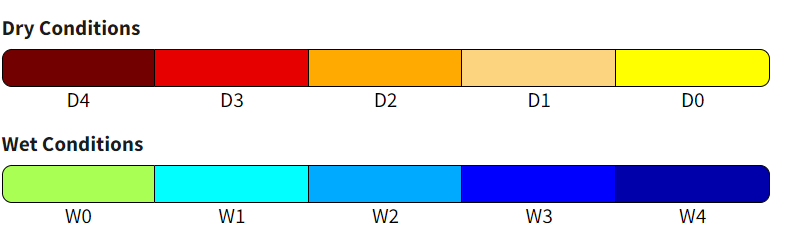
- It uses a legend to indicate drought conditions, with D4 representing exceptional drought, D3 representing extreme drought, D2 representing severe drought, and D1 representing moderate drought.
- Transformation- Precipitation data is transformed using probability distributions like gamma or Pearson III to fit a normal distribution.
- SPI Values
- Positive SPI – It indicates wet conditions (greater than median precipitation).
- Negative SPI – It indicates dry conditions (less than median precipitation).
References
- PIB | Environmental hazards in the North-Eastern States
- NASA | Standardized Precipitation Index (SPI)
Price Monitoring System (PMS) version 4.0
Union Food and Consumer Affairs Ministry has launched the Price Monitoring System (PMS) Version 4.0 and Mobile App.
- Price Monitoring System - The price Monitoring Division (PMD) in the monitors prices of selected essential commodities.
- Ministry - Consumer Affairs, Food and Public Distribution.
- It monitors retail and wholesale prices and spot and future prices of selected essential commodities daily.
- It also implements commodity-specific market intervention schemes in the event of shortage and to control prices.
- Civil Supplies Departments of 34 States/UTs provide information on 550 market centers.
- Monitored Commodities – 38
- Earlier 22 - Rice, Wheat, Atta, Gram Dal, Tur (Arhar) Dal, Urad Dal , Moong Dal, Masur Dal, Sugar, Gur, Groundnut Oil, Mustard Oil, Vanaspati, Sunflower Oil, Soya Oil, Palm Oil, Tea, Milk, Potato, Onion, Tomato and Salt.
- 16 new commodities under Version 4 - Bajra, Jowar, Ragi, Suji (wheat), Maida (wheat), Besan, Ghee, Butter, Brinjal, Egg, Black Pepper, Coriander, Cummin seed, Red chilies, Turmeric powder and Banana.
- The new commodities will be monitored from 1st August 2024.
- The 38 commodities constitutes close to 31% of the total CPI weights.
- Benefit of Monitoring - Facilitate policy interventions to stabilize price volatility in food items and to control the overall inflation.
- Price Monitoring System (PMS) mobile app - It is a tool designed to track and analyze pricing data for products across various retailers.
- It helps users to monitor price changes in real-time, compare prices, and receive alerts for price drops or promotions, making it easier to make informed purchasing decisions.
References
PIB | Price Monitoring System version 4
Maritime Partnership Exercise (MPX)
Recently, Indian Navy successfully conducted the Maritime Partnership Exercise (MPX) at Baltic Sea.
- MPX – A multilateral event conducted by Indian Navy in which naval forces of foreign countries participate.
- Aim – To enhance Indian Navy’s operational capabilities and strengthen its partnerships with friendly nations.
- Importance – It enhances the ability of different naval forces to operate together seamlessly, which is crucial in times of crisis or conflict.
- It strengthens diplomatic and military ties between participating nations, fostering greater regional and global stability.
- It also allows participating navies to train and refine their tactics, techniques, and procedures, leading to improved operational effectiveness.
- MPX 2024 – It is between India and Russia, which involved naval ships from both nations
- India- INS Tabar
- Russia- Soobrazitelny
INS Tabar was built in Russia and was commissioned into the Indian Navy, on April 19, 2004.
- Activities – It involved a series of complex naval manoeuvres, including
- Communication drills
- Search-and-rescue tactics
- Replenishment at sea procedures
- Significance – The Indian Navy's participation in the 328th Russian Navy Day Parade and MPX highlights a key step in maritime cooperation for regional peace and security.
In 2023, Indian Naval ships INS Rana and INS Sumedha undertook a Maritime Partnership Exercise (MPX) with French Navy ship FS Surcouf, in the Bay of Bengal on 30 June 2023.
Reference
1. PIB | Maritime Partnership Exercise



