|
One Liners 28-11-2026
|
|
Species
|
|
Two New Cave-Dwelling Gecko Species Discovered – Meghalaya
Two new species of bent-toed geckos were discovered in the limestone cave systems of Meghalaya’s Khasi and Jaintia Hills, increasing the number of recognised Cyrtodactylus species in the state to nine.
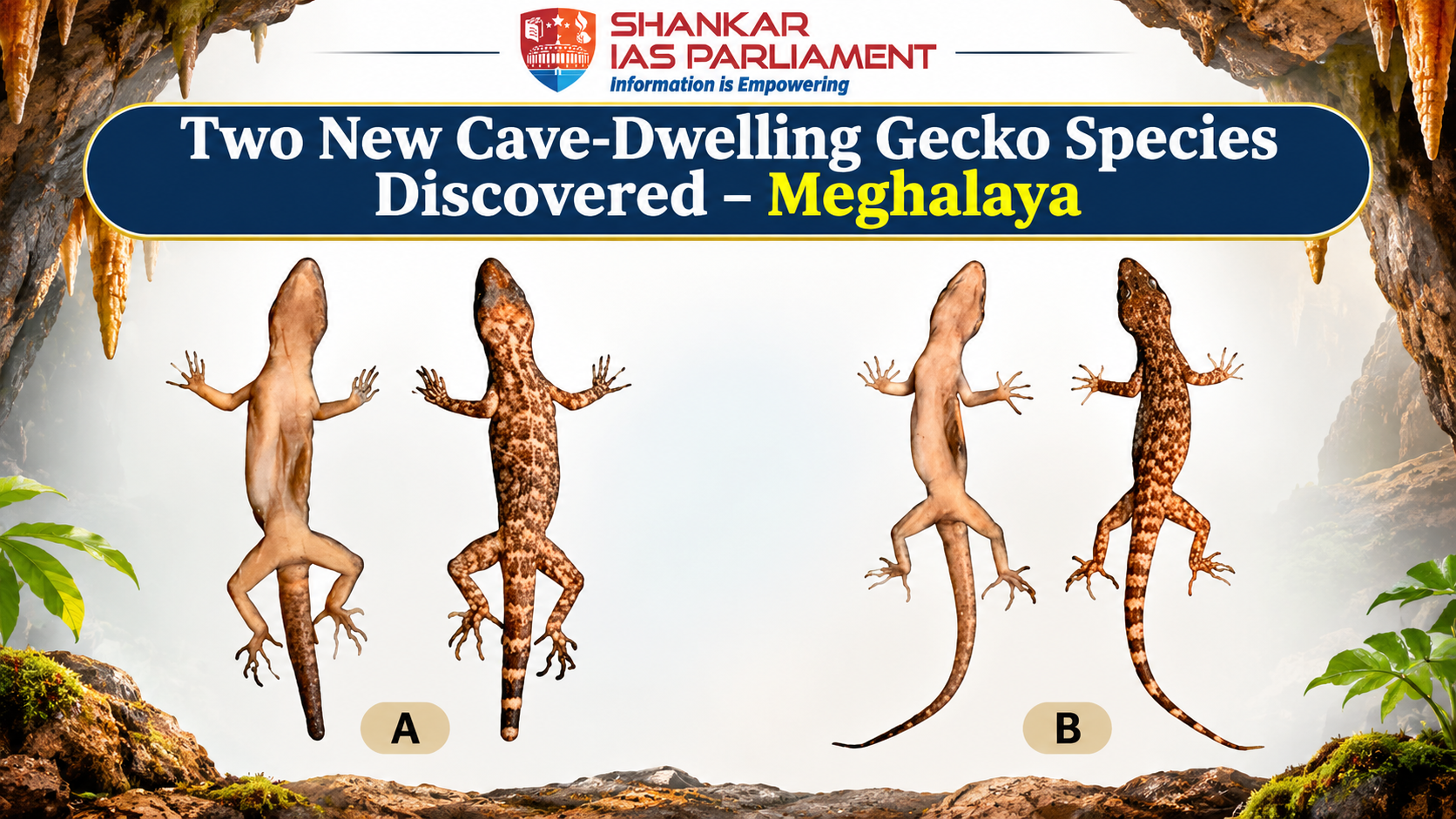
- New Species
- Cyrtodactylus bossmit – Named after Shillong’s iconic wooden bus, ‘Bossmit’; found in Khasi Hills.
- Cyrtodactylus kremicola – Derived from the Khasi word ‘Krem’, meaning cave; discovered in Rupasor Cave, West Jaintia Hills.
- Identification – Based on morphological examination and mitochondrial DNA analysis.
- Taxonomic Revision – Populations previously classified as Cyrtodactylus khasiensis were found to represent distinct genetic lineages.
- Arwah Cave population represents the true C. khasiensis.
- Habitat – Limestone caves, rock crevices, limestone outcrops and surrounding forest vegetation.
- Significance – It highlights the Khasi-Jaintia Hills as a centre of micro-endemism within the Indo-Burma Biodiversity Hotspot.
|
|
International Relations and Issues
|
|
Maitri Setu Yatra – India–Sri Lanka NCC Cycling Expedition 2027
- A joint India–Sri Lanka National Cadet Corps (NCC) cycling expedition promoting bilateral friendship and youth engagement.
- Participants – 24 cyclists – 14 Indian and 10 Sri Lankan NCC personnel.
- Distance – Approximately 3,500 km over 75 days.
- Flag-off – 15 November 2026, from Galle Face, Colombo, Sri Lanka.
- Sri Lankan leg – Approximately 500 km, covering Colombo, Kurunegala, Dambulla, Anuradhapura, Vavuniya, Kilinochchi and Jaffna.
- Indian leg – Approximately 3,000 km across 11 Indian States/Union Territories, from Karaikal to New Delhi.
- Transport across sea – Participants are supported by the Indian Navy ship INS Sujata.
- Conclusion – Expected to culminate at the NCC Prime Minister’s Rally in New Delhi in January 2027.
- Significance – Promotes people-to-people ties, youth cooperation, discipline and endurance, drawing inspiration from shared civilisational, cultural and Buddhist heritage.
|
|
Economy
|
|
Doloo Greenfield Airport, Silchar – Assam
The Cabinet Committee on Economic Affairs (CCEA) approved the development of a new Greenfield Airport at Doloo, Silchar, Assam, at an estimated cost of Rs.2,014 crore.
- Location – Doloo, Cachar District, Assam, in the Barak Valley.
- Implementing agency – Airports Authority of India (AAI).
- Objective – To overcome operational and spatial constraints of the existing defence landlocked civil enclave at Silchar Airport and accommodate growing air traffic.
- Key Infrastructure
- Terminal area – 12,351 sq. m.
- Passenger capacity – 800 passengers during peak hour.
- Runway – 2,705 m × 45 m, Code 4C compliant.
- Aircraft compatibility – Airbus A-320 operations.
- Apron capacity – 6 A-320 aircraft, with a dedicated isolation bay.
- Significance – Boost regional connectivity, trade, tourism, agro-industries and economic development in South Assam and adjoining States.
|
|
Environment
|
|
World Environment Protection Day
- Observed annually on – 26 November.
- Aim – To raise global awareness and encourage actions for environmental protection.
- Organised by – United Nations Environment Programme (UNEP), the primary UN body for environmental coordination.
- Distinct from – UN's World Environment Day on June 5, this date emphasizes localized education and action.
|
|
World Sustainable Transport Day
- Observed annually on – 26 November
- Aim – To promote awareness of safe, affordable, accessible and sustainable transport for economic, social and environmental development.
- Adopted in – May 2023.
- Established by – United Nations General Assembly through Resolution 77/286.
- Significance (2026) – First observance during the UN Decade of Sustainable Transport (2026–2035).
- Regional Focus – Asia & Pacific
- 5th Ministerial Conference on Transport – Held in Bangkok, Thailand, from 17–20 November 2026.
- Focus areas include transport connectivity, low-emission mobility and logistics, and safe and inclusive mobility.
- Considered a new Ministerial Declaration and Regional Action Programme for Sustainable Transport Development (2027–2031).
- Key stakeholders – UN DESA and UN ESCAP promote international and regional cooperation for sustainable transport.
|
|
Security
|
|
Assam’s 1st Defence Manufacturing Facility
- The foundation stone for Northeast India’s first integrated defence manufacturing unit was laid at Tulsibari, Rangia, Assam.
- Developer – Mumbai-based Speed4Defence Systems Pvt. Ltd.
- Land area – Around 14 acres; the project will manufacture indigenous:
- Underground bunkers and missile emplacements.
- Tactical and habitable shelters.
- Drones and anti-drone systems.
- Employment – Initially around 150 jobs, expected to increase to 500 after expansion, with priority for local youth.
- R&D and Innovation – Collaboration with IIT Guwahati, including incubation centres and a research and development centre.
- Strategic Significance
- It reduces equipment delivery time to Northeast border areas from 30–40 days to 3–5 days.
- It supports rapid deployment and reduces logistics and transportation costs.
- It strengthens defence preparedness in a region sharing international borders with five countries.
- Additional Development – Assam Cabinet approved a larger Defence Park at Nellie, Morigaon district; around 2,000 acres have been earmarked for a proposed defence park near Jagiroad.
- Policy Support – Assam Aerospace and Defence Manufacturing Policy, 2025, provides capital subsidies, SGST reimbursement, transport subsidies and skill-development support.
|
|
Science
|
|
BharatGen – Patram 1.5 (OCR 3.0)
BharatGen launched Patram 1.5 on 26 November 2026, a 7-billion-parameter vision-language AI model introducing OCR 3.0 for advanced document understanding.
- Developer – BharatGen, an India-based AI initiative anchored at IIT Bombay.
- Model type – 7-billion-parameter Vision-Language Model (VLM) with open weights.
- OCR 3.0 – It reads documents as images, combining visual understanding, text extraction and reasoning in a single step, unlike conventional OCR that converts images into plain text.
- Capabilities – It recognises tables, charts, photographs, signatures, stamps, handwritten annotations, blurry scans and multilingual documents.
- Instruction-based extraction – It extracts user-specified information in formats such as Markdown, HTML and JSON.
- Reliability – Flags illegible or missing information and seeks clarification rather than hallucinating.
- Evaluation – Tested across 49 evaluations; its indigenous benchmark includes 11,828 test items from 8,773 pages.
- Applications – Banking, healthcare, governance, legal and financial document processing.
- Accessibility – Open weights available on Hugging Face; supports deployment on users' own infrastructure for data privacy.
- BharatGen – Backed by the Department of Science and Technology (DST) and the IndiaAI Mission; builds indigenous AI models.
|
|
Six Brownfield Urea Plants – National Investment Policy for Urea (NIPU), 2026
The Government approved six brownfield urea plants under NIPU-2026, involving an estimated investment of Rs.54,000 crore to strengthen fertiliser security and domestic urea production.
- Total investment – Approximately Rs.54,000 crore.
- Number of plants – Six, each with an annual installed capacity of 12.7 lakh metric tonnes (LMT).
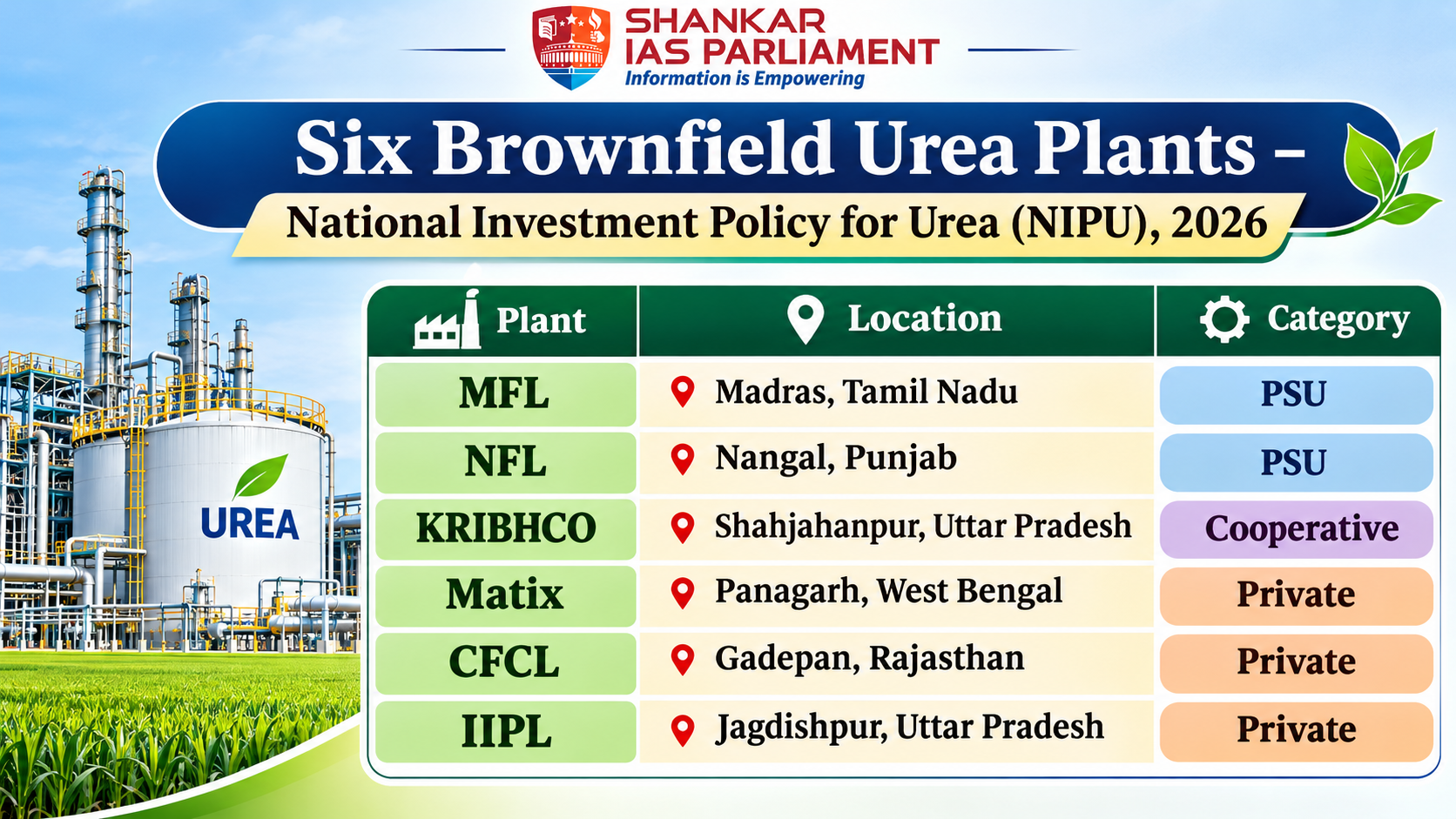
- Brownfield Project – Expansion, modernisation or replacement of an existing industrial facility.
- Objectives
- Enhance domestic urea production and reduce import dependence.
- Strengthen fertiliser security and agricultural resilience.
- Modernise ageing fertiliser plants.
- Generate employment and promote industrial development.
- Capital cost norm – Approximately Rs.9,000 crore per project.
|
|
Chariot-1 Indigenous AI Foundation Models
- Launched at – Bharat Mandapam, New Delhi, by Ministry of Electronics and Information Technology (MeitY).
- Developer – Chariot Artificial Intelligence Pvt. Ltd., one of the first four teams selected under the IndiaAI Mission to develop sovereign foundation models.
- Model Suite – Chariot-1 Large Language Model (LLM) and Text-to-Speech (TTS), pre-trained from scratch in India.
- Key Features and Innovations
- Chariot-1 LLM – 11-billion-parameter Mixture-of-Experts model with 4 billion active parameters per token; available in 10.7B, 1.7B and 745M parameter sizes.
- Chariot-1 TTS – Generates speech in English and 10 Indian languages, including Tamil, Hindi, Bengali and Telugu.
- IndicShift – Shared alphabet covering 1,012 characters across 12 Indian scripts; reduces Indian-language token usage by up to 2.5 times.
- Nested Training – Trains three model sizes simultaneously using one training run and one set of weights; improves training speed by 62%.
- Mixture of Vocabularies – Divides vocabulary into 11 groups; reduces vocabulary scoring by 5.7 times and improves training speed by 38%.
- Performance and Significance
- TTS achieved over 97% verbalisation accuracy on the Async TTS Pronunciation Benchmark.
- It supports context-aware pronunciation of numbers, dates, currencies, units, URLs and abbreviations.
- It strengthens India's sovereign AI capabilities, multilingual accessibility, indigenous research and technological self-reliance.
|



