|
One Liners 27-10-2026
|
|
International Relations and Issues
|
|
United Nations Disarmament Week
United Nations Disarmament Week 2026 takes place from October 24 to October 30, 2026, starting on the anniversary of the founding of the United Nations.
- Core Themes & Focus Areas
- Weapons of Mass Destruction– Primary emphasis on nuclear disarmament, reducing nuclear arsenals, and supporting international frameworks like the Biological Weapons Convention and Chemical Weapons Convention.
- Conventional Arms– Curbing the illicit trade and excessive accumulation of small arms and light weapons, as well as protecting civilians from heavy weapons use in populated areas.
- Emerging Technologies– Addressing risks associated with autonomous weapons systems, cyberwarfare, outer space arms races, and hypersonic tech.
- Global Cooperation & Dialogue– Highlighting the role of multilateralism, the UN Office for Disarmament Affairs (UNODA), and youth and women in peace and security initiatives.

|
|
Meeting of the International Committee of Legal Metrology (CIML)
The China Zorrilla is the world's largest battery-electric ship, built by Australian shipbuilder Incat Tasmania for the South American ferry operator Buquebus.
- Dates– October 26–28, 2026
- Location– New Delhi, India
- Organizer– Department of Consumer Affairs (Government of India) in association with the International Organization of Legal Metrology (OIML)
- Participation– Over 100 international delegates, legal metrology experts, representatives from OIML Member States, Corresponding Members, and international bodies like the International Bureau of Weights and Measures (BIPM).
- Key Themes and Discussions
- Harmonized Standards– Promoting globally aligned measurement standards to eliminate technical barriers to trade and avoid redundant testing and certification.
- Digital Transformation– Deliberating on OIML’s Smart Recommendations initiative for machine-readable technical standards and exploring artificial intelligence in measurement and verification.
- Modernization & Compliance– Discussing mutual recognition of conformity assessment, EV charging equipment metrology, and global accountability for new commercial and household instruments.

|
|
Environment
|
|
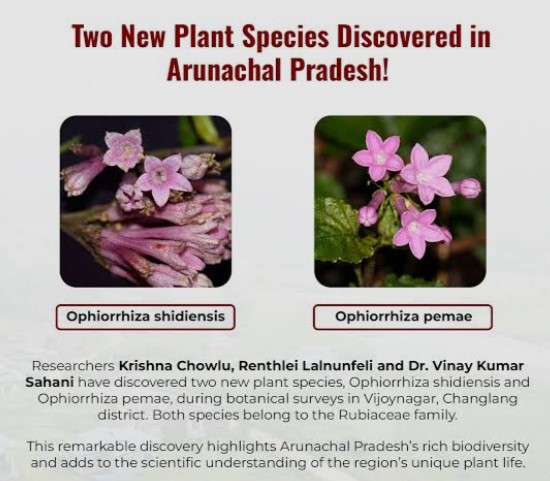
Ophiorrhiza shidiensis and Ophiorrhiza pemae
Ophiorrhiza shidiensis and Ophiorrhiza pemae are two newly discovered flowering plant species belonging to the Rubiaceae (coffee, madder, or bedstraw) family. They were found in Vijoynagar within the Changlang district of Arunachal Pradesh, India, by researchers Krishna Chowlu, Renthlei Lalnunfeli, and Dr. Vinay Kumar Sahani. Their formal descriptions were published in the scientific journal Taiwania.
- Ophiorrhiza shidiensis
- Type– An erect, perennial herb growing up to 1 meter (1,000 cm) tall.
- Physical Features– Features pale green leaf undersides and tubular flowers that are white at the base, pale pink in the middle, and rose-pink toward the mouth, along with a vesicular stigma. Taxonomic Comparison– Morphologically similar to Ophiorrhiza wallichii, but distinguished by its larger habit, variable leaf lamina size, presence of both axillary and terminal inflorescences, and longer peduncles and pedicels.
- Name Origin– Named after "Shidi," the traditional name for the locality Gandhigram used by the indigenous Lisu (Yobin) community where the plant was collected.
- Ophiorrhiza pemae
- Type– A smaller perennial herb (roughly 25–40 cm tall).
- Physical Features– Features larger leaf blades with cuneate to rounded bases, undulate margins, acute to attenuate apexes, pale green abaxial surfaces, longer pilose-villous petioles, large ovate bifid stipules, simple cymes with ensiform to falcate bracts, light pink to purplish flowers, and a micropunctate stigma.
- Taxonomic Comparison– Closely related to Ophiorrhiza himadrica, but differs through its taller stature relative to that baseline, distinct leaf margins, and lighter pink to purplish floral coloration.
- Name Origin– Named in honor of Arunachal Pradesh Chief Minister Pema Khandu to acknowledge support for documenting the state's natural heritage.
- Significance
- Geographical Context– Discovered in Vijoynagar (recorded at elevations roughly between 1,100 and 2,600 meters), a remote section of the Eastern Himalayas that forms part of the Indo-Burma biodiversity hotspot.
- Genus Value– The Ophiorrhiza genus is widely recognized in botanical and medicinal research (such as being a source of camptothecin compounds), making local taxonomy updates important for regional conservation.
|
|
Health
|
|
50 Crore Teleconsultations
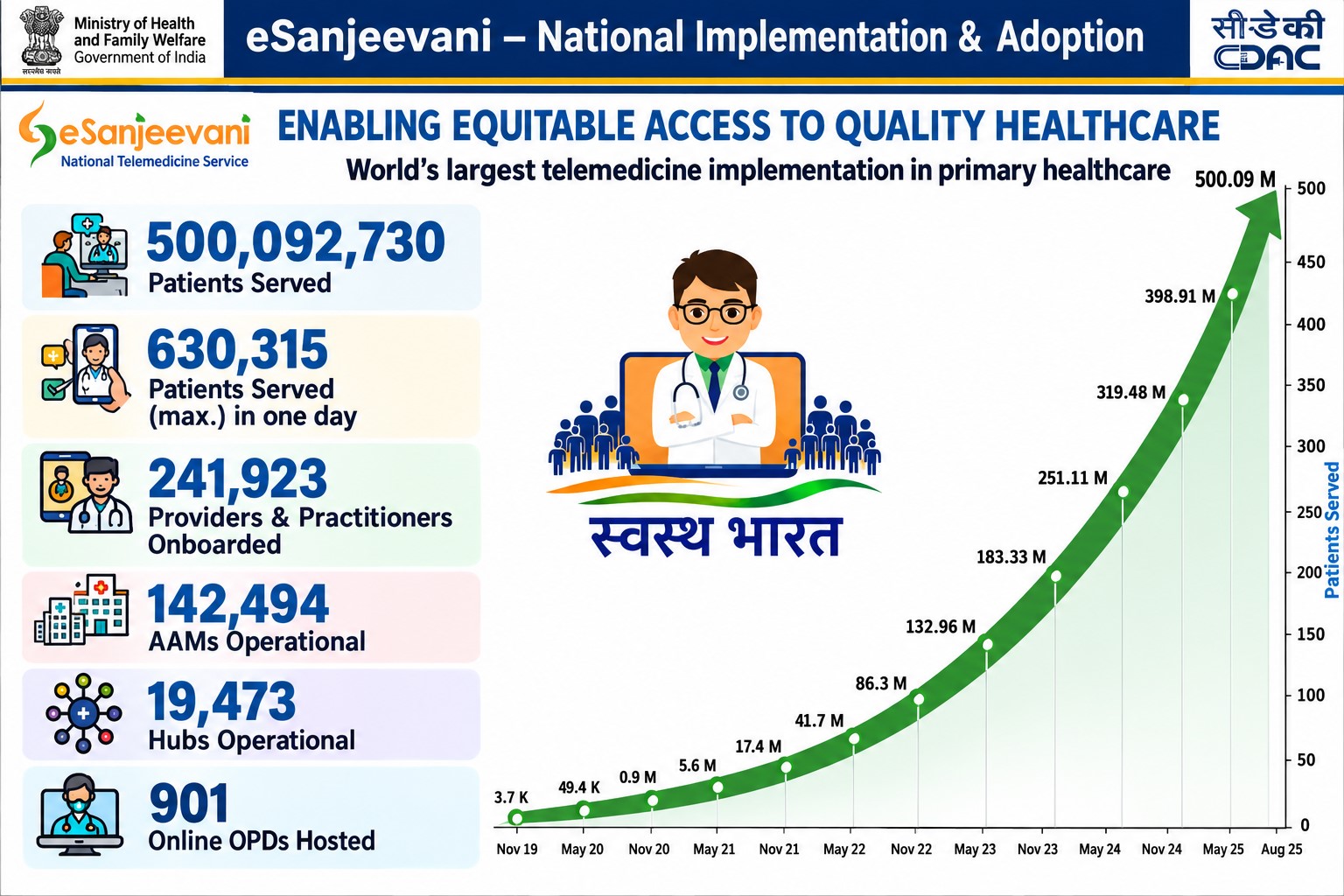
India's national telemedicine service, eSanjeevani, crossed the milestone of 50 crore (500 million) teleconsultations on September 15, 2026, recording a cumulative total of 50,00,92,730 consultations across all 36 States and Union Territories.
- What is eSanjeevani?
- Definition– eSanjeevani is India's free, cloud-based national telemedicine service developed by the Centre for Development of Advanced Computing (C-DAC) and launched by the Ministry of Health and Family Welfare.
- Goal– It bridges geographical and distance gaps to deliver affordable, equitable, and timely medical advice to rural, remote, and underserved populations.
- Two Modes of Operation
- eSanjeevani – Ayushman Arogya Mandirs (Provider-to-Provider)–
- Operates as a "hub-and-spoke" model.
- Community health workers or nurses at local Ayushman Arogya Mandir spokes connect patients via live video to specialist doctors stationed at medical hubs.
- This mode accounts for the vast majority (over 93%) of platform usage.
- eSanjeevaniOPD (Patient-to-Provider)–
- Direct patient-to-doctor consultations from home using internet-connected devices.
- Key Scale and Impact Statistics
- Daily Volume– Facilitates approximately 2.5 to 3 lakh (250,000 to 300,000) consultations every day.
- Infrastructure– Connects over 1.42 lakh Ayushman Arogya Mandir spokes, 19,473 medical hubs, and 901 online OPDs.
- Registered Providers– Over 2,41,923 doctors, specialists, and health workers are onboarded.
- Language Support– Operates in 15 languages (English and 14 Indian languages).
- Demographics– Women account for 57.14% of total platform utilisation, helping overcome traditional travel and mobility barriers to healthcare.
|
|
Science
|
|
India's first AI × Food Tech Hackathon
India's first AI × Food Tech Hackathon, titled "Hack the Fork," was hosted by the National Institute of Food Technology Entrepreneurship and Management, Kundli (NIFTEM-K) in Haryana.
- Dates– October 24–25, 2026 (a 24-hour hackathon; overall timeline ran from September 20 to October 25, 2026).
- Organizer– Hack the Fork (a France-based non-profit initiative) in collaboration with NIFTEM-K.
- Inauguration– Opened by Ms. Alice Pjie, Director of Hack the Fork.
- Participation– Out of more than 85 applicant teams, 25 teams were shortlisted for the final round.
- Core Focus– Harnessing artificial intelligence to tackle challenges in the alternative protein industry, plant-based food innovation, fermentation technologies, nutritional optimization, food safety, and food waste reduction.
- Prizes & Rewards– A total prize pool of ₹1.5 lakh, plus direct opportunities to enter NIFTEM-K's Startup Incubation Programme.
- Mentors & Jury– Included experts from the Good Food Institute (GFI) India, IIIT Sonepat, and the University of Delhi.

|
|
World’s largest battery electric vessel
The China Zorrilla is the world's largest battery-electric ship, which officially entered commercial service in October 2026.
- Key Details
- Operator & Builder– Built by Incat Tasmania in Australia for South American ferry operator Buquebus.
- Route– Crosses the Río de la Plata between Buenos Aires, Argentina, and Colonia del Sacramento, Uruguay (55–60 km) in about 90 minutes.
- Dimensions– 130 meters long and 32 meters wide.
- Capacity– Can carry up to 2,100 passengers and 225 vehicles.
- Battery & Power– Features a 40+ MWh battery system (using over 5,000 Corvus Energy modules) weighing more than 250 metric tons.
- Propulsion– Eight electric motors connected to waterjets, reaching speeds up to 25 knots.
- Amenities– Includes a three-deck layout and a 2,300 m² duty-free retail complex.

|
|
Miscellaneous
|
|
World Development Information Day
World Development Information Day is observed annually on October 24 to draw global attention to development problems and strengthen international cooperation to solve them.
- Establishment– Created by the UN General Assembly in 1972 via Resolution 3038 (XXVII), first held on October 24, 1973. [1, 2, 3]
- Core Purpose– To improve the dissemination of information and mobilize public opinion—especially among youth—around global challenges like poverty, education, inequality, and sustainable progress.
- Connection to UN Day– Timed to coincide with United Nations Day (October 24) and the adoption of the International Development Strategy.
- Role of Technology– Focuses on leveraging information and communication technologies (ICT), expanding broadband connectivity, and closing the digital and scientific divides.

|
|
World Day for Audiovisual Heritage
The World Day for Audiovisual Heritage is observed on October 27, 2026, under the theme “Your Window to the World.”
- Origin– Commemorates UNESCO’s 1980 adoption of the Recommendation for the Safeguarding and Preservation of Moving Images.
- Purpose– Highlights the importance, fragility, and urgent need to conserve audiovisual documents (such as films, radio broadcasts, and sound recordings) as a vital part of shared global memory.
- Organizers– Led by UNESCO and the Coordinating Council of Audiovisual Archives Associations (CCAAA).

|
|
Infantry Day
India observes Infantry Day on October 27, 2026, marking the 80th Shaurya Diwas.
- Historical Event– Commemorates October 27, 1947, when the 1st Battalion of the Sikh Regiment was airlifted from Delhi to Srinagar Airport.
- Significance– Marks the first military action by the independent Indian Army to defend Jammu and Kashmir against Pakistan-backed tribal raiders.
- Key Heroes–
- Lt Col Dewan Ranjit Rai– Commanding Officer of 1 Sikh who made the supreme sacrifice while holding critical ground.
- Major Somnation Sharma– Remembered for his valor during the Battle of Budgam.
- Brig Rajinder Singh– Honored as the "Saviour of Kashmir" for delaying the advance.
- Main Observances–
- Wreath-laying ceremonies at the Amar Jawan Jyoti at India Gate in New Delhi.
- Special parades and events hosted by the Chinar Corps at Badami Bagh Cantonment in Srinagar.
- The Field Marshal SHFJ Manekshaw Memorial Lecture at the Manekshaw Centre in Delhi Cantonment.

|
|
Vigilance Awareness Week
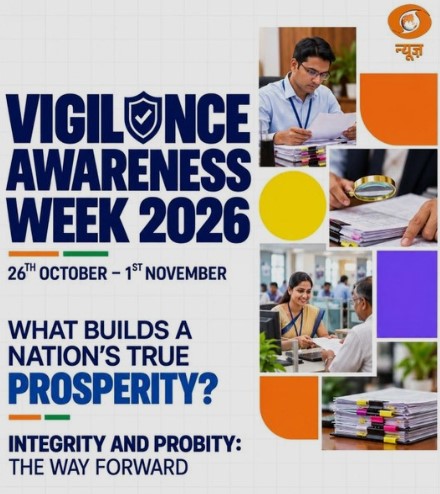
Vigilance Awareness Week 2026 is observed from October 26 to November 1, 2026, led by the Central Vigilance Commission.
- Theme– "Probity for Prosperity"
- Preceding Campaign– A three-month preventive vigilance campaign runs from August 17 to November 16, 2026.
- Core Focus Areas–
- Disposal of pending complaints and cases
- Capacity building (IT, cyber security, public procurement, conduct rules, conflict of interest)
- Digital initiatives and contract management
- Citizen Participation– Individuals and organizations can take the online Integrity Pledge via the Central Vigilance Commission portal.
- Outreach Activities– Includes Awareness Gram Sabhas in rural and semi-urban areas, walkathons, debates, vendor meets, and grievance redressal camps.
- Reporting Deadline– Final activity reports must be submitted to the CVC by November 30, 2026.
|



