|
One Liners 25-07-2026
|
|
International Relations and Issues
|
|
Rome Declaration for an Unarmed and Disarming Peace
- It is formally titled as "Humanity at the Threshold: A Declaration on Artificial Intelligence and Nuclear Weapons".
- It calls for an international treaty to ban autonomous AI systems from accessing nuclear launch systems.
- The initiative was heavily inspired by Pope Leo XIV's encyclical Magnifica Humanitas, which warns against technological overreach and the erosion of human dignity.
- It was adopted by participants of the Global Nobel Laureates Assembly (an international summit on Artificial Intelligence and Nuclear War).
- It was held in Rome, Italy.
- Guiding Principles
- Disarming the next arms race
- Responsible Development
- Responsible Use of AI
- Responsible Governance
- Nuclear Disarmament
- Responsible Leadership
|
|
BRICS Science Academies Forum Meeting 2026
BRICS Science Academies Forum Meeting 2026 successfully concluded at IIT Hyderabad with focus on AI for Sustainability and Global South Cooperation.
- Theme – “Harnessing Artificial Intelligence for Sustainable Development and Strengthening Global South Cooperation”
- Focus – bringing together member and participating countries from BRICS to deliberate on the 3C’s Collective, Collaborative and Context sensitive approaches towards Artificial Intelligence (AI).
- Areas of AI Collaboration
- Advanced Materials and Manufacturing
- Healthcare
- Climate Change and Environmental Sustainability
- Agriculture and Food Security
- Disaster Prediction and Management
|
|
Romania
The recent arrival of Indian President in Romania marks the first visit by an over three decades.
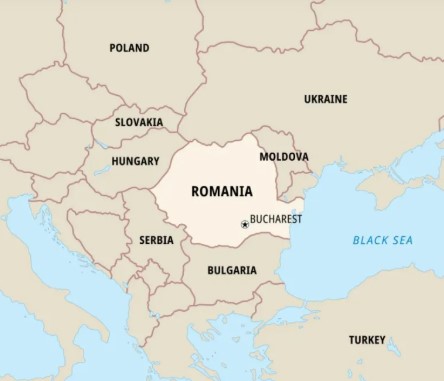
- Location – Bounded by the Black Sea to the southeast.
- Bordered by – Ukraine (north), Moldova (northeast), Bulgaria to (south), Serbia (southwest), and Hungary (west).
- Terrain – Dominated by the Carpathian Mountains and the Danube River.
- Capital – Bucharest.
- Romania is a North Atlantic Treaty Organization (NATO) member.
- Note – It does not share a land border with Russia, though it sits close to Black Sea shipping conflicts.
|
|
3rd BRICS Ministerial Meeting on Disaster Risk Reduction
The 3rd BRICS Ministerial Meeting on Disaster Risk Reduction was successfully hosted by India recently in New Delhi.
- Organised by – National Disaster Management Authority (NDMA) under the Ministry of Home Affairs.
- Chaired by – Minister of State for Home Affairs.
- Theme – "Building for Resilience, Innovation, Cooperation and Sustainability”
- BRICS member states unanimously adopted the BRICS Joint Statement on Disaster Risk Reduction.
- This reaffirmed their commitment to accelerate the BRICS Disaster Risk Reduction Work Plan (2025–2028)
- Focused on –
- Climate-smart infrastructure.
- Innovative financing models.
- Emerging technologies.
- Robust cross-border partnerships to counter growing global climate vulnerabilities.
|
|
Global Road Deaths Data
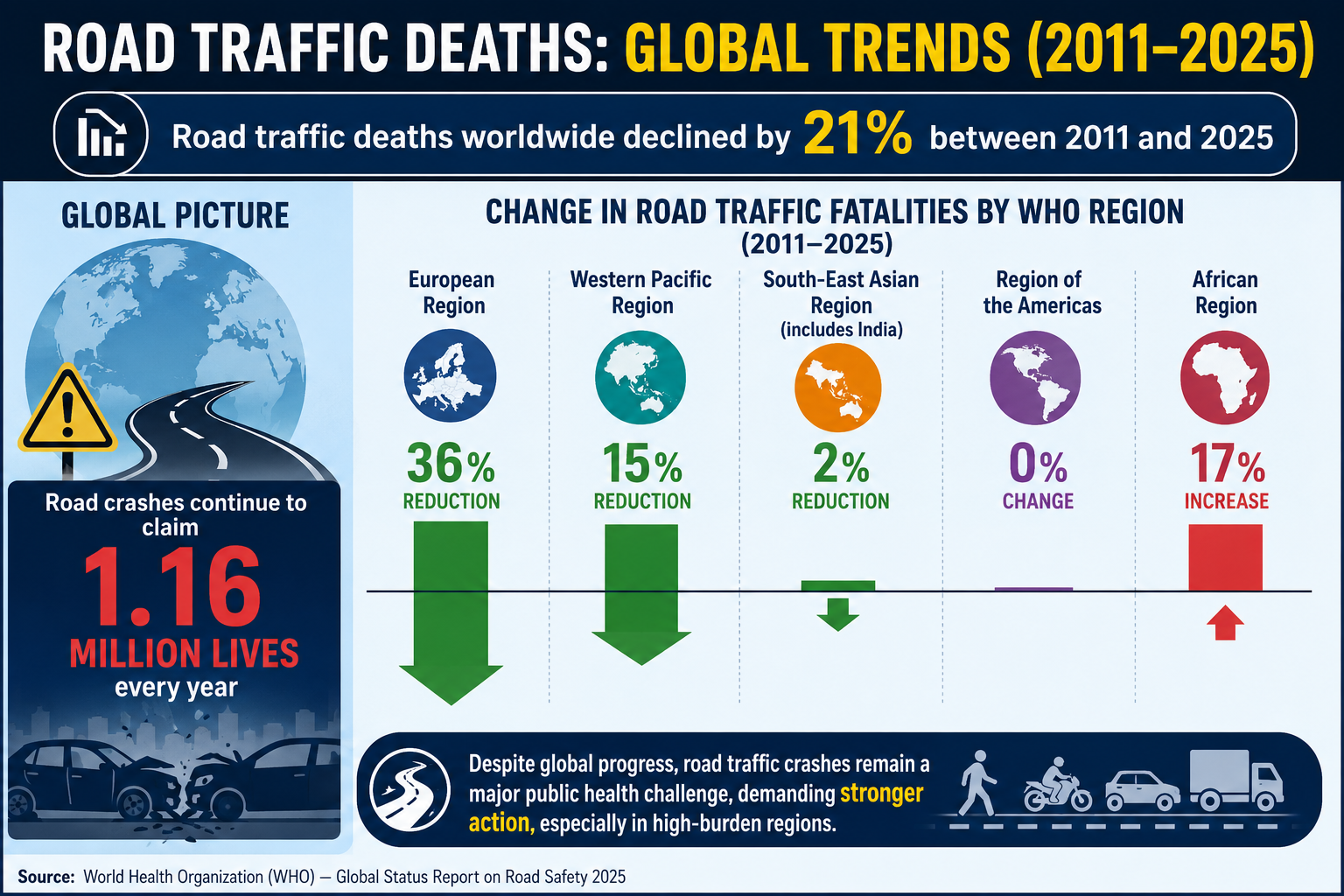
As per recent World Health Organisation (WHO) data road deaths declined globally.
- Road traffic deaths worldwide declined by 21 % between 2011 and 2025.
- Road crashes continue to claim 1.16 million lives every year.
- United Nations (UN) member states adopted a new General Assembly declaration on road safety.
- The declaration seeks to accelerate efforts to achieve the SDG of reducing road deaths and serious injuries by 50 % by 2030, compared with 2021 levels.
- Motorcyclists now account for nearly one-third of all road traffic deaths globally.
- WHO estimates that road traffic injuries cost most countries about 3 % of their GDP through healthcare expenses, lost productivity and the wider social impact on families and communities.
|
|
Economy
|
|
New Index of Core Industries (ICI)
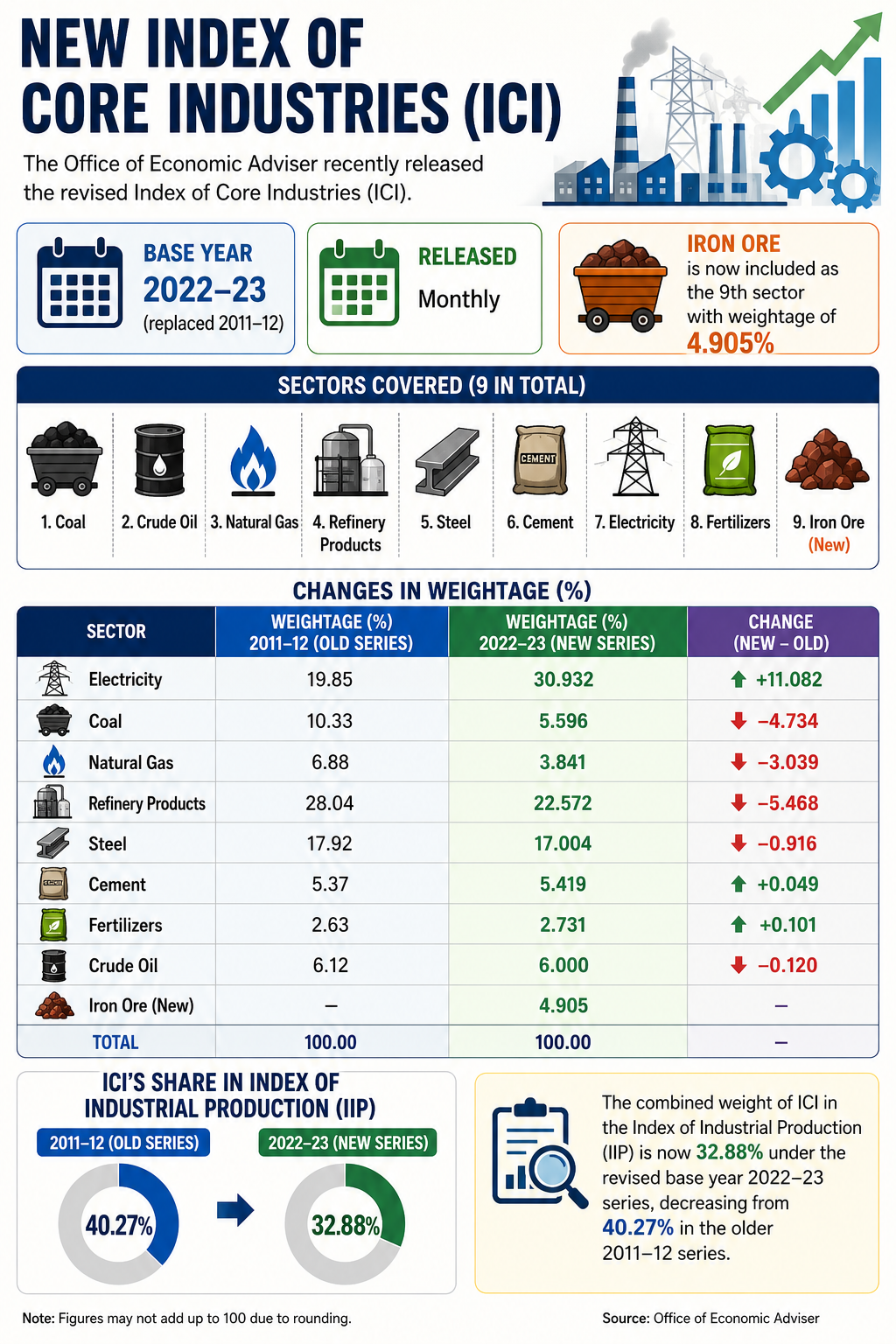
The Office of Economic Adviser under the Ministry of Commerce and Industry recently released the revised Index of Core Industries (ICI).
- Base year – 2022–23 (replaced 2011–12).
- Released – Monthly.
- Iron ore is now included as the 9th sector has weightage of 4.905%.
- The eight sectors earlier covered were coal, crude oil, natural gas, refinery products, steel, cement, electricity, and fertilizers.
- Changes in weightage –
- Electricity sector now makes up 30.932% of the entire index, (earlier 19.85%).
- Coal - 5.596% (reduced from 10.33%).
- Natural gas - 3.841% (reduced from 6.88%).
- Refinery products – 22.572 %( reduced from 28.04%).
- The fertilizers increase to 2.731% (earlier 2.63%).
- The combined weight of ICI in the Index of Industrial Production (IIP) is now 32.88% under the revised base year 2022-23 series, decreasing from 40.27% in the older 2011-12 series.
|
|
Bank’s credit-deposit ratio
- Indian banks’ credit deposit (CD) ratio stood at a 62-year high of 82.6% in the first quarter (Q1) of fiscal 2027 as loans grew faster than deposits, as per data of Centre for Monitoring Indian Economy (CMIE).
- Over the last 5 years, banks had excess investments on their balance sheet, which they have redeployed into loans.
- So optically, the loan book is growing faster and the investment book is growing slower, therefore the CD ratio looks higher.
- Second, the bank's capital is at an all-time high, giving it greater capacity to support lending and absorb losses.
|
|
Agriculture
|
|
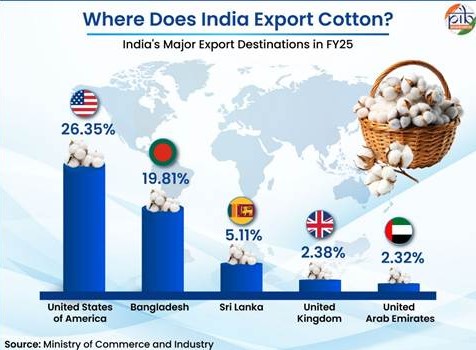
India’s Cotton – “White Gold”
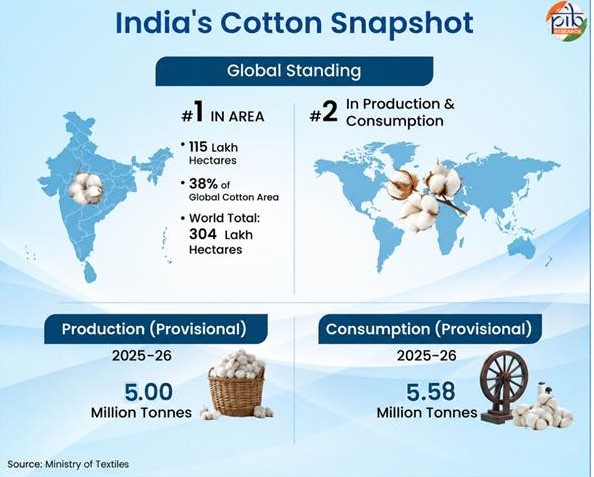
- India is the only country cultivating all four recognised cotton species.
- India ranks first globally in acreage and second in production (as of mid 2026, China is first) and consumption Cotton production stood at 290.91 lakh bales in 2025-26 (provisional).
- Domestic consumption reached 328 lakh bales during the same period.
- The Mission for Cotton Productivity aims to raise output to 498 lakh bales by 2031 MSP operations continue to provide price support during market downturns.
|
|
Science
|
|
Virtual Magnet Technology
- "Virtual Magnet" technology developed by Bengaluru startup Vimag Labs.
- It claims to eliminate the need for rare-earth elements in electric vehicles (EVs).
- Traditional EVs use Permanent Magnet Synchronous Motors (PMSMs), which embed physical rare-earth magnets (like neodymium) into the rotor to create a magnetic field.
- Vimag Labs replaces physical permanent magnets with copper coils.
- Mechanism – Using "Virtual Magnet Synchronous Motor" (VMSM) architecture, the company uses power electronics and software algorithms to dynamically simulate and regulate a magnetic field in real time.
- This creates a brushless, slip-ring-free design using only raw steel and copper.
- Concerns –
- Electro an electromagnet requires software to continuously pump and modulate current through copper coils.
- This extra step introduces core resistance losses, copper heating, and switching losses.
- Replacing permanent magnets with electromagnets or iron elements introduces severe constraints regarding starting torque capability and maximum achievable speeds in EV’s.
|
|
Maglev trains
- A maglev train is a high-speed vehicle that uses magnetic levitation to float, move, and stop without touching the ground.
- It rely on electromagnetic suspension (EMS) and electrodynamic suspension (EDS).
- Working –
- Floating (Levitation) – Strong magnets on the train and track push or pull the train up so it hovers a few centimeters in the air.
- Moving (Propulsion) – Electricity sent through the track creates a magnetic wave that pulls and pushes the train forward very fast.
- No Friction – Because the train does not touch the track, there is no wheel wear or rolling resistance, allowing for smooth, quiet, and rapid travel.
- Top speeds – 431 km/h.
- Public maglev service is currently limited to just three countries – China, Japan, and South Korea.
- Drawbacks – Building the special tracks (guideways) is very expensive, and they cannot run on standard old train tracks.
|



