|
One Liners 23-11-2026
|
|
History, Art and Culture
|
|
Shillong Cherry Blossom Festival 2026
- Held on – 20-21 November 2026 at Madan Kurkalang Sports Complex, Bhoirymbong, Meghalaya.
- Headliners – Nelly, Khalid, Swae Lee, Boys Like Girls, Galantis and Elliot James Reay; Indian artist Darshan Raval.
- Origin of Name – Named after Himalayan cherry trees that bloom during autumn, painting Shillong and surrounding Khasi Hills pink.
- Significance – It promotes Meghalaya's tourism, music culture, local businesses and the regional creative economy.
- Cultural Promotion – Features Northeast Indian cuisine, local artists, merchandise, cultural showcases and interactive activities.
- Indian International Music Week – Industry networking and engagement with music-sector delegates.
- Grassroots Music Programme – It connects local musicians with industry professionals through workshops, discussions and artist showcases.
- Tourism & Regional Cooperation – It supports Meghalaya's concert economy and assists other Northeastern States in organising music festivals.
|
|
Geography
|
|
Damdama Lake (Haryana) – Shrinking Reservoir
- Damdama Lake in south Gurgaon (Haryana) has lost 95% of its mapped area since 1993.
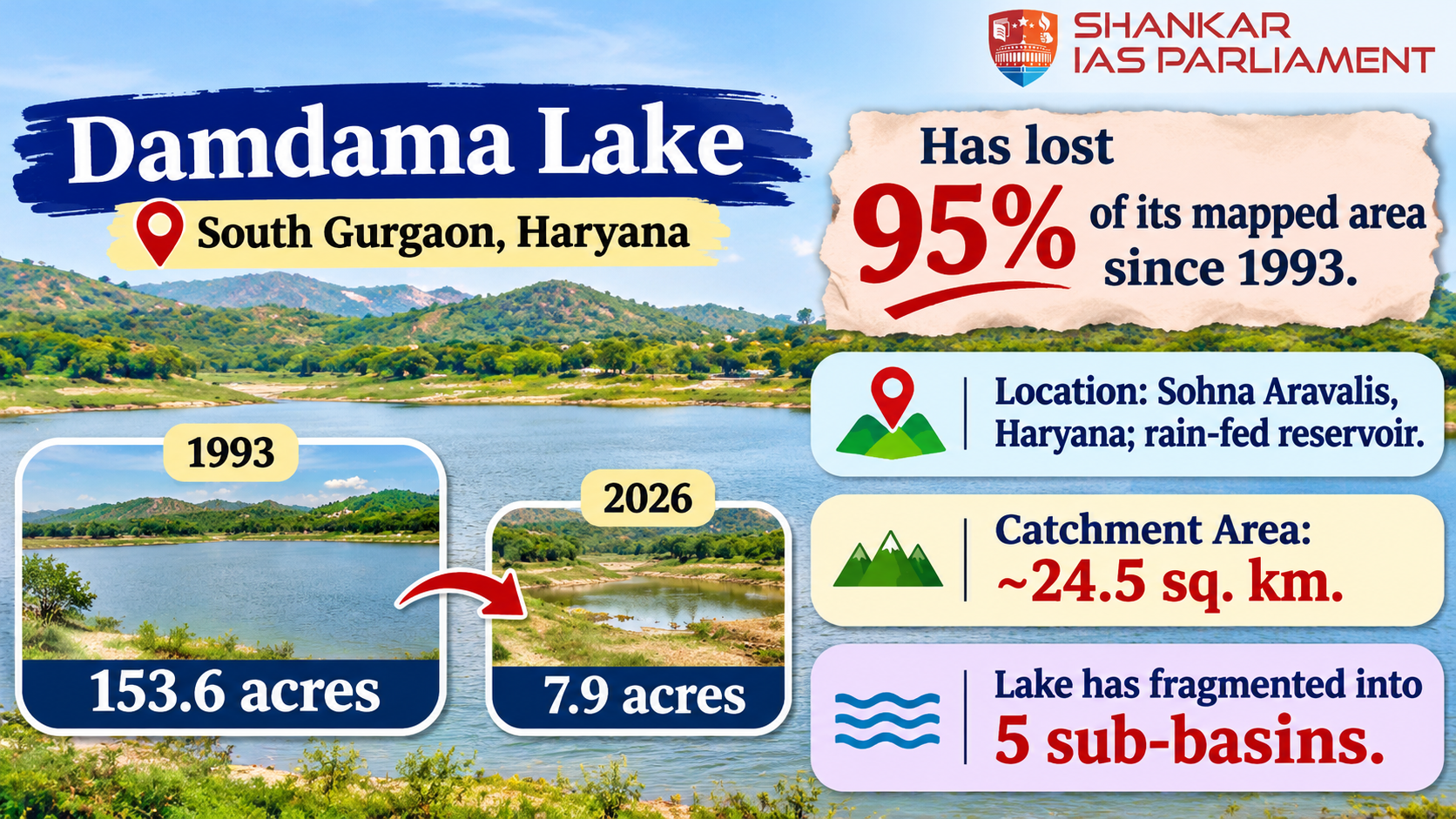
- Area Decline – 153.6 acres (1993) → 7.9 acres (2026).
- Location – Sohna Aravalis, Haryana; rain-fed reservoir.
- Catchment Area – ~24.5 sq. km; lake has fragmented into 5 sub-basins.
- Causes of Shrinkage
- Groundwater depletion and borewell extraction.
- Destruction/blockage of natural drainage channels.
- Construction, mining, encroachment and land fragmentation.
- Road and culvert blocking rainwater flow.
- Protection – Parts of catchment protected under Sections 4 and 5 of Punjab Land Preservation Act (PLPA).
- Restoration Proposal (2022) – GuruJal, Haryana State CSR Trust and EY Foundation proposed:
- 500-acre biodiversity park (10-year plan).
- 6-km green corridor and 1.5 lakh native trees.
- Catchment treatment, desilting and groundwater recharge.
- Status – Restoration proposal awaits Government approval, as around 60% of lake land falls under the Forest Department.
|
|
Health
|
|
National HPV Vaccination Campaign
- India administered over 1 crore HPV vaccine doses in less than nine months after launching the National HPV Vaccination Campaign in February 2026.
- Launched by – Prime Minister of India.
- Implementation – Union Ministry of Health and Family Welfare in coordination with State/UT governments and frontline workers.
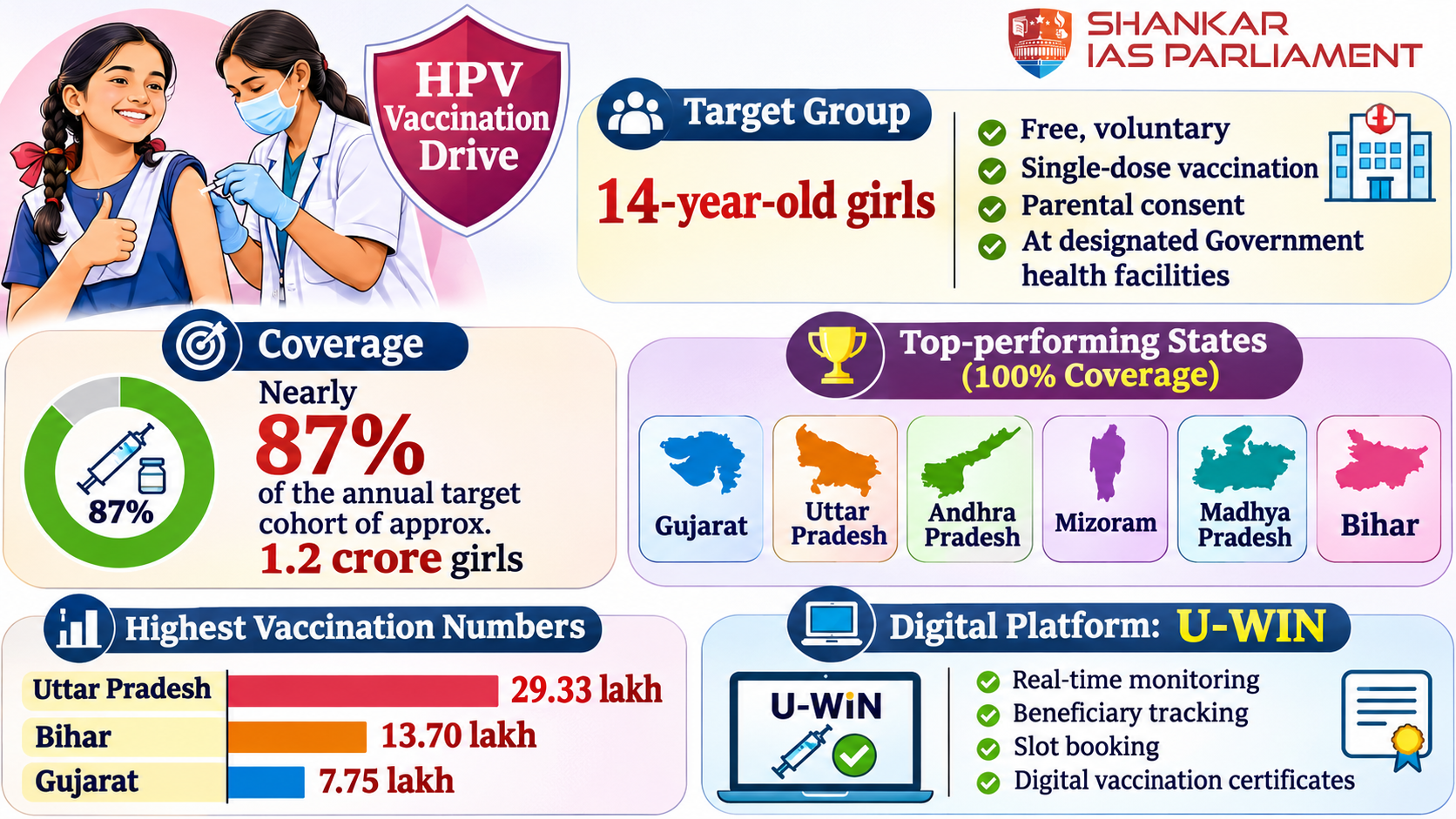
- Target Group – 14-year-old girls; free, voluntary, single-dose vaccination with parental consent at designated Government health facilities.
- Coverage – Nearly 87% of the annual target cohort of approximately 1.2 crore girls.
- Top-performing States – Gujarat, Uttar Pradesh, Andhra Pradesh, Mizoram, Madhya Pradesh and Bihar achieved 100% coverage of their identified target populations.
- Highest Vaccination Numbers – Uttar Pradesh (29.33 lakh), Bihar (13.70 lakh) and Gujarat (7.75 lakh).
- Digital Platform – U-WIN enables real-time monitoring, beneficiary tracking, slot booking and digital vaccination certificates.
- Purpose – To prevent HPV infections that can cause cervical cancer.
- Safety – Vaccination under trained Medical Officers at designated Government health facilities, with 24×7 healthcare arrangements for managing adverse events following immunisation (AEFI).
|
|
Economy
|
|
Anthropic IPO – World's 1st Publicly Listed Frontier AI Company

- Anthropic reportedly raised $81 billion through its IPO, becoming the first publicly listed frontier AI company.
- Stock Exchange – Nasdaq (USA).
- IPO Price - $83/share; shares opened at $111.50 and closed at $97.17 on debut.
- Valuation – Reached nearly $2 trillion (fully diluted valuation); outstanding-share valuation reportedly peaked at $1.5 trillion.
- Company – Anthropic – US-based AI company founded in 2021, led by CEO Dario Amodei.
- Focus on – AI research, development of AI models and AI safety.
- IPO Proceeds – Could reach $93.5 billion from IPO, subject to additional share purchase options; private placement also reported.
- Major Investors (private placement) – AMD, Broadcom, Google, Micron, Microsoft, Nvidia and TSMC.
- Significance – IPO provides a market benchmark for frontier AI companies and highlights investor interest as well as concerns over AI profitability, infrastructure costs and valuation bubbles.
|
|
Agriculture
|
|
World Fisheries Day 2026
- Observed annually on – 21st November.
- Objective – To promote sustainable fisheries and aquaculture for food security, livelihoods and ecological balance.
- Originated in – 1997, Representatives from 18 countries met in New Delhi and established the World Fisheries Forum.
- Theme 2026 – “Empowering People for Change: Advancing Decent Work in Fisheries and Aquaculture, Particularly for Youth and Women.”
- India’s Position – 2nd-largest fish-producing country globally, contributing nearly 8% of global fish production.
- Fish Production – Increased from 96 lakh tonnes to 195 lakh tonnes over the past decade.
- Significance – It supports livelihoods, nutritional security, exports and economic growth.
|
|
Strengthening India’s Community Seed Banks (CSBs) – DIVERSIFARM-India
- DIVERSIFARM-India mapped 652 Community Seed Banks (CSBs) through a digital atlas; India is estimated to have at least 1,000 CSBs.
- National Seminar – Held on 17–18 November 2026 at National Agricultural Science Complex (NASC), New Delhi.
- DIVERSIFARM-India – Three-year collaborative project led by Fridtjof Nansen Institute (FNI), Norway and M.S. Swaminathan Research Foundation (MSSRF), India.
- Objective – To strengthen community-based seed systems to improve food and nutritional security and livelihoods of small farmers.
- Major Outputs
- GIS-based digital atlas mapping 652 CSBs.
- Policy brief identifying six CSB typologies based on management structures.
- 10-point roadmap for Odisha to strengthen CSBs.
- Capacity-building manual for establishing and managing CSBs.
- Community Seed Banks – Community-managed institutions that conserve, multiply, store and distribute traditional/local seeds, supporting in-situ conservation and farmers' resilience.
- Legal Framework
- Protection of Plant Varieties and Farmers’ Rights (PPV&FR) Act, 2001.
- Biological Diversity Act, 2002.
- Institutional Linkage – It promote collaboration between community gene banks and national gene banks such as ICAR-National Bureau of Plant Genetic Resources (NBPGR).
|
|
Environment
|
|
Brown Shrike (Lanius cristatus)
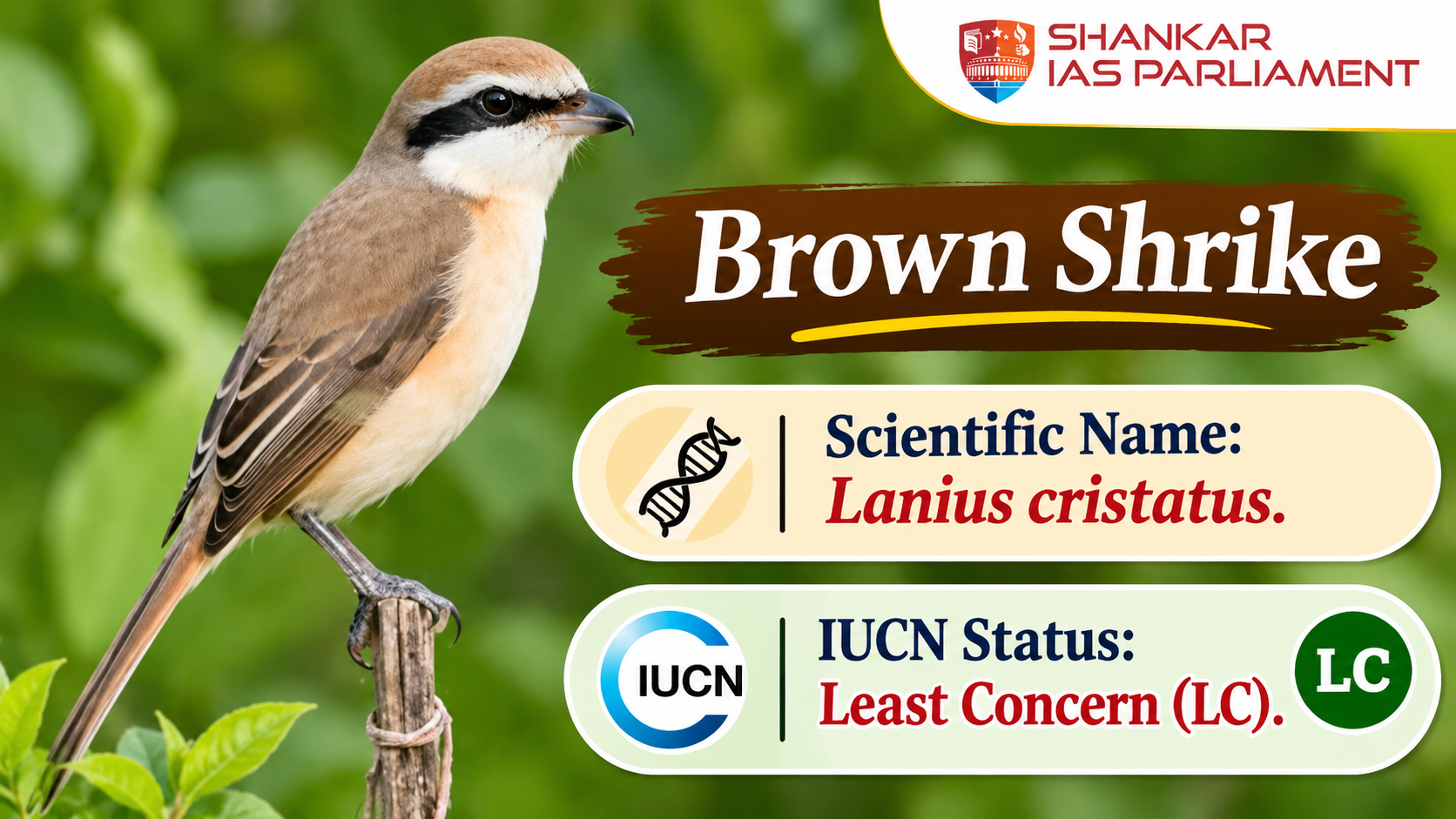
- Brown Shrike travelled nearly 6,000 km from Siberia and was spotted at Ulavatti village, Hagaribommanahalli taluk, Vijayanagara district, Karnataka.
- Scientific Name – Lanius cristatus.
- IUCN Status – Least Concern (LC).
- Habitat – Scrub forests, grasslands, agricultural fields and open landscapes; near Malavi reservoir (Chikkahagari River).
- Distribution – Breeds from Mongolia to Siberia (Northern Asia); winters in South Asia, Myanmar and Malay Peninsula.
- Migration – Winter migrant to India; generally arrives during August–September and departs around April.
- Identification – Black eye-mask, white brow, brown upperparts and hooked/notched bill.
- Feeding – Impales prey on thorns; hence, shrikes are popularly called butcher birds.
|
|
Science
|
|
Indigenous Atomic Clock Prototype Developed by Pune Startup
- Pune-based deep-tech startup QuPrayog Private Limited developed a laboratory-scale indigenous atomic clock prototype.
- Technology – Rubidium-87 atomic clock using Coherent Population Trapping (CPT) technology.
- Development – Achieved Technology Readiness Level (TRL) 4 after seven months of development; miniature integrated product targeted by end of 2027.
- Performance – Demonstrated nearly 50 times better timekeeping stability than a conventional free-running crystal oscillator over 1,000 seconds (company-reported).
- Applications:
- Satellite navigation and telecommunications.
- Space missions and strategic systems.
- Precision timing and quantum instrumentation.
- Significance – It reduces dependence on imported high-performance atomic clocks amid export restrictions on dual-use technologies.
National Quantum Mission (NQM)
- Launched in – 2023.
- Outlay – Rs.6,003.65 crore over eight years (2023–24 to 2030–31).
- It promotes indigenous quantum technologies, including quantum sensing, metrology and precision measurement.
|
|
Miscellaneous
|
|
World Heritage Week – India
- Recently, ASI-protected monuments across India offered free entry on 19 November 2026 to mark the opening of World Heritage Week.
- Annually observed – From 19 to 25 November.
- Implementing Agency – Archaeological Survey of India (ASI), under the Ministry of Culture.
- ASI – It protects over 3,800 monuments and sites across India, of which 143 are ticketed.
- Examples – Taj Mahal, Red Fort and Qutub Minar.
- Objective – To promote awareness, appreciation and conservation of India's cultural heritage.
|
|
Women's Entrepreneurship Day
- Observed annually on – 19th November
- Aim – To celebrate, support, and empower women founders and business leaders worldwide.
India
- Women Entrepreneurship Day celebrated with a roadmap towards Viksit Bharat 2047.
- Organisers – Ministry of MSME, Government of India, in association with India SME Forum and Women Entrepreneurs Forum.
- Focus – Empower women-led enterprises through 4 pillars – Enable, Accelerate, Digitise and Globalise.
- Enable – Udyam registration, access to finance, government schemes, entrepreneurship skills and capacity building.
- Accelerate – Market access, branding, procurement, quality certification, e-commerce and sustainable business growth.
- Digitise – Digital literacy, AI, digital commerce, technology adoption and D2C models.
- Globalise – Export opportunities, gender-inclusive FTAs, cross-border e-commerce, trade finance and global value chains.
|



