|
One Liners 23-10-2026
|
|
History, Art and Culture
|
|
Commemorative coin honouring Sindhi saint
President Droupadi Murmu released a Rs.200 commemorative coin in Raipur, Chhattisgarh, to mark the 200th birth anniversary of Pujya Mata Sahib Hasi Devi Ji, the fifth spiritual head of the historic Shadani Darbar.
- Significance– Honours Pujya Mata Sahib Hasi Devi Ji, a revered spiritual leader of the Sindhi community, to preserve her legacy and teachings for future generations.
- Denomination & Release– A Rs.200 coin issued by the Union Finance Ministry, featuring her portrait on one side and the Ashoka Pillar with the denomination on the reverse.
- Event & Availability– Unveiled at Lok Bhavan, Raipur, alongside state dignitaries, with availability for acquisition through Shadani Darbar branches.

|
|
Polity & Governance
|
|
The Telecommunications (Regulatory Sandbox) Rules, 2026
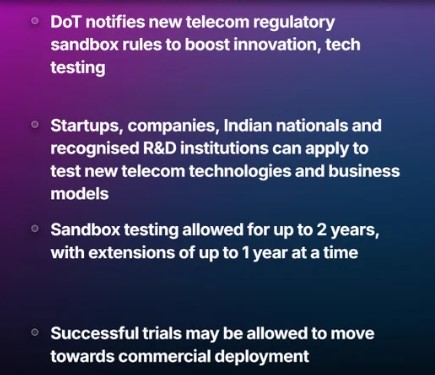
The Telecommunications (Regulatory Sandbox) Rules, 2026, notified by the Department of Telecommunications under the Telecommunications Act, 2023, enable controlled, real-world testing of emerging telecom innovations with temporary regulatory relaxations.
- Purpose & Eligibility– Allows entities like startups, R&D units, and companies to test 5G and IoT technologies.
- Process & Fees– Applications require a Rs.10,000 processing fee and prior lab test reports via the official portal.
- Duration– Valid for up to 24 months initially, with possible 12-month extensions.
- Safeguards– Prohibits commercial sales or user charges during trials, mandates informed consent, and requires retaining records for at least a year post-validity.
- Transitions– Requires an outcome report upon completion to guide future commercial authorization.
|
|
Economy
|
|
VOC Port’s Green Terminal Initiative
Tuticorin International Container Terminal (TICT), located at VOC Port, Tamil Nadu, has been declared a ‘Green Terminal’ after fully electrifying 100% of its operational equipment.
- Electric Mobility–The port has introduced 13 electric Internal Transfer Vehicles (E-ITVs) to make container-handling operations cleaner and more energy-efficient.
- Green Infrastructure–VOC Port is developing a methanol bunkering facility, green hydrogen pilot project and wind-energy facilities, supporting India’s green maritime transition.
- Outer Harbour Project–An investment exceeding Rs.15,000 crore is being made in the Outer Harbour to add 4 MTPA capacity and strengthen Tamil Nadu’s role as a southern India transhipment hub.
- Significance–The initiative promotes decarbonisation, clean energy adoption and sustainable port operations.

|
|
All-Time High Coal Loading Record
Indian Railways set an all-time high record in coal loading, achieving a 22.5% growth in October 2026 (up to October 18) compared to the same period in October 2025.
- Performance Metrics– Indian Railways boosted daily dispatches by an average of 87 coal rakes in October 2026 compared to the previous year.
- During the first half of FY 2026-27, shipments to thermal plants averaged 430 rakes daily (a 7.1% year-on-year rise), while early October daily loading ranged from 447 to 482 rakes, supplying an average of 2.49 million tonnes daily.
- Drivers of Growth– The surge was propelled by elevated industrial production, seasonal power demand, and uneven rainfall that amplified reliance on thermal energy.
- Strong inter-ministerial cooperation among Railways, Coal, and Power ministries ensured steady logistics, maintaining plant inventories above 18 million tonnes

|
|
Agriculture
|
|
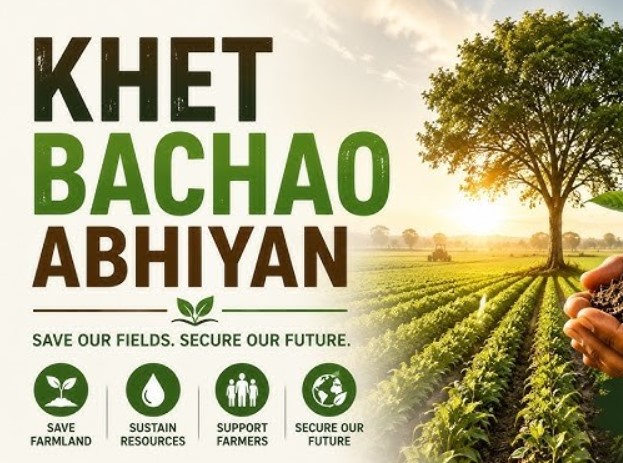
Khet Bachao Abhiyan (Rabi 2026)
The Ministry of Agriculture and Farmers Welfare launched the nationwide Khet Bachao Abhiyan (Rabi 2026) campaign on October 22, 2026.
- Campaign Timeline & Scope
- Launch Date– October 22, 2026 (initiated by Union Agriculture and Farmers Welfare Minister Shivraj Singh Chouhan from Karnal, Haryana)
- Duration– October 22 to November 30, 2026
- Target & Reach– Involves thousands of field teams and Krishi Vigyan Kendras (KVKs) across states like Haryana, Bihar, Odisha, and Manipur.
- Core Objectives & Focus Areas
- Soil Health & Fertiliser Use– Educates farmers on balanced and judicious application of fertilisers based on soil testing.
- Crop Diversification– Promotes oilseed, pulse, and horticulture missions.
- Resource Management– Encourages efficient use of fallow land after paddy harvesting and proper crop residue management.
- Sustainable Practices– Focuses on water conservation, rainwater harvesting, groundwater recharge, organic and bio-based products, and natural farming.
|
|
Environment
|
|
Eyeless Freshwater Cave Snail
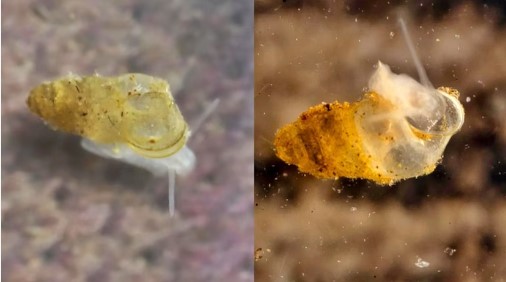
Erhaia dijiang is the first freshwater cave snail ever documented in China, discovered deep inside a high-altitude mountain cave in the Hongta District of Yuxi City, Yunnan Province.
- Key Characteristics
- Appearance– It has an unpigmented, ghostly body, a cone-shaped translucent shell, and long, slender tentacles.
- No Eyes– It is a troglobiont (an organism adapted exclusively to life in caves) with a complete loss of functional eyes.
- Name Origin– Named after Di Jiang, a faceless mythical creature from the ancient Chinese text Classic of Mountains and Seas (Shan Hai Jing).
- Habitat– Lives among submerged gravel and broken rock in shallow water (less than 1 meter deep) at an altitude of 2,062 meters, with water temperatures near 20°C.
- Diet– Feeds on diatoms (microscopic algae on rocks) and organic debris.
- Conservation Status & Population
- Rarity– During initial field surveys in August 2025, researchers found only three living adult snails and one empty shell, with no juveniles recorded.
- Outlook– Scientists describe the population status as vulnerable and "far from optimistic" due to its highly restricted underground habitat.
|
|
The Bangka slow loris
The Bangka slow loris—a rare, venomous primate last documented by science in the 1930s—has been officially confirmed alive and thriving on the Indonesian island of Bangka after being considered lost for nearly a century.
- Scientific Confirmation– A new study published in the journal Spixiana verified the survival of the species.
- The Research Partners– The study was co-authored by the Alobi Wildlife Rescue Center, Vienna's Haus des Meeres Aqua Terra Zoo, and the Taman Safari Prigen Conservation Breeding Ark.
- Rescue Records– Between 2015 and 2025, Alobi documented more than 90 individual Bangka slow lorises across all four regencies of Bangka and the city of Pangkal Pinang.
- Local Awareness– While science lost track of the species for nearly 100 years, local residents and authorities frequently encountered the animals in gardens, plantations, roadsides, and power lines.
- Releases into the Wild– Of the animals rescued, 86 individuals recovered and were released back into protected forests on the island.
- Venomous Nature– The slow loris is famously known as one of the world's only venomous mammals/primates, producing a toxic secretion from a gland on its elbow that it mixes with saliva.
- Appearance– It features large, expressive eyes, reddish-brown fur, and distinct facial markings. It is nocturnal and moves slowly through the canopy.
- Conservation Status– Classified by the IUCN Red List as Critically Endangered (possibly extinct).
- Major Dangers– The species faces continuous habitat loss from tin mining, the expansion of oil palm plantations, and accidental injuries such as electrocution from power lines.

|
|
New Subterranean Fish Species in Assam
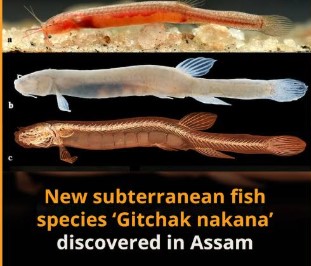
Two previously unknown subterranean fish species, Gitchak nakana and Rakthamichthys anchi, were discovered in wells in Goalpara district, Assam, and announced on 21 October 2026.
- Key Features–Gitchak nakana is a ~2 cm blind loach with a transparent body. Rakthamichthys anchi is a slender, transparent, eel-like fish belonging to the Synbranchidae family.
- Scientific Identification–Researchers used micro-computed tomography (micro-CT) to examine internal structures without conventional dissection.
- Conservation Significance–The discoveries highlight Assam’s unexplored groundwater biodiversity.
- Exact locations remain undisclosed to prevent exploitation.
- Researchers stressed protecting subterranean habitats from pollution and groundwater contamination.
|
|
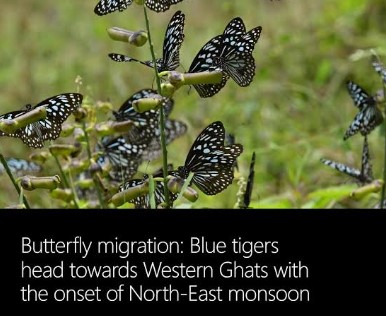
Blue Tiger Butterflies in Western Ghats
Blue Tiger butterflies (Tirumala limniace) and other milkweed species migrate toward the hills of the Western Ghats with the onset of the Northeast monsoon between October and December.
- Route and Direction– They travel from the plains and the Eastern Ghats across Tamil Nadu and the Mysore plateau into the deep forests of the Western Ghats.
- Timing– This westward return movement happens annually around October to December with the Northeast monsoon, while the reverse journey toward the Eastern Ghats happens from April to June before the Southwest monsoon.
- Species Involved– Primarily milkweed butterflies of the Danainae subfamily, including the Blue Tiger (Tirumala limniace), Dark Blue Tiger (Tirumala septentrionis), Common Crow (Euploea core), and Double-branded Crow (Euploea sylvester).
- Life Cycle– Once they reach the host plants in the Western Ghats, they feed, mate, and lay eggs before dying, with later generations flying back to the Eastern Ghats the following year.
- Threats– Large-scale movements across western districts (such as Salem, Erode, Coimbatore, and Tiruppur) face hazards like roadkills from heavy traffic along migration corridors.
|
|
Health
|
|
First Human Case of Shamonda Virus
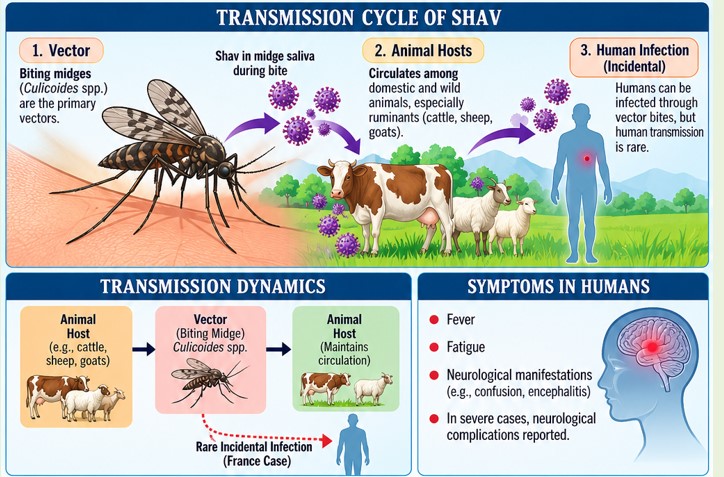
French health authorities reported the first-ever documented human case of the Shamonda virus in October 2026, involving a patient in their 60s in Lyon who died in early October.
- What is Shamonda Virus?
- Classification– Shamonda virus (SHAV) is an Orthobunyavirus belonging to the Simbu serogroup.
- History– It was first isolated in cattle in Nigeria in the mid-1960s and has sporadically appeared in livestock across parts of Africa and Asia.
- Transmission– It spreads primarily through the bites of tiny flying insects called midges (Culicoides).
- Impact on Animals– In livestock (such as cattle, sheep, goats, and horses), it causes fever, diarrhea, reduced milk production, and reproductive issues.
- Details of the First Human Case
- Patient Profile– The individual was in their 60s, lived near Lyon, and was severely immunocompromised while undergoing treatment for a serious underlying illness.
- Outcome– The patient passed away in early October 2026. Preliminary investigations linked brain complications prior to death to the viral infection.
- How it Happened– Officials suspect the patient was bitten by a virus-carrying midge in eastern France, where the virus had recently circulated among farm animals over the summer. Public Health Risk
- General Population Risk– Public health agencies—including the World Health Organization and the European Centre for Disease Prevention and Control—state that this is an isolated, exceptional case.
- Spread Potential– There is currently no alert or indication of wider human-to-human transmission. Midge-borne virus activity also typically drops during cooler seasonal months.
|



