|
One Liners 21-01-2026
|
|
History, Art and Culture
|
|
Ramayana
Recently, 233-Year-Old Valmiki Ramayana gifted to Ram Katha Museum.
- Authored by – Adi Kavi Valmiki with a classical commentary (Tattvadipikaṭika) by Maheshvara Tirtha, is written in Sanskrit (Devanagari script).
- Dating back to – Vikrama Saṁvat 1849 (1792 CE) and represents a rare preserved textual tradition of the Ramayana.
- 5 principal kaṇḍas of the epic – Balakanda, Araṇyakanda, Kiṣkindhakanda, Sundarakanda, and Yuddhakanda reflecting the narrative and philosophical depth of the Itihasa.
|
|
Polity & Governance
|
|
Karnataka's Bhoomi Project: Digital Land Records
Karnataka's Bhoomi project, celebrating 25 years, exemplifies successful administrative reform through digital land records.
- Launched in – 2000.
- Aim – To provide citizens with secure, accurate, and easily accessible Record of Rights, Tenancy, and Crops (RTC) while addressing long-standing issues in land administration.
- Key Achievements
- Computerized land records (RTCs), making them accessible.
- Legal recognition of computerized RTCs, abolition of hand written records.
- Integrated with Kaveri registration system, reducing fraud.
- Automated mutation process.
- Mojini (Survey) software for digital land measurement.
- 11E Sketch for accurate land boundaries.
- Integration with welfare services (crop compensation, PM-Kisan, FRUITS, Aadhaar).
|
|
International Relations and Issues
|
|
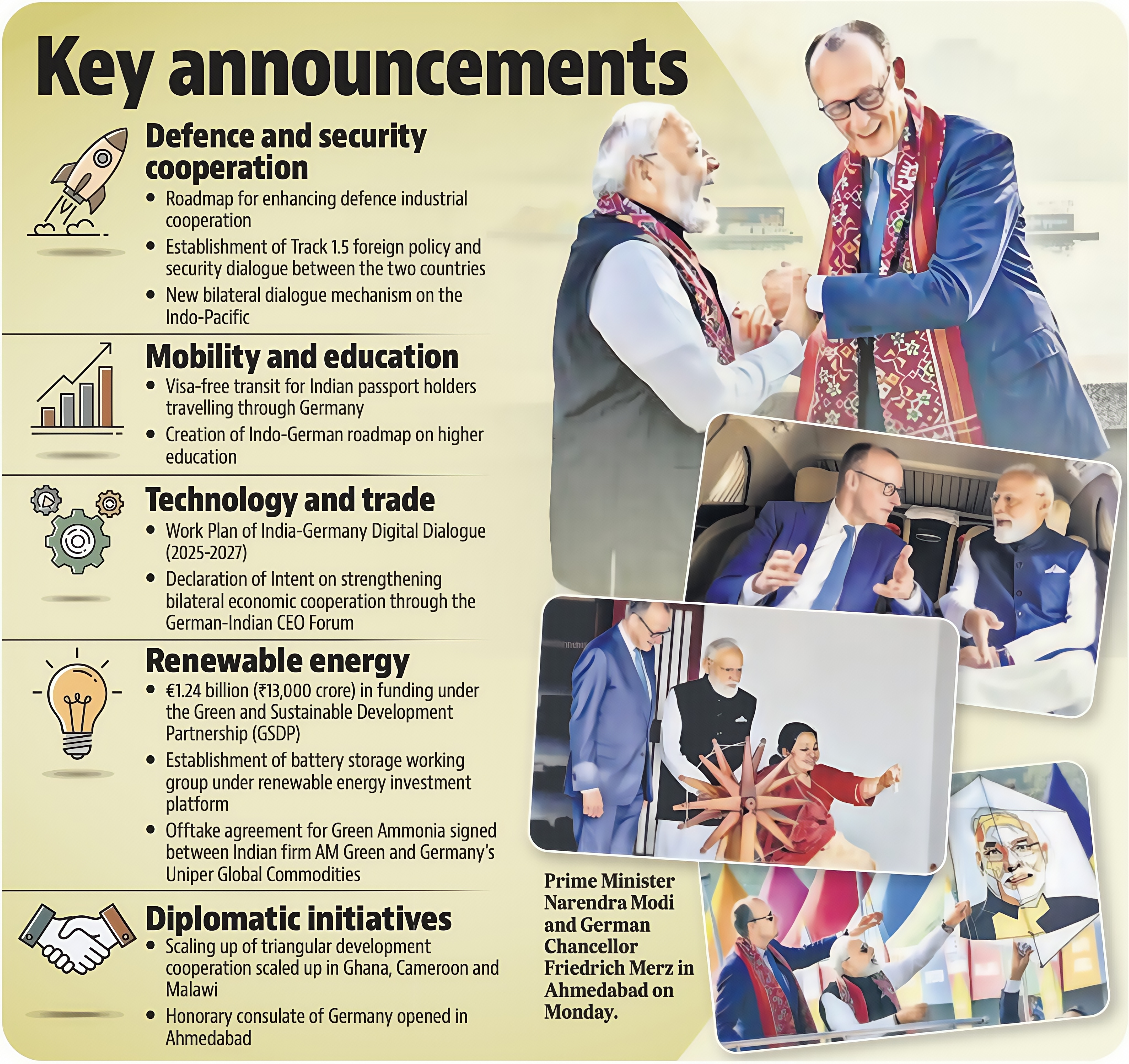
India-Germany Defence & Strategic Cooperation
|
|
Pax Silica Initiative
India is set to be invited to the "Pax Silica"initiative.
- It is a multilateral arrangement for cooperation on semiconductors, critical minerals, and AI.
- Led by – United States
- Objectives –
- To reduce coercive dependencies.
- To secure global tech supply chains, address AI supply chain opportunities and vulnerabilities, and explore joint investment with partners.
- To protect sensitive technologies and build trusted digital infrastructure.
- Signatories – Australia, Greece, Israel, Japan, Qatar, Republic of Korea, Singapore, United Arab Emirates and United Kingdom.
- Non-signatory Participants – Canada, European Union, Netherlands, Organization for Economic Cooperation & Development and Taiwan.
|
|
Monroe Doctrine of 1823
Recently, Trump administration invoked the Monroe Doctrine to justify intervention in Venezuela.
- Declared in – 1823 by President James Monroe to US Congress.
- 4 basic points –
- United States would not interfere in the internal affairs of or the wars between European powers.
- United States recognized and would not interfere with existing colonies and dependencies in the Western Hemisphere.
- Western Hemisphere was closed to future colonization.
- Any attempt by a European power to oppress or control any nation in the Western Hemisphere would be viewed as a hostile act against the United States.
|
|
Economy
|
|
Chain-Based Index of Industrial Production (IIP)
Release of Discussion Paper 2.0: Adoption of Chain-Based Index of Industrial Production (IIP).
- Base revision exercise of IIP is undertaken by – Ministry of Statistics and Programme Implementation (MoSPI).
- Traditional methodology – IIP has been compiled using a fixed-base Laspeyres framework, in which sectoral and industry weights remain unchanged until a base-year revision.
- However, shifts in demand, technology, and policy cause some industries to grow, others to decline, and new ones to emerge.
- Therefore, fixed weights become progressively less relevant and thus affects the efficacy of the indices.
- New methodology – The chain-based method of compilation of IIP offers better accuracy by capturing these changes by allowing the increase and decrease in weights annually to correctly reflect a more recent production structure.
|
|
Agriculture
|
|
Rajasthan's 1st Fully Organic Panchayat
Bamanwas Kankar panchayat in Rajasthan has become the 1st in the state to be certified as fully organic.
- Located in – Bamanwas Kankar panchayat, Kotputli-Behror district, Rajasthan.
- Transition support by – Cofarmin Federation of Organic Societies and Producer Companies (COFED).
- Key benefits – Access to premium markets, reduced input costs, increased biodiversity, better animal health, safer dairy products.
- Model – Community-driven movement, not bureaucratic.
- Aim – To convert 300 panchayats by year-end.
- Key features –
- All farming practices are free of chemical pesticides and synthetic fertilizers.
- Animal husbandry is carried out according to ecological principles.
- Agriculture, livestock, and the environment are managed through an integrated approach.
|
|
Science
|
|
Bharat Electricity Summit 2026
- A global conference-cum-exhibition for the power and electricity sector.
- To be held from – 19th to 22nd March 2026 at New Delhi.
- Theme – “Electrifying Growth. Empowering Sustainability. Connecting Globally”.
- Objectives – To deliberate on the future of electricity and sustainable energy systems, facilitate cross-sector dialogue.
- To strengthen global cooperation, foster strategic partnerships.
|
|
Index
|
|
Responsible Nations Index (RNI)
- RNI – It introduces a comprehensive global framework for assessing nations on parameters such as ethical governance, social well-being, environmental stewardship, and global responsibility, going beyond conventional indicators of power and economic prosperity.
- Launched by – World Intellectual Foundation (WIF).
- Collaboration with – Jawaharlal Nehru University (JNU), Indian Institute of Management Mumbai (IIM Mumbai), and the Dr. Ambedkar International Centre (DAIC).
|
Top 3 Ranks
|
|
Countries
|
Overall Score
|
|
Singapore
|
0.61945
|
|
Switzerland
|
0.58692
|
|
Denmark
|
0.58372
|
- India’s Ranking – 16th (overall score - 0.551513)
|
|
India’s Energy Shift
India saw year-on-year decline in coal-fired generation (2025), first time in 50 years; driven by rapid renewable expansion.
- Key Data
- Coal generation – Output fell from 1,322 billion units in 2024 to 1,283 billion units in 2025, a 3% drop.
- Renewable capacity – 41 GW was added in the first 11 months of 2025, compared to a 15% increase in 2023.
- Overall trend – Coal output is steady in absolute numbers but its share of total energy is shrinking.
- Renewable Energy Growth
- Renewable generation – Production rose from 221 billion units in 2024 to 270 billion units in 2025, marking 22% growth.
- Large hydroelectric – Generation increased by 15%, reaching 151 billion units.
- Future target – India aims to meet electricity demand by 2030 without expanding coal capacity.
|



