|
One Liner 16-11-2026
|
|
Geography
|
|
Lumina Simulation – Early Universe Evolution
- Recently, International researchers developed Lumina, one of the largest and most detailed cosmological simulations, to study the first 2 billion years of the universe.
- Published in – Monthly Notices of the Royal Astronomical Society.
- Objective – To understand the formation of the 1st stars, galaxies and black holes and their role in cosmic evolution.
- Key Features
- Covers a region approximately 1.5 billion light-years across in each direction.
- Covers over 100 times more space than earlier comparable simulations.
- Models the evolution of hydrogen and helium in the early universe.
- Enables simultaneous study of large-scale cosmic structures and individual galaxies.
- Computational Infrastructure
- Used over 15,000 GPUs.
- Run on the Frontier supercomputer, Oak Ridge National Laboratory, USA.
- Took nearly 3 years to complete.
- Reionization – Early stars and black holes emitted ultraviolet radiation, ionising neutral hydrogen by removing electrons and enabling light to travel more freely.
- Significance – It helps to understand galaxy formation, dark matter, ordinary matter and the evolution of the early universe; findings can be compared with observations from the James Webb Space Telescope (JWST).

|
|
International Relations and Issues
|
|
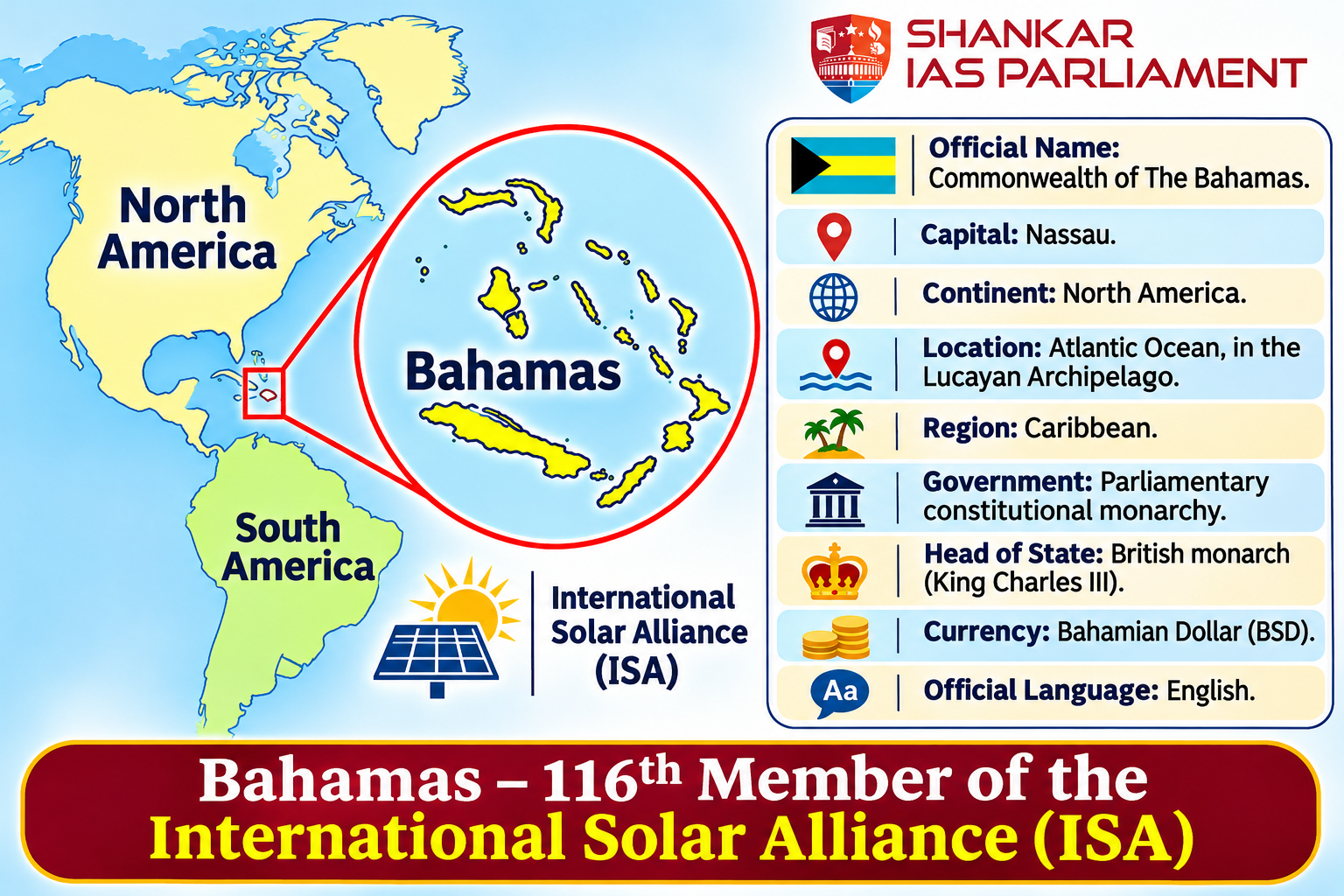
Bahamas Joins International Solar Alliance (ISA)
- Recently, Bahamas became the 116th member of the International Solar Alliance (ISA).
- Accession – Bahamas handed over the Instrument of Accession to the ISA Framework Agreement during the 9th ISA Assembly in New Delhi.
Commonwealth of the Bahamas
- Geographical Features
- Consists of approximately 700 islands and cays.
- Located southeast of Florida (USA) and north of Cuba.
- Does not share a land boundary with any country.
International Solar Alliance (ISA)
- It is a joint initiative of India and France, launched at COP21 (Paris, 2015).
- Headquarters – Gurugram, Haryana, India.
- Aim – To promote solar energy deployment, particularly in solar-rich countries.
- Focus – Energy access, energy security and clean energy transition.
|
|
Economy
|
|
NDC Transport Initiative for Asia – Phase II (NDC-TIA II)
- Recently, NITI Aayog and GIZ India signed an Implementation Agreement to accelerate road freight decarbonisation in India.
- It is a regional initiative supported by Germany's International Climate Initiative (IKI) to decarbonise road freight transport and commercial vehicles.
- Countries covered – China, India and Vietnam.
- Implementing organisation – Deutsche Gesellschaft für Internationale Zusammenarbeit (GIZ) GmbH.
- Political Partners
- India – NITI Aayog.
- China – Ministry of Ecology and Environment.
- Vietnam – Ministry of Construction.
- Implementing Partners
- World Resources Institute (WRI),
- International Council on Clean Transportation (ICCT),
- Agora Transport Transformation,
- SLOCAT and REN21.
- Funding – €4.9 million under Germany's IKI.
- Duration – November 2024 - September 2028.
- Major Objectives
- Promote electrification of medium- and heavy-duty freight vehicles.
- Develop charging infrastructure, innovative financing and enabling regulatory frameworks.
- Promote renewable energy use in transport.
- Facilitate cooperation among governments, civil society and private sector.
- Significance – It supports India's Nationally Determined Contribution (NDC) targets and transition towards low-carbon, energy-efficient transport.
|
|
Agriculture
|
|
Pioxaniliprole – India's First Indigenously Discovered Insecticide
- Recently, PI Industries Ltd's Pioxaniliprole, India's first indigenously discovered insecticide molecule, received CIB&RC approval for use on rice, chilli, tomato and chickpea (chana).
- Trade Name – Pioxazon (planned launch in the Rabi season).
- Chemical Class – Anthranilic diamide; registered as a 20% w/v Suspension Concentrate (SC).
- Mechanism of Action
- Targets Ryanodine Receptors (RyRs) in insect muscle cells.
- Causes uncontrolled release of calcium ions.
- Leads to feeding cessation, muscle paralysis and eventually death.
- Target Pests – Yellow stem borer, leaf folder, fall armyworm, tobacco cutworm, fruit borer and pod borer.
Insecticide Regulation in India
- Insecticides Act, 1968 – It regulates import, manufacture, sale, transport, distribution and use of insecticides to protect humans and animals.
- Insecticides Rules, 1971 – It prescribe packaging, labelling, storage, transport, licensing, safety standards and residue limits.
Central Insecticides Board and Registration Committee (CIB&RC)
- Headquarters – Faridabad, Haryana.
- Functions under – Department of Agriculture and Farmers Welfare, Ministry of Agriculture.
- Central Insecticides Board (CIB) – It advises Central and State Governments on technical matters, toxicity, safety and residue limits.
- Registration Committee (RC) – It registers insecticides after examining their composition, efficacy and safety.
- Directorate of Plant Protection, Quarantine & Storage (DPPQ&S) – It coordinates Integrated Pest Management (IPM), plant quarantine, pesticide regulation and locust control.
- Significance – It promotes indigenous agrochemical innovation, agricultural productivity and reduced dependence on foreign-developed crop-protection technologies.
|
|
Environment
|
|
India's Space Debris Removal Initiative – Vision 2030
Recently, Union Minister announced India's vision of achieving debris-free space by 2030 during the inauguration of Cosmoserve Space's Base 1 facility in Hyderabad.
- Cosmoserve Space – Indian space startup working on Active Debris Removal (ADR) and in-orbit satellite servicing.
Base 1 Facility
- Location – VSD Tech Park, Gachibowli, Hyderabad.
- Area – Approximately 14,800 sq. ft.
- Facilities – Space robotics labs, orbital rendezvous and capture labs, microgravity simulation platforms and satellite integration clean rooms.
- Mission EMBRACE – Tested soft robotic petals in space in July 2026.
- Collaborations – Pixxel (satellite systems), Dhruv Aerospace Netherlands (propulsion) and Skyroot Aerospace (launch services).
India's Space Economy
- Current value – Nearly US$9 billion.
- Target – US$40–45 billion in the coming decade.
- Space startups – Increased from single digits to nearly 450.
- Key Institutions – ISRO, IN-SPACe and NewSpace India Limited (NSIL).
- Significance – It promotes space sustainability, technological self-reliance and India's global leadership in space technology.
|
|
Allianz Green Transition Tracker 2026
- Recently, India climbed 5 places to 45th rank in the Allianz Green Transition Tracker 2026, despite a 0.2% decline in GHG emissions in 2025 alongside 7.6% economic growth.
- Report Coverage – Assessed 65 economies accounting for 81% of global GHG emissions; released on 5 November 2026 ahead of COP31.
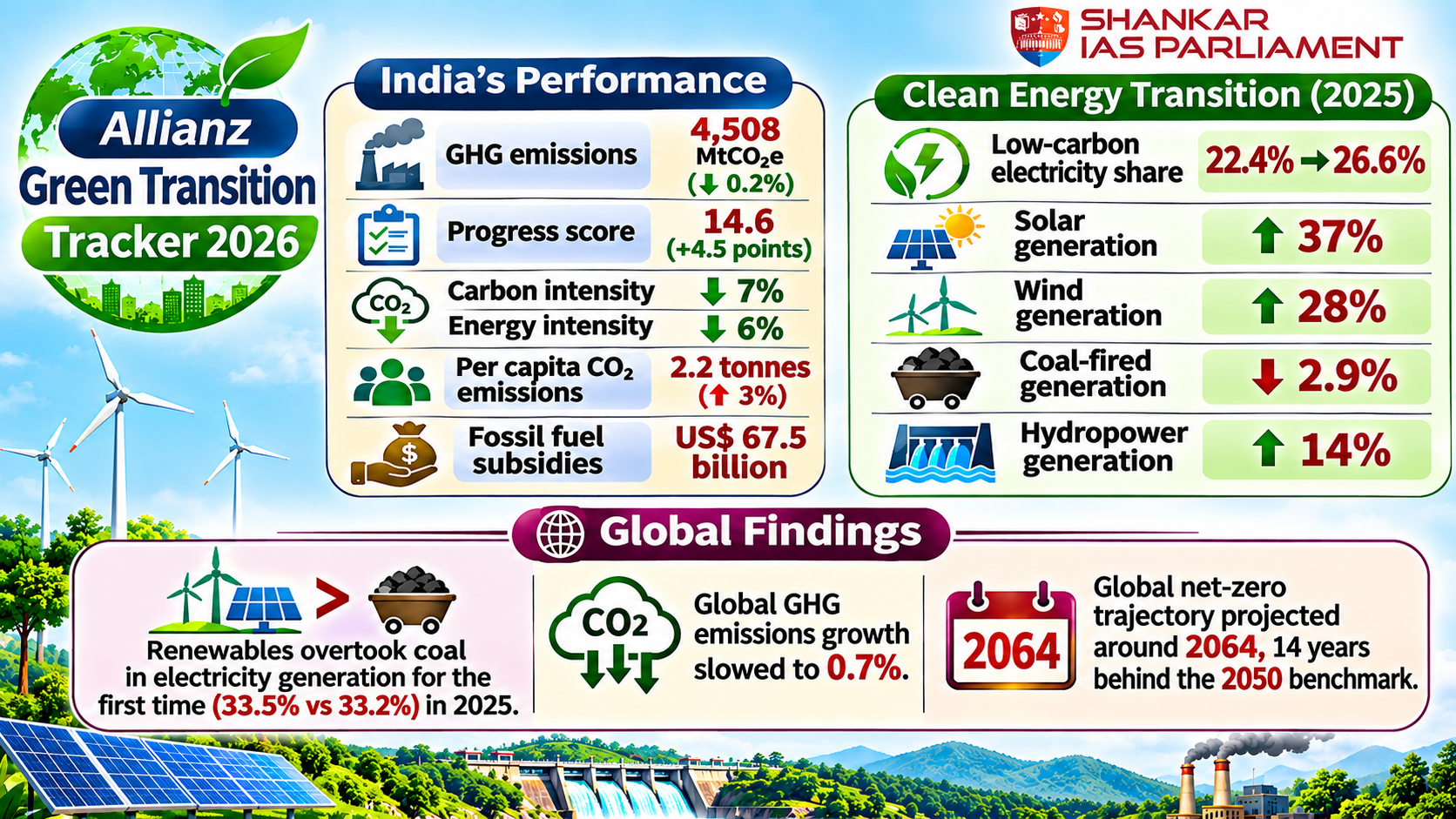
- Significance – It highlights the need to balance economic growth, energy security and climate commitments through renewable energy expansion and reduced fossil fuel dependence.
|
|
Security
|
|
Next Generation Offshore Patrol Vessel (NGOPV) – Srishti
- Recently, Yard 1283, named Srishti, a Next Generation Offshore Patrol Vessel (NGOPV), was launched on 27 October 2026.
- Etymology – Srishti means ‘Creation’ in Sanskrit.
- Shipyard – Goa Shipyard Limited (GSL), Goa.
- Construction – NGOPVs are being built at two shipyards:
- Goa Shipyard Limited (GSL) – Goa.
- Garden Reach Shipbuilders & Engineers (GRSE) – Kolkata.
- Major Roles
- Maritime surveillance and search & rescue (SAR).
- Protection of offshore assets.
- Humanitarian Assistance and Disaster Relief (HADR).
- Anti-piracy and multidomain operations.
- Significance – Indigenous shipbuilding initiative supporting Aatmanirbhar Bharat and Make in India.
|
|
Science
|
|
IndiaAI Mission: Indigenous Foundation Models
- Recently, IndiaAI Mission released indigenous AI foundation models under the IndiaAI Innovation Centre (Foundation Models) pillar.
- Developers – EKA-1 – Soket Labs; Dhīr 2B & Dhīr 5B – ZenteiQ AiTech Innovations.
EKA-1
- 26.3 billion parameters; trained on approximately 7.5 trillion tokens.
- Supports all 22 Scheduled Indian Languages + English.
- Open, sparse hybrid language model for mathematics, coding, reasoning and agentic applications.
Dhīr 2B & Dhīr 5B
- Open-source multilingual AI models supporting English + 10 Indian languages.
- Enable secure, on-premise, offline-capable deployment, including on mobile devices.
- Applications – Defence, governance, industry and education.
- Significance – It strengthens India's AI self-reliance, data privacy, technological sovereignty and indigenous innovation.
IndiaAI Mission
- Approved by – Union Cabinet on 7 March 2024.
- Ministry – MeitY.
- Guided by – The vision of “Making AI in India and Making AI Work for India
- 7 pillars – Compute Capacity, Innovation Centre, AIKosh (Datasets Platform), Application Development, FutureSkills, Startup Financing and Safe & Trusted AI.
|
|
ESA's Hera Mission – Dimorphos Asteroid
- Recently, ESA's Hera spacecraft captured its first image clearly distinguishing Dimorphos from its parent asteroid Didymos (18 October).
- Mission – Hera is a planetary defence mission of the European Space Agency (ESA), launched in October 2024 aboard SpaceX Falcon 9.
- Target – Didymos–Dimorphos binary asteroid system.
DART Mission (NASA)
- 1st demonstration of asteroid deflection through human intervention.
- DART – Double Asteroid Redirection Test (September 2022).
- Deliberately impacted Dimorphos and successfully changed its orbital period.
- Hera's Objectives
- Assess the impact crater and damage caused by DART.
- Study the physical properties of both asteroids.
- Improve understanding of asteroid deflection for planetary defence.
- Key Features – It carries 12 scientific payloads and two CubeSats for close-up observations and potential landing on Dimorphos.
- Significance – It advances global planetary defence against potentially hazardous asteroids.
|
|
Species
|
|
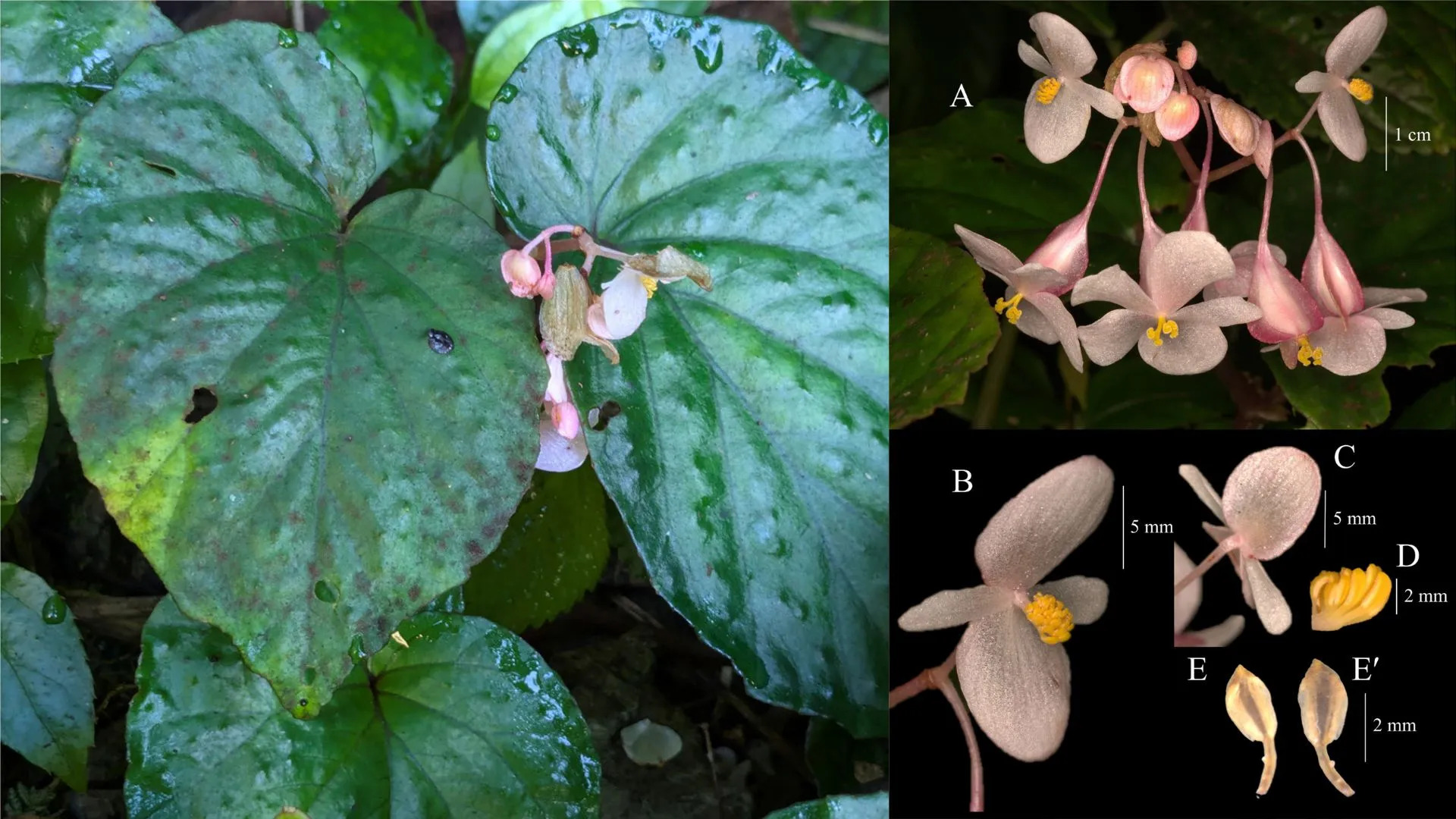
Begonia siangensis – New Wild Flower Species
- Discovered in – Siang Valley of Arunachal Pradesh.
- Discoverer – Researchers from Thackeray Wildlife Foundation, Mumbai (discovery made in 2024).
- Location – Upper Siang District, between Bomdo and Jengging, along the Siang River basin.
- Altitude – Approximately 600 metres above sea level.
- Key Features
- Pale-pink flowers and creeping stems.
- Dark-green, non-variegated leaves with blister-like bumps underneath.
- Belongs to the genus Begonia, section Platycentrum.
- Closely resembles Begonia iridescens.
- Nomenclature – Named after the Siang River Valley, Arunachal Pradesh.
- IUCN Status – Provisionally classified as Data Deficient (DD) due to insufficient information on its population and distribution.
- Significance – It highlights the rich, unexplored floral biodiversity of the Eastern Himalayas, a global biodiversity hotspot.
|



