|
One Liners 16-07-2026
|
|
Social Issues
|
|
Odisha’s Recognition of Habitat Rights for PVTGs
Odisha has formally recognised 10 habitat rights claims covering 8 Particularly Vulnerable Tribal Groups.
- PVTGs (Particularly Vulnerable Tribal Groups) - Most marginalized and isolated sub-groups of Scheduled Tribes in India.
- The Government of India recognizes 75 such groups across 18 states and the Andaman and Nicobar Islands.
- They are characterized by stagnant populations, pre-agricultural technology, extreme isolation, and very low literacy rates.
- Based on the recommendations of the Dhebar Commission (1960-61).
- Habitat – It is defined as the customary territory of primitive tribal groups, pre-agricultural communities, and Scheduled Tribes in both reserved and protected forests.
- Recognised under – Forest Rights Act (FRA), 2006.
Odisha records 13 PVTGs (Highest in India).
- The first habitat title went to the Paudi Bhuyan community in Deogarh, covers protecting the Maa Rambha Devi sacred grove.
- 9 subsequent titles distributed to—
- Juang of Jajpur.
- Keonjhar.
- Chuktia Bhunjia of Nuapada.
- Saora of Gajapati.
- Mankidia of Mayurbhanj.
- Paudi Bhuyan of Angul.
- Hill Kharia of Mayurbhanj.
- Kutia Kondh of Kandhamal.
- Bonda of Malkangiri.
|
|
Polity & Governance
|
|
National Board for Wildlife (NBWL)
NBWL Standing Committee (91st Meeting) recently held.
- It is a statutory apex body in India responsible for promoting the conservation and development of wildlife and forests.
- Constituted under – Section 5A of the Wild Life (Protection) Act, 1972.
- Chairperson – Prime Minister of India.
- Key Functions -No alteration of boundaries of national parks or wildlife sanctuaries can take place without the prior approval of the NBWL.
- The de-notification or boundary alteration of any Tiger Reserve also falls strictly under the regulatory oversight of the NBWL.
|
|
National Tiger Conservation Authority (NTCA)
- It is a statutory body operating under the Ministry of Environment, Forest and Climate Change (MoEFCC).
- Established under – Wildlife (Protection) Act, 1972 (by 2006 amendment).
- Chairperson – Minister for Environment, Forest and Climate Change.
- It provides legal backing, policy direction, and institutional oversight to Project Tiger.
|
|
Central Zoo Authority (CZA)
- It is a statutory body in India responsible for the oversight, regulation, and development of zoos across the country.
- Headquarters – New Delhi.
- Established in – 1992.
- Under – Wildlife (Protection) Act of 1972.
- Union Minister for Environment, Forest and Climate Change serves as the ex-officio Chairman.
- The CZA ensures that Indian zoos maintain proper standards for animal housing, veterinary care, and conservation.
|
|
International Relations and Issues
|
|
Ballistic Missile Defence Coalition
Missile Defence Coalition is formed recently based on the experience of Russia’s invasion faced by Ukraine in Europe.
- Formed on – July 13, 2026.
- Formed by – Ukraine and 9 European nations to develop a shared missile defence architecture for Europe.
- It was launched during a "Coalition of the Willing" summit in Paris, France.
- Aim – To pool technical, industrial, and operational resources to counter the escalating threat of ballistic missiles.
- Member States – 10 founding members
- Denmark
- France
- Germany
- Italy
- The Netherlands
- Norway
- Spain
- Sweden
- Ukraine
- United Kingdom.
|
|
SHANTI Vision
- SHANTI Vision – Securing Holistic Advancement through Norms, Trust and Integrity.
- It is an India’s campaign for election as a non-permanent member of the United Nations Security Council (UNSC).
- It reflects India’s guiding approach to promoting global peace, security and equitable development.
- India contributions –
- 3 lakh personnel to about 50 UN peacekeeping missions since UNSC inception.
- Currently has over 4,300 personnel serving in 10 UN peacekeeping missions.
- India has previously served 8 terms as a non-permanent member of the Security Council, most recent 2021-22.
- If elected, India will serve a 2-year term for 2028 - 2029.
|
|
49th Session of the Codex Alimentarius Commission (CAC49)
- Held in – Geneva in Switzerland.
- Highlights –
- Commission adopted 7 Codex guidelines developed under India's chairmanship.
- India appointed as co-chair of the Electronic Working Group for future regulatory frameworks.
- Global standards for dried Coriander Seeds and Fresh Curry Leaves were adopted.
- India successfully initiated the development of a global Codex Standard for Cashew Kernels.
Codex Alimentarius Commission (CAC)
- It is an international intergovernmental body.
- Established by – FAO and WHO.
- Objective – To develop science-based food standards, guidelines, and codes of practice.
- Its main goals are protecting consumer health and ensuring fair practices in the international food trade
|
|
India – Australia Traditional knowledge and Patent Cooperation Agreement
- India and Australia have officially partnered to safeguard India's indigenous wisdom by granting CSIR’s Traditional Knowledge Digital Library (TKDL) database access.
- Signatories – IP Australia and Council of Scientific and Industrial Research (CSIR).
- Signed during –3rd India–Australia Annual Summit held in Melbourne, Australia
- Purpose –
- Preventing Biopiracy.
- Targeting Erroneous Patents.
- Protecting Global Systems.
|
|
Environment
|
|
Indian Plate and ‘Roof of the World’
- "Roof of the World" is epithet primarily used to describe high-altitude regions of Central and South Asia (Tibetan Plateau).
- Unique topography at the summit of the plateau indicate how far the Indian continental plate, to the south, has been pushed beneath the Asian plate, to the north.
- The uplift of the central and western parts of the plateau was radically different between 45 and 20 million years ago.
- This coincides with the time that the Indian plate is known to have moved under the Asian plate in the west but has not yet reached the central plateau.
- Tibetan Plateau –
- It is the highest and largest upland area on Earth, average elevations exceed 4,500 m.
- It is a major driver of the global climate and it is the source of Asia’s 10 largest rivers, providing water to billions of people.
|
|
Animal and Plant Discoveries 2025
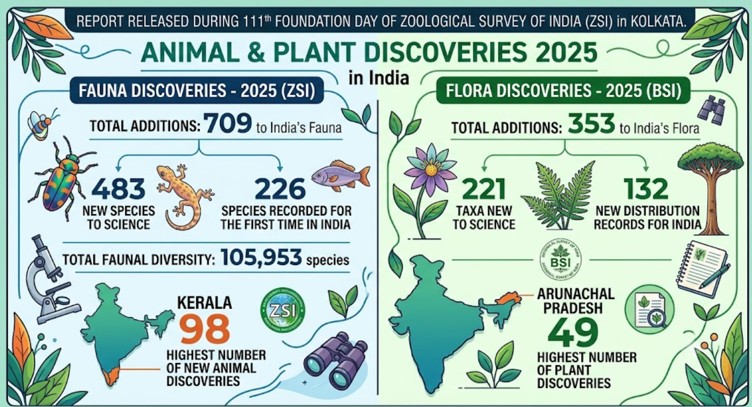
The Animal Discoveries–2025 and Plant Discoveries–2025 reports were officially released in Kolkata during the 111th Foundation Day of the Zoological Survey of India (ZSI).
- India documented a biodiversity addition in 2025, with the Zoological Survey of India (ZSI) and the Botanical Survey of India (BSI).
- Animal Discoveries–2025
- Total Additions - 709 additions to India's fauna.
- New Species - 483 species new to science.
- First-Time Records - 226 species recorded in India for the first time.
- Kerala recorded the highest number of new animal discoveries, with 98 new additions.
- Arunachal Pradesh recorded the highest number of new plant discoveries, with 49 new additions.
|
|
3.61 lakh saplings in one hour
- Location – Bhadaj, Ahmedabad, Gujarat.
- It got Guinness World Record by planting 3.61 lakh saplings in one hour.
- Organized by – Ahmedabad Municipal Corporation (AMC)
- The drive utilized the Miyawaki method (Japanese method).
- Native species are planted very close together.
- This method forces trees to grow up to 10 times faster and become 30 times denser than conventional plantations.
|



