|
One Liners 13-11-2026
|
|
Polity & Governance
|
|
1st All India Conference on Official Language 2026
- Organized by – Department of Telecommunications (DoT).
- Held at – Dr. Ambedkar International Centre, New Delhi.
- Key Objectives
- Promote the progressive use of Hindi as the Official Language in government functioning and administration.
- Strengthen the implementation of Rajbhasha Hindi in official communication.
- Provide a platform to exchange ideas on the use and enrichment of Hindi.
- Constitutional Provisions
- Article 343 – Hindi in Devanagari script is the Official Language of the Union; numerals follow the international form of Indian numerals.
- Article 344 – Provides for a Commission and Parliamentary Committee on Official Language.
- Article 351 – Directs the Union to promote the spread and development of Hindi.
- Institutional Framework
- Department of Official Language – Functions under the Ministry of Home Affairs; organises All India and Regional Official Language Conferences.
- Parliamentary Committee on Official Language – Reviews the progress of the use of Hindi for official purposes.
|
|
International Relations and Issues
|
|
Karakoram-2026: China–Pakistan Military Cooperation
China and Pakistan conducted their 1st joint army-level military exercise, Karakoram-2026, from 14–22 October 2026.
- Key Features
- Participants – People's Liberation Army (PLA) of China and Pakistan Army.
- Location – Xinjiang, bordering India's Ladakh and Jammu & Kashmir.
- Objective – To enhance high-altitude warfare capabilities, counterterrorism operations and military interoperability.
- Two Phases
- Phase I – Specialised tactics, close-quarter combat and UAV operations.
- Phase II – Joint command, mixed formations, counterterrorism clearance, coordinated fire drills and joint manoeuvres.
- Equipment – Chinese small arms, armoured vehicles, artillery, drones and support systems.
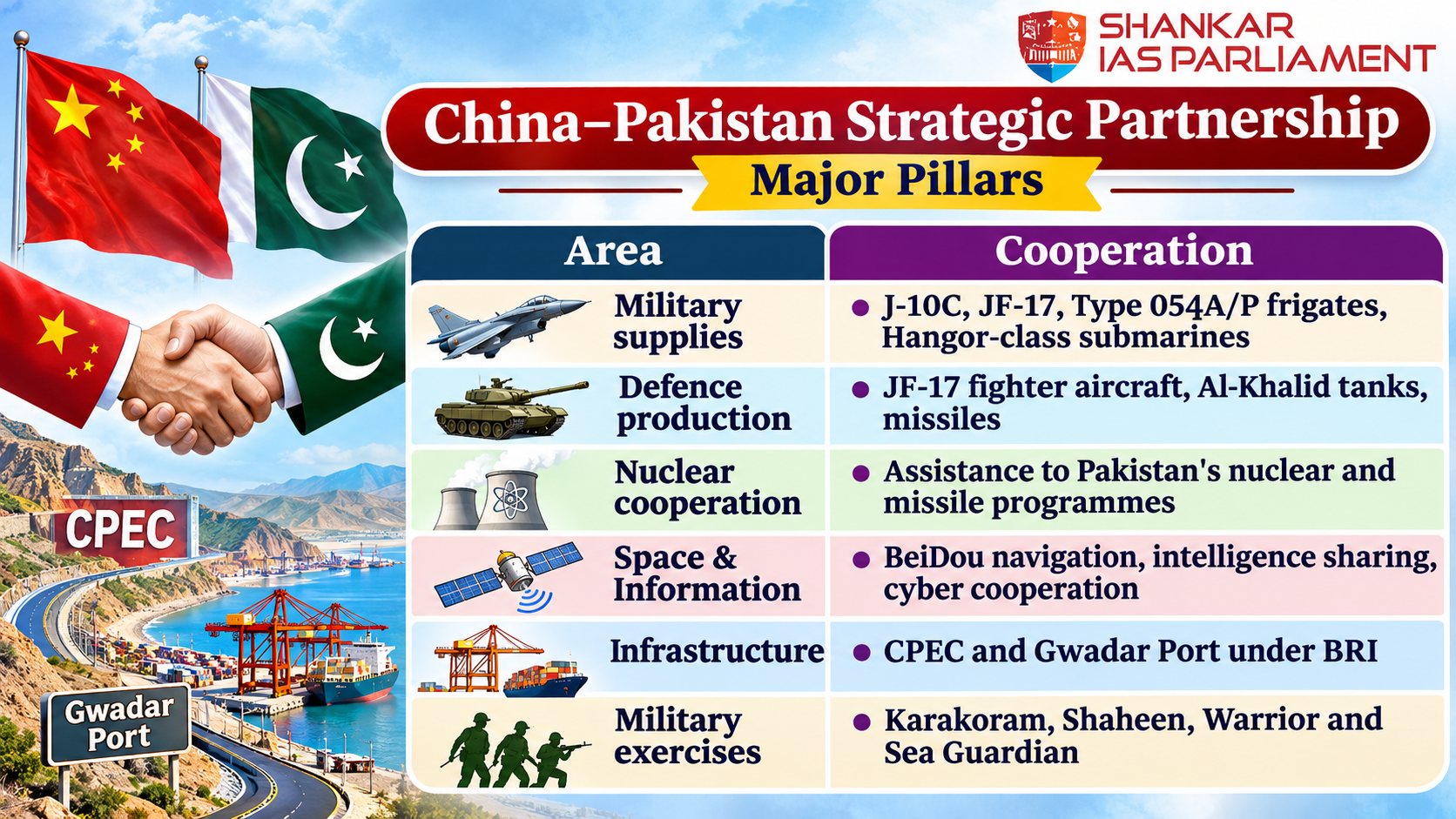
Historical Background – 1963 Sino-Pakistan Boundary Agreement, under which Pakistan ceded the Shaksgam Valley to China.
|
|
Economy
|
|
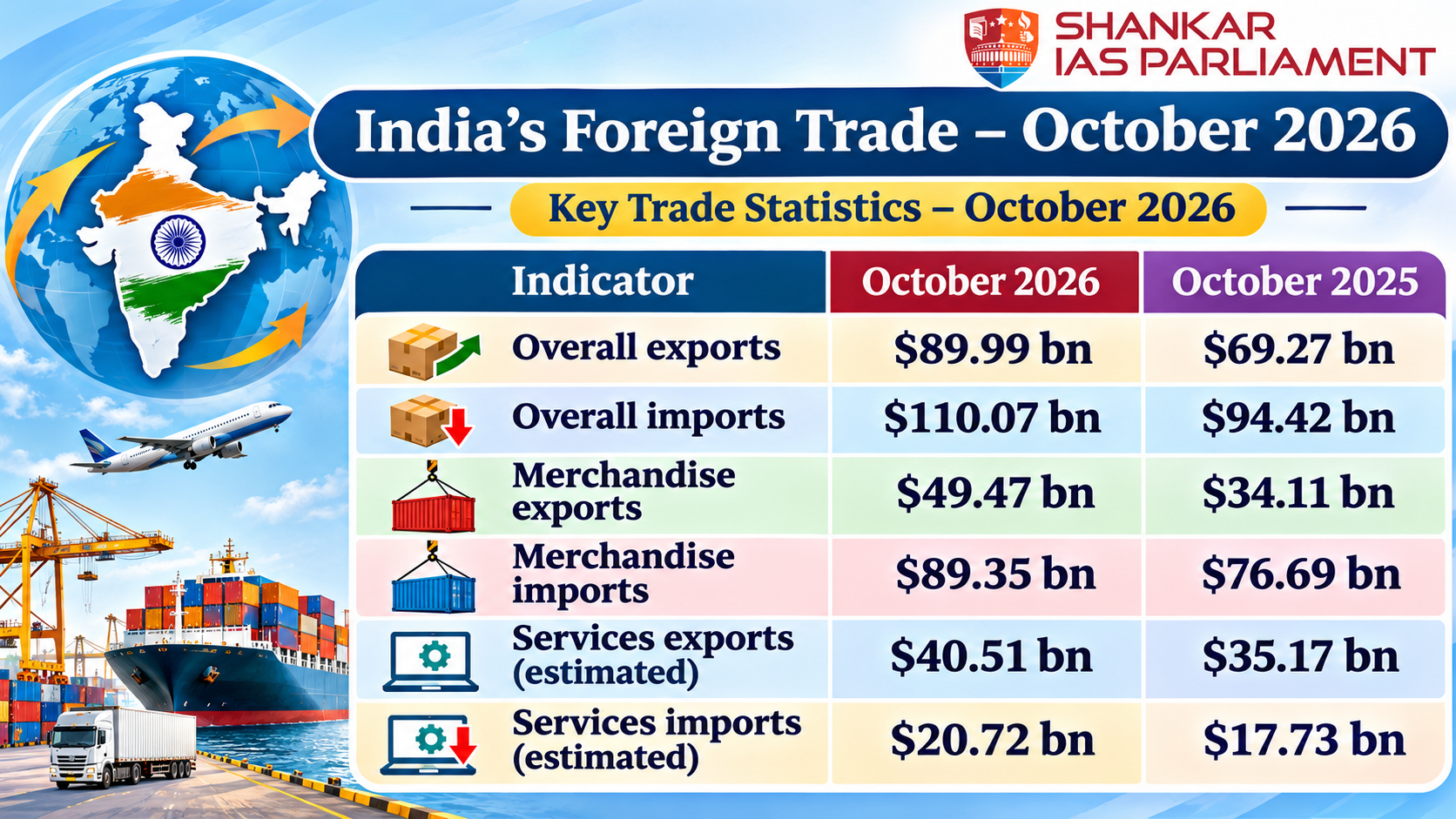
India’s Foreign Trade – October 2026
India's overall exports (merchandise + services) increased 29.9% year-on-year to $89.99 billion in October 2026, recording strong export growth.
- Major Highlights
- Highest-ever monthly merchandise exports – $49.47 billion.
- Overall trade deficit – Narrowed to $20.09 billion from $25.15 billion in October 2025.
- Merchandise trade deficit – Widened to $39.88 billion, the highest in one year.
- Services trade surplus – Helped offset the merchandise trade deficit.
- October 2026 services figures are estimates; latest actual RBI data was for September 2026.
- Factors Affecting Trade
- Higher crude oil import costs due to disruptions in global energy markets.
- India imports nearly 85% of its crude oil requirements.
- Brent crude prices falling to around $92/barrel offered some relief.
- Export-market diversification and trade agreements with the UK and New Zealand supported export growth.
- India–EU trade deal is expected to be implemented early next year.
|
|
Agriculture
|
|
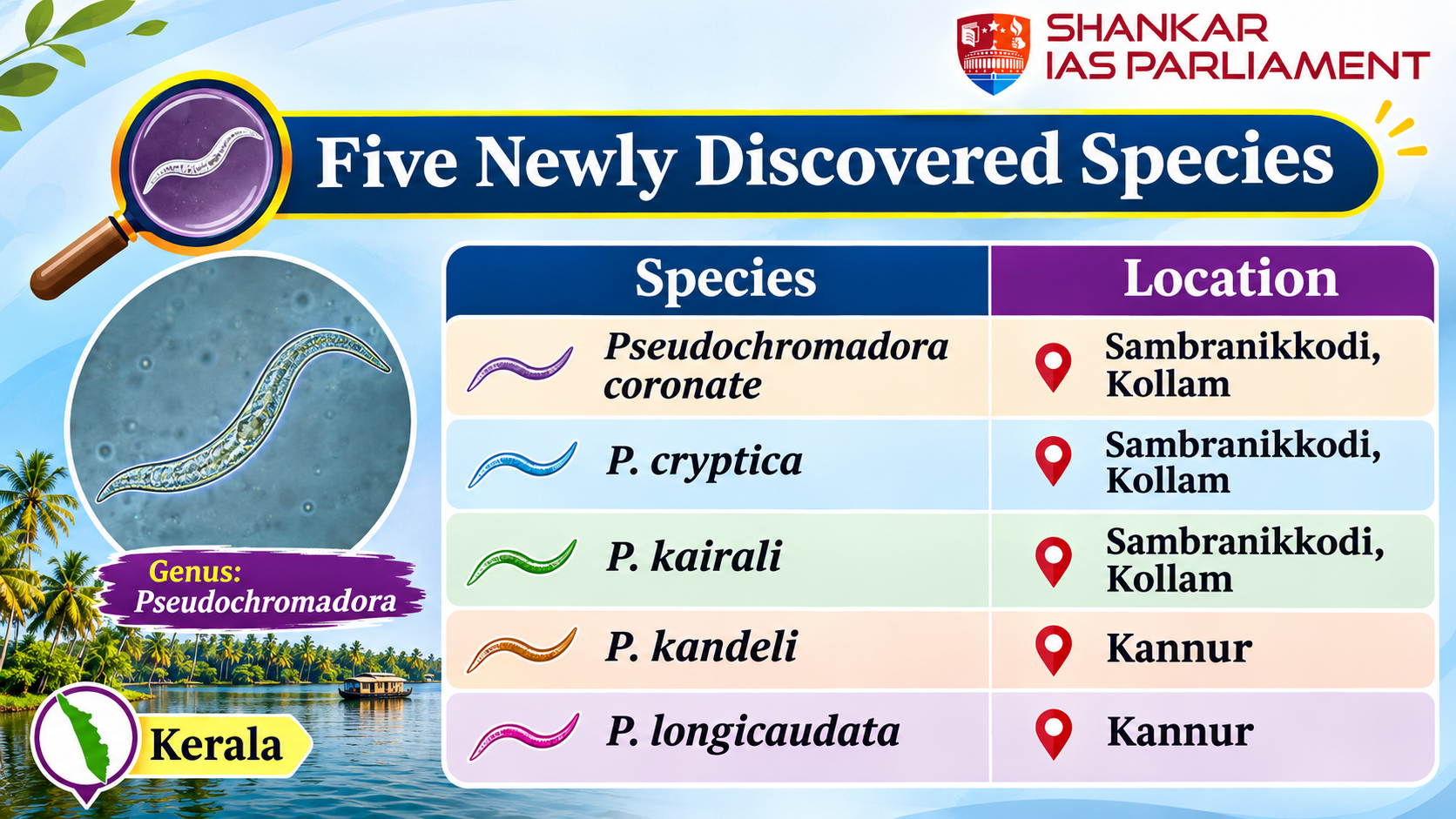
5 New Species of Free-Living Nematodes Discovered Along Kerala Coast
Researchers from the University of Kerala discovered 5 new species of free-living nematodes in mangrove sediments along the Kerala coast.
- Scientific Journal – Marine Biodiversity (Springer Nature).
- Significance – 1st confirmed record of the genus Pseudochromadora from the Arabian Sea.
- Free-Living Marine Nematodes
- Microscopic, non-parasitic roundworms, generally a few millimetres long.
- Inhabit marine and estuarine sediments.
- It play important roles in organic matter decomposition and nutrient cycling.
|
|
Plant Genome Saviour Awards 2026
- Two farmers from Wayanad, Kerala, received national-level recognition under the Plant Genome Saviour Awards of the Protection of Plant Varieties and Farmers’ Rights Authority (PPVFRA).
- Awards were presented on 12 November 2026 in New Delhi.
- Award Winners
- Babu N.K. – Plant Genome Saviour Farmer Reward (2023–24)
- Prize – Rs.1.50 lakh, citation and memento.
- Conserves traditional and underutilised crop varieties on his four-acre farm.
- Collection includes 39 banana, 11 root tuber, 9 colocasia, 6 ginger and 4 turmeric varieties.
- Shared greater yam germplasm with ICAR-Central Tuber Crops Research Institute and seed material with Kerala Agricultural University's Seed Gene Bank.
- Sooraj C.S. – Plant Genome Saviour Farmer Recognition (2024–25)
- Prize – Rs.1 lakh, citation and memento.
- Conserves 670 genetic resources, including 104 tomato, 23 brinjal, 36 chilli and 32 banana varieties.
- Shares germplasm with Kerala Agricultural University for research and characterisation.
Protection of Plant Varieties and Farmers’ Rights Authority (PPVFRA)
- Established under – Protection of Plant Varieties and Farmers’ Rights Act, 2001.
- Functions under – Ministry of Agriculture and Farmers Welfare.
- Objectives – It protects plant varieties and recognises farmers' and plant breeders' rights.
- It promotes conservation of agro-biodiversity and farmers' contribution to preserving genetic resources.
|
|
Security
|
|
12th edition of Exercise MITRA SHAKTI 2026
A 170-member Indian contingent departed for Sri Lanka to participate in the Exercise Mitra Shakti 2026.
- It is an annual bilateral military exercise conducted alternately in India and Sri Lanka.
- Participating Countries – India and Sri Lanka.
- Duration – 13–26 November 2026 (14 days).
- Venue – Army Training School, Maduru Oya, Sri Lanka.
- Indian Contingent – Primarily troops from a battalion of the Rajputana Rifles, along with personnel from other arms, services and the Indian Air Force.
- Objectives
- To enhance interoperability and joint operational capabilities of both armies.
- To improve counter-terrorism operations in a semi-urban environment under a UN mandate.
- To exchange operational experiences and best practices.
- Major Training Activities
- Joint operational planning and tactical rehearsals.
- Urban patrolling and roadblock operations.
- Vehicle convoy protection and area ambushes.
- Crowd dispersal operations.
- Combined arms operations against fortified positions.
- Culminates in a joint validation exercise.
- Significance
- It strengthens India–Sri Lanka defence cooperation.
- It promotes mutual trust, professional camaraderie and regional security.
|
|
6th Edition of Exercise HARIMAU SHAKTI 2026
- It is bilateral joint military exercise.
- Participating Countries – India and Malaysia.
- Duration – 13 days from 18–30 November 2026.
- Previous Edition – 5th edition, held at Mahajan Field Firing Range, Rajasthan, in December 2025.
- Objectives
- It enhances interoperability and operational coordination between the two armies.
- It strengthens professional military cooperation and mutual understanding.
- It improves capabilities for counter-terrorism and sub-conventional operations.
- Major Training Areas (Previous Edition)
- Joint tactical drills under a UN mandate.
- Counter-insurgency and counter-terrorism operations in semi-urban and urban terrain.
- Joint patrolling, ambush theory and operational planning.
- Counter-Improvised Explosive Device (IED) familiarisation.
- Army Martial Arts Routine (AMAR) drills.
- Helicopter slithering and low-hover jumps from MI-17 helicopters.
- Command Post Exercise for tactical planning and battlefield management.
- Significance
- It strengthens India–Malaysia defence relations.
- It promotes regional peace, stability and military-to-military cooperation.
|
|
Science
|
|
COSMOS-Mysuru Planetarium
Prime Minister inaugurated COSMOS-Mysuru Planetarium in Mysuru, Karnataka, on 13 November 2026.
- It is India’s 1st LED dome planetarium.
- Aim – It promotes astronomy education, scientific curiosity and innovation among students.
- Associated institutions – Indian Institute of Astrophysics (IIA) and University of Mysore.
- It highlights the integration of India's scientific heritage with modern astronomy.
- Recent Indian Space Achievements
- Chandrayaan-3 – India became the 1st country to land near the Moon’s south polar region.
- Aditya-L1 – India’s first space-based solar observatory.
- Space docking – India became the fourth country to demonstrate space docking and undocking capability.
- Gaganyaan – India’s human spaceflight programme; experience from the recent Indian astronaut’s ISS mission supports its development.
- Applications
- Satellite-based communication and weather alerts for fishermen.
- Real-Time Train Tracking System – Indian Railways and ISRO.
- PM Fasal Bima Yojana – satellite data supports crop-yield estimation and insurance claims.
- Other Research Initiatives
- Atal Tinkering Labs – Over 10,000 labs; benefited more than one crore students.
- One Nation One Subscription – Access to leading global research journals for domestic institutions.
- Anusandhan National Research Foundation (ANRF) – Promotes research and innovation.
- Research, Development and Innovation Scheme – Rs.1 lakh crore funding initiative to support research and technology development.
- India’s Scientific Heritage
- Aryabhata, Varahamihira, Bhaskaracharya and Nilakantha Somayaji – notable ancient Indian astronomers.
- Ancient contributions included planetary movements, calendars and calculations of solar and lunar eclipses.
|
|
Personality
|
|
Stephanie Case – 1st Woman to Complete Antarctic Ice Ultra 100-Mile Race

- Achievement – Finished in 17 hours, 31 minutes and 39 seconds, securing second place overall.
- Location – Schirmacher Oasis, Queen Maud Land, East Antarctica.
- Race Details
- Distance – 100 miles (approximately 160.9 km).
- Course – 38 laps of a 4.2-km circuit.
- Temperature – As low as –35°C.
- Only 4 of the 8 participants completed the race.
- Challenges – Extreme cold, strong winds, risk of frostbite, dehydration and maintaining body temperature.
- Significance – n1st-ever female finisher of the Antarctic Ice Ultra 100-mile race.
- Stephanie was the only woman among three female starters to finish.
|
|
Index
|
|
Impact Assessment of PLI Schemes – NITI Aayog
- Released by – NITI Aayog
- Collaboration with – IIM Ahmedabad as the knowledge partner.
- Production Linked Incentive (PLI) Scheme
- Launched by – Government of India to boost domestic manufacturing and global competitiveness.
- It provides incentives linked to incremental production/sales by eligible manufacturers.
- It aims to attract investment, promote exports, create employment and integrate India into global value chains.
- It covers 14 sectors across different Ministries and Departments.
- Key Findings
- Nearly 70% of targeted segments are on track.
- Encouraging progress in:
- Pharmaceuticals
- Mobile manufacturing (Large Scale Electronics Manufacturing)
- Food processing
- Telecom
- White goods
- Automobiles
- Drones
- Drones sector – Emerging as an early implementation success.
- High-efficiency Solar PV modules – Significant expansion in domestic manufacturing capacity.
- ACC batteries, specialty steel and technical textiles – Gradual capacity creation and ecosystem development.
- Assessment Parameters
- Investment
- Additional production
- Exports
- Employment generation
- Sectoral Performance Categories
- On-Track
- Partial Impact
- Insignificant Evidence of Impact
- Data Unavailable
|



