|
One Liners 12-09-2026
|
|
History, Art and Culture
|
|
Brick structure found in Kollidam riverbed
Brick structure found in the Kollidam riverbed, traced to the Sangam period, was used for water management: T.N. Archaeology Dept.
- Location – On the bed of the Kollidam river at Koogur near Lalgudi in Tiruchi district, close to the ancient Kallanai dam (built by Karikala Chola).
- The exposed structure on the riverbed could possibly be a Sangam-period irrigation structure.
- Date – The structure is dated to the Sangam/early historic period, around 2,000 years ago.
- Structure – Large rectangular and wedge-shaped bricks, along with stone structural elements.
- Such brick structures were later replaced by stone anicuts and later, during the British period, by iron sluices.
- Likely function – Sluice, inlet/outlet channel or canal-regulating structure used for water management.
- Comparison – Its design is comparable to an ancient water-management structure discovered at Vanagiri near Kaveripoompattinam (Poompuhar).
- Kurampu, a water-management structure comparable to a check dam and referred to in literary and inscriptional sources.

|
|
Kollidam River
- Kollidam River – It is the northern and larger distributary of the Kaveri (Cauvery) River in southeastern India.
- Origin – It splits from the main branch of the Kaveri River just west of the island of Srirangam in Tamil Nadu.
- It empties into the Bay of Bengal near Pazhaiyar in the Mayiladuthurai district.
|
|
Thirukkural
Ahead of the BRICS summit in New Delhi, the Indian Prime Minister gifted the Russian President a translated version of the traditional Tamil text Thirukkural.
- Thirukkural – Also called Kural- is a classic Tamil text written by Thiruvalluvar, believed to have lived sometime between the 2nd century BCE and the 5th century CE.
- Thirukkural, which translates to “sacred verses” or “sacred couplets” in English.
- It consists of 1,330 stanzas or couplets, each of seven words called “kurals”. These are arranged into 133 chapters, each containing 10 couplets.
- 3 themes
- Aram - Virtue (Dharma), dealing with the morality and values of an individual - has 38 chapters.
- Porul - Polity is filled with teachings regarding materialism and socio-economic values - has 70 chapters.
- Inbam – Details teachings of love (inbam), has 25 chapters.
- Core teachings – It emphasises moral conduct and speaks of the realities of human life.
- 1st English publication – Thirukkural was first published in English in 1840. Since then, it has been translated into more than 60 different languages.
- Modi’s gifted Putin – Translated to Russian by Naira Mkrtchyan, published this year by the Central Institute of Classical Tamil as part of its Thirukkural translation series.

|
|
Geography
|
|
Bakhira Lake
A new study about the sediments from Bakhira Lake can help water resource management in the Central Ganga Plain.
- Location – It is the largest natural floodplain wetland, located in the Sant Kabir Nagar district of eastern Uttar Pradesh.
- It is part of the Ghaghara-Rapti alluvial system and is a perennial oxbow/floodplain wetland created through the migration and eventual cut-off of the Rapti River.
- Ramsar Site – One of Uttar Pradesh’s largest wetlands, it was designated a Ramsar Site in 2022.
- Significance – It is an important habitat for migratory and resident waterbirds.
About the recent study –
- Sediment record are extends back approximately 25,000 years, providing a long-term palaeoclimate archive.
- The findings can support agricultural planning, flood and drought mitigation, water-resource management and wetland conservation in the Central Ganga Plain.

|
|
Polity & Governance
|
|
Recognition of Political Parties
The Election Commission of India (ECI) has recognised the TVK as a State party in both Tamil Nadu and in the UT of Puducherry.
- Registration & Recognition – The Election Commission of India (ECI) registers and recognises political parties as National or State parties under the Election Symbols (Reservation and Allotment) Order, 1968, based on electoral performance.
Conditions for recognition
National Party – The registered party has to satisfy any of the 3 conditions (ECI’s Political Parties and Election Symbols, 2019 handbook):
- Secure at least 6% of the valid vote in an Assembly or a Lok Sabha election in any four or more states & won at least 4 seats in a Lok Sabha election from any State or States
- Win at least 2% of the total Lok Sabha seats in a Lok Sabha election from 3 states.
- The party is recognised as a State Party in at least four states
State Party – The registered party has to satisfy any of the 5 conditions.
- Secure at least 6% of the valid vote & win at least 2 seats in a state legislative assembly election
- Secure at least 6% of the valid vote & win at least 1 seat in a Lok Sabha election from the same state.
- Win at least 3% of the seats or at least 3 seats, whichever is more, in an election to the legislative assembly of the state concerned.
- Win at least 1 out of every 25 seats from a state in a Lok Sabha General Election
- Secure at least 8% of the total valid vote in an Assembly or a Lok Sabha General Election.
Privileges Enjoyed by Recognised Parties
- Reserved Symbols – Exclusive symbols nationwide for National parties and state-specific for State parties.
- Star Campaigners – Up to 40-star campaigners whose expenses are excluded from candidate caps (compared to 20 for unrecognised parties).
- Other Benefits – Free broadcast time on state media, free electoral rolls, and requiring only a single proposer for candidate nominations.

|
|
National Commission for Safai Karamcharis (NCSK)
Recently, Bhagwat Prasad Makwana has assumed charge as chairperson of the National Commission for Safai Karamcharis (NCSK).
Safai Karamchari means a person engaged in, or employed for, manually carrying human excreta or any sanitation work.
- Origin – Constituted on 12th August, 1994 as a statutory body (not a constitutional body), under the National Commission for Safai Karamcharis Act, 1993.
- Current Status – After the 1993 Act lapsed in 2004, NCSK became a temporary non-statutory body, with its tenure periodically extended by the Union Cabinet, currently up to 31 March 2028.
- Purpose – To safeguard the interests, rights and welfare of Safai Karamcharis and to monitor implementation of laws and schemes concerning them.
- Nodal Ministry – Ministry of Social Justice & Empowerment.
- Composition – Consists of a Chairperson, a Vice-Chairperson, 5 members (including at least one woman member) and a Secretary; all should be nominated by the Central Government.
- Tenure – The Commission's tenure is determined by the Central Government.

|
|
International Relations and Issues
|
|
International Space Summit, 2026
India and France step up cooperation in space sector with signing of three agreements announced at the International Space Summit in Paris.
Key agreements signed
- Space surveillance – The contracts worth more than five million euros between France’s Safran Space and India’s Dhruva Space for technologies to be used in India’s planned 52-satellite space-surveillance constellation – the constellation is envisaged to deploy satellites between 2027 and 2030.
- Satellite launches – French launch-services provider RIDE! and Indian company ‘TakeMeToSpace’ (country’s first designer of orbital data centres ) signed an agreement to launch two satellites, including the recent integration, launch and return of a European atmospheric re-entry capsule aboard India’s Polar Satellite Launch Vehicle.
- Microsatellite technology – French space company U-Space and Indian firm AXISCADES have signed a commercial cooperation agreement to explore India's microsatellite market and address growing commercial and institutional demand.

|
|
Environment
|
|
National Forest Martyrs Day, 2026
- It is observed in India every year on September 11.
- Objective – To honour the brave forest guards, rangers, and community members who lost their lives protecting the country’s forests, wildlife, and biodiversity.
- Theme, 2026 – "Guardians of the Green: Honouring Sacrifice, Sustaining Biodiversity”.
- Focus for 2026 – Celebrating the unsung frontline heroes who defend vulnerable ecosystems from poachers, smugglers, and forest fires, while reinforcing the public's shared responsibility toward wildlife and forest preservation.
- Historical Significance – September 11th was chosen to commemorate the historic Khejarli Sacrifice of 1730 in Rajasthan.
- Led by Amrita Devi Bishnoi, over 360 members of the Bishnoi community laid down their lives by hugging sacred Khejri trees to prevent them from being cut down by order of the local Maharaja.
- Their extraordinary resistance later inspired modern environmental movements like the Chipko Movement.

|
|
Security
|
|
Lipulekh Pass
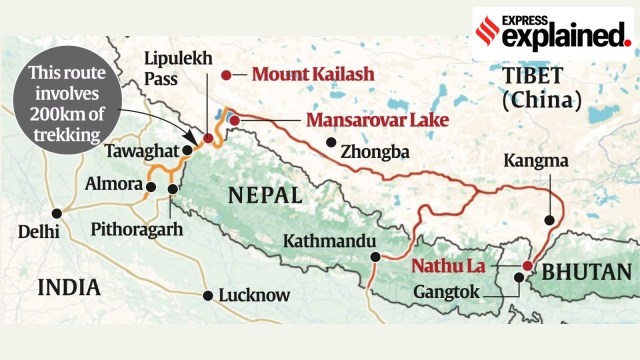
India-Tibet trade route through Lipulekh Pass has reopened, with a 17-member Indian delegation entering Taklakot in Tibet.
- Lipulekh Pass – It is a high-altitude Himalayan mountain pass located in the Pithoragarh district of Uttarakhand, India, connecting the Kumaon region with Tibet, China, near the trijunction with Nepal.
- Territorial Issue – The southern area near the pass (Kalapani region) is administered by India but claimed by Nepal – India rejected Nepal’s claims.
- Lipulekh Pass trade route – Located at an altitude of over 17,000 feet, it was closed after the 1962 India-China war.
- Trade resumed in 1992 but was suspended again in 2019 due to the COVID-19 pandemic, latest movement marks the resumption of cross-border trade after six years.
- Taklakot – Traditionally has been a key market linking Himalayan communities.
- Indian traders export spices, tea, jaggery, sugar candy, cosmetics and household goods, while importing wool, pashmina, yak hair, garments, footwear and other local products.
- Significance – The reopening of the route is expected to revive trade and support the livelihoods of traders, transporters and porter families in Dharchula and nearby border villages.
|
|
Science & Technology
|
|
One Tag System
Union Minister for Road Transport and Highways launches ‘OneTag’ to enable NETC FASTag portability at Global Fintech Fest (GFF) 2026, Mumbai.
- ‘OneTag’ – It is a new FASTag portability solution.
- A portability facility that will allow users to shift to another issuer bank while retaining the existing tag affixed to their vehicle, eliminating the need to obtain a new physical tag..
- Joint initiative – Indian Highways Management Company Limited (IHMCL), a company promoted by NHAI & National Payments Corporation of India (NPCI).
- Objective – To enhance interoperability and provide greater choice and convenience to NETC FASTag users.
- Availability – The service will be made available through NHAI’s Rajmargyatra mobile app.
- Future Goal – To achieve a barrier-free tolling system with zero stoppage and zero waiting time, leveraging AI and automatic number-plate recognition for seamless mobility.
- FASTag penetration – With a penetration rate of over 98% and around 13 crore NETC FASTags issued, including approximately 6 crore active tags, FASTag has revolutionised the Electronic Toll Collection system in the country.

|
|
7th edition of the Global Fintech Fest (GFF 2026)
- It is widely recognised as the world's largest financial technology gathering; the four-day event is being held in Mumbai, India.
- Organised by – Payments Council of India (PCI), the National Payments Corporation of India (NPCI), and the Fintech Convergence Council (FCC).
- Theme – “Potential to Impact: Trusted, Connected, Global Systems for Inclusive Finance”.
|
|
Miscellaneous
|
|
Digvijay Diwas, 2026
- It is observed annually on 11 September.
- Purpose – To commemorate Swami Vivekananda’s historic address at the World’s Parliament of Religions in Chicago on 11 September 1893.
- The word "Digvijay" means the "proclamation of victory".
Historical Significance
- He began his address with “Sisters and Brothers of America”, receiving an enthusiastic response.
- He presented India’s philosophical traditions, particularly Vedanta, on a global platform.
- His message emphasised religious tolerance, universal acceptance, interfaith harmony and universal brotherhood.
- The day is termed “Digvijay Diwas” to symbolise India’s victory in the realm of ideas and spiritual thought.

|



