|
One Liners 07-11-2026
|
|
History, Art and Culture
|
|
Waree Leeba – Traditional Storytelling Art of Manipur
Manipur Governor inaugurated the 1st North East Waree Leeba Festival 2026 in Imphal West, Manipur.
- Aim – To promote and preserve the traditional storytelling art.
- Origin – Traditional oral narrative art of the Meitei community of Manipur, dating back to the reign of King Khagemba (1597–1652 AD).
- Nature of Art – A traditional solo storytelling performance in which a single male artist narrates the entire story and portrays all characters.
- Performance Features
- Combines rhythmic narration, facial expressions, hand gestures, mimicry and humour.
- Traditionally performed without musical instruments.
- Performer sits on a Vyasa Asana.
- Uses a white pillow for dramatic effects and a sacred text placed on a wooden stool called Lairik-phan.
- Themes – Stories from the Mahabharata, Ramayana, Meitei folklore, history and spiritual teachings.
- Cultural Significance – It preserves ancestral knowledge, myths, legends, beliefs and Meitei cultural identity.
Five-day festival
- Organised in – Imphal West, by the Repertory of Waree Leeba, Khurai, in association with Irom Meijrao Women for Cultural Centre.
|
|
Geography
|
|
Climate Zone Shift in India
An IMD–IITM study published in MAUSAM journal found that peninsular India has become wetter over the past 7 decades (1951–2020).
- Title – Identifying the Climate Zones Shifts of Indian Meteorological Subdivisions: Insights from Historical Records.
- Methodology – Used the Köppen–Geiger Climate Classification System, based on IMD rainfall and temperature data (1951–2020).
- Major Findings
- Peninsular India
- Hot semi-arid climate zone declined from 30% to 16% (1951–1980 to 1991–2020).
- Tropical savannah climate expanded from approximately 60% to 75% of peninsular India.
- Shift primarily driven by increased rainfall.
- North-West India
- Hot semi-arid climate zone expanded towards eastern Uttar Pradesh.
- Declining rainfall has contributed to increasingly dry conditions.
- Temperature Trend – Both day-time and night-time temperatures have increased across India.
- Implications – It affect agriculture and water management, highlighting the need for continuous monitoring and adaptive planning.
Tamil Nadu – Related Developments (2026)
- Northeast monsoon onset – 5 days earlier than normal.
- IMD forecast – Normal northeast monsoon rainfall for Tamil Nadu (seasonal average: approximately 44 cm).
- Southwest monsoon rainfall deficit – Tamil Nadu (20%) & India (12.6%).
|
|
Polity & Governance
|
|
Four-Layer Motor Insurance Cover – IRDAI
- Directed by – Insurance Regulatory and Development Authority of India (IRDAI), for general insurers.
- Aim – To offer a four-layer motor insurance policy for new private cars and two-wheelers from 15 December 2026, following Supreme Court directions.

- Key IRDAI Directions
- Effective Date – 15 December 2026.
- Uniform Policy Wordings – Insurers must follow standardised policy wording.
- Option Form – Mandatory for customers to indicate their selection of optional covers.
- Customer Information Sheet (CIS) – Mandatory issuance at the point of sale.
- Premium Transparency – Policy schedule must specify actual coverage and premium charged against each component.
- Optional Covers – Available on payment of additional premiums.
- Existing Policies – Optional covers can also be added by paying additional premiums.
Third-Party Motor Insurance
- It is mandatory under the Motor Vehicles Act, 1988.
- It covers the insured person's legal liability for injury, death or property damage caused to third parties, not damage to the insured vehicle itself.
|
|
Environment
|
|
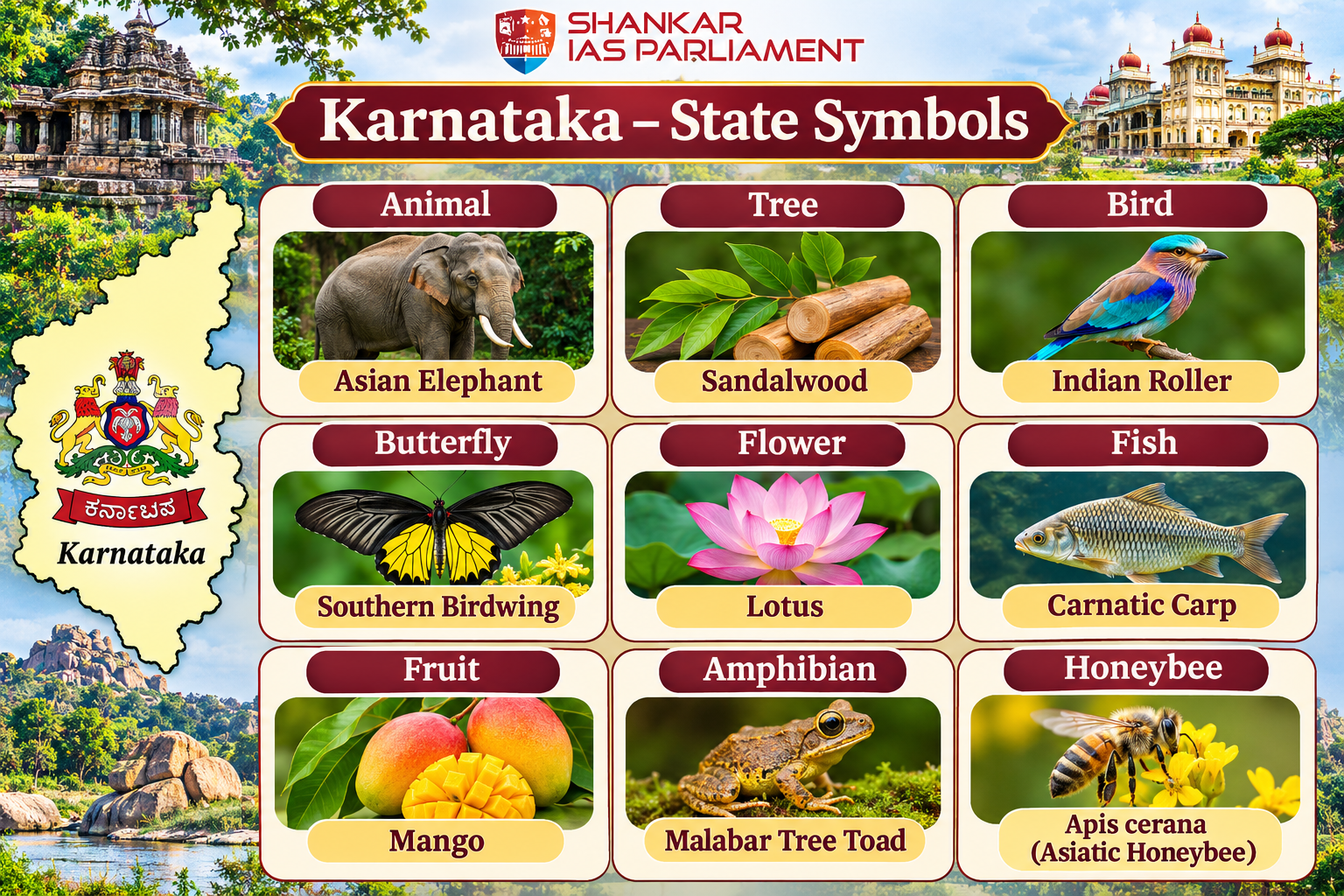
Malabar Tree Toad – Karnataka's State Amphibian
- Karnataka became the 1st Indian state to designate an official State Amphibian, declaring the Malabar Tree Toad (Malenadina Mara Gantikappe).
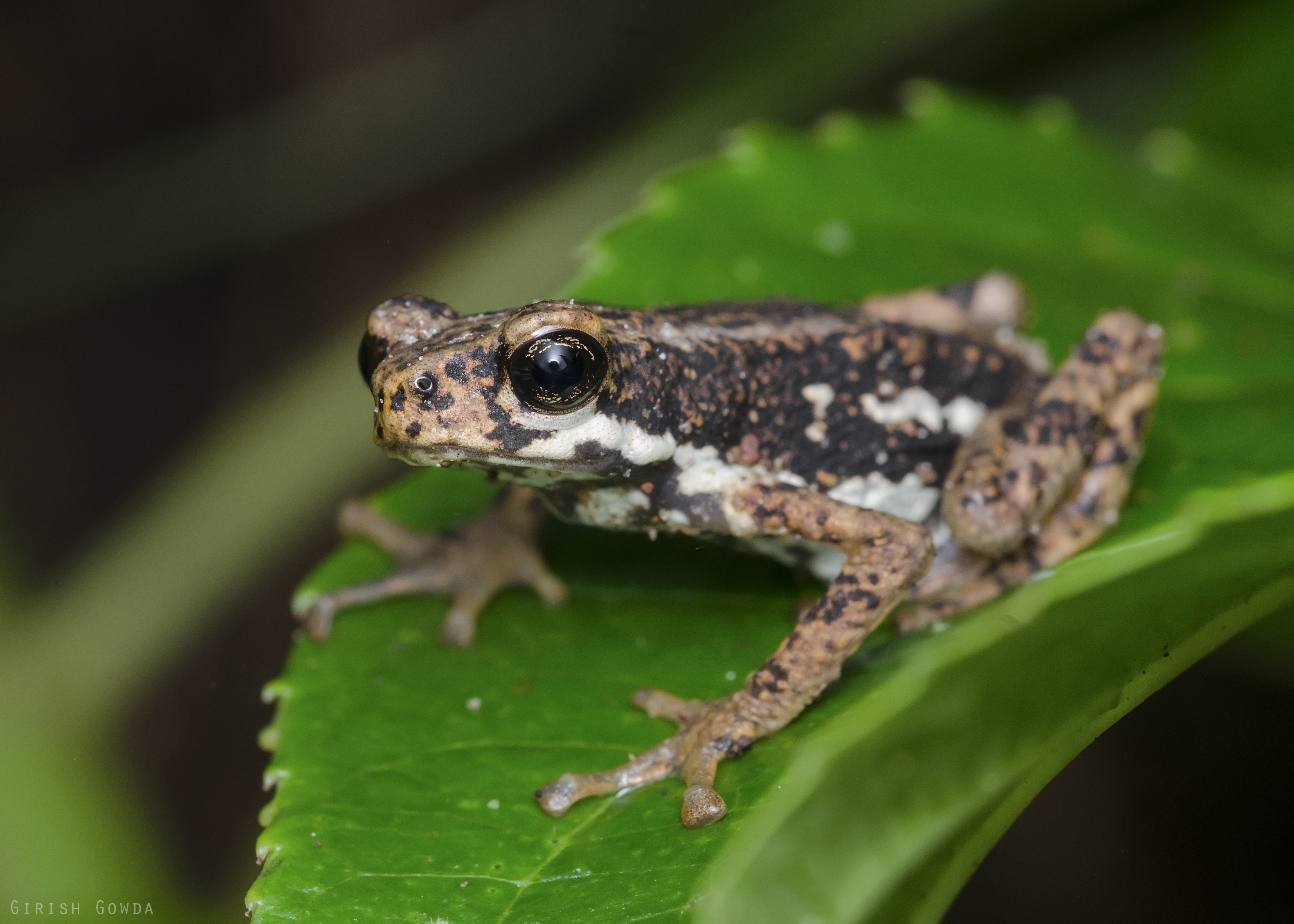
- Endemic to – Western Ghats.
- Discovery – First discovered in 1876; rediscovered at Ponmudi (Kerala) in 1980 and recorded in Karnataka in 2005.
- Conservation Status
- Classified as Endangered.
- Wildlife Protection Act, 1972 – Reportedly the only amphibian listed under Schedule II
- Breeding Season – March–June (pre-monsoon period), unlike most amphibians.
- Significance – It is considered an indicator species of evergreen forest health.
- Unique among toads for its tree-climbing ability.
Karnataka also selected Apis cerana (Asiatic honeybee) as its State Honeybee in May 2026.
|
|
Kazakhstan's Tiger Reintroduction Programme – Amur Tiger
Kazakhstan released its 2nd Amur tiger, a male named Amur, into the wild at the Ile-Balkhash State Nature Reserve.
- First Release – Female tiger Umit was released on 31 July 2026 and is adapting successfully to the wild.
- Objective – To restore the tiger population in its historical habitat in Central Asia, where native tigers disappeared over 70 years ago.
- Historical Distribution – The region was historically inhabited by the Caspian (Turanian) Tiger, which became extinct in the mid-20th century.
- Location – Ile-Balkhash State Nature Reserve, south-eastern Kazakhstan, established in 2018.
- Conservation Measures
- Restoration of natural habitats and prey populations.
- Relocation of Bukhara deer and kulans to the reserve.
- 30 kulans relocated from Altyn-Emel National Nature Park in September 2026.
- Satellite collars used to monitor tiger movements and adaptation.
- International Cooperation – Kazakhstan, Russia, Amur Tiger Centre, WWF and other conservation partners.
- Future Plan – Two tiger cubs remain under specialist supervision and may be released after reaching the appropriate age and completing assessments.
|
|
Disporum kamakhasiense – New Flowering Plant Species
Botanists discovered a new flowering plant species, Disporum kamakhasiense, in the forests of Assam and Meghalaya.

- Family – Colchicaceae.
- Nature – Perennial herb, growing up to 180 cm in height.
- Distribution – Recorded at three locations:
- Garbhanga Reserve Forest – Assam.
- Laisong – Dima Hasao district, Assam.
- Barapani – Meghalaya.
- Habitat – Grows on cliffs, mainly beneath bamboo forests, at elevations of 200–1,100 metres.
- Identification Features – Extensively branched stems, broad yellowish-green leaves with prominent veins and white, star-shaped flowers.
- Distinctive Features – Taller than its close relative Disporum calcaratum (approximately 100 cm) and differs in leaf and floral structures.
- Name Significance – Derived from Kamrupa (ancient name associated with Assam) and the Khasi Hills of Meghalaya.
- Conservation Concerns – Described as potentially endangered due to restricted distribution, small populations, road expansion, over-exploitation and deforestation.
|
|
High-Altitude Wildlife Records in Sikkim
A camera-trap study in eastern Sikkim recorded new high-altitude wildlife sightings.
- Study from – Wildlife Institute of India (WII).
- Survey Period – February 2023 to May 2026.
- Coverage – 64 camera-trap stations, 20,411 trap nights across three protected areas and adjoining forests.
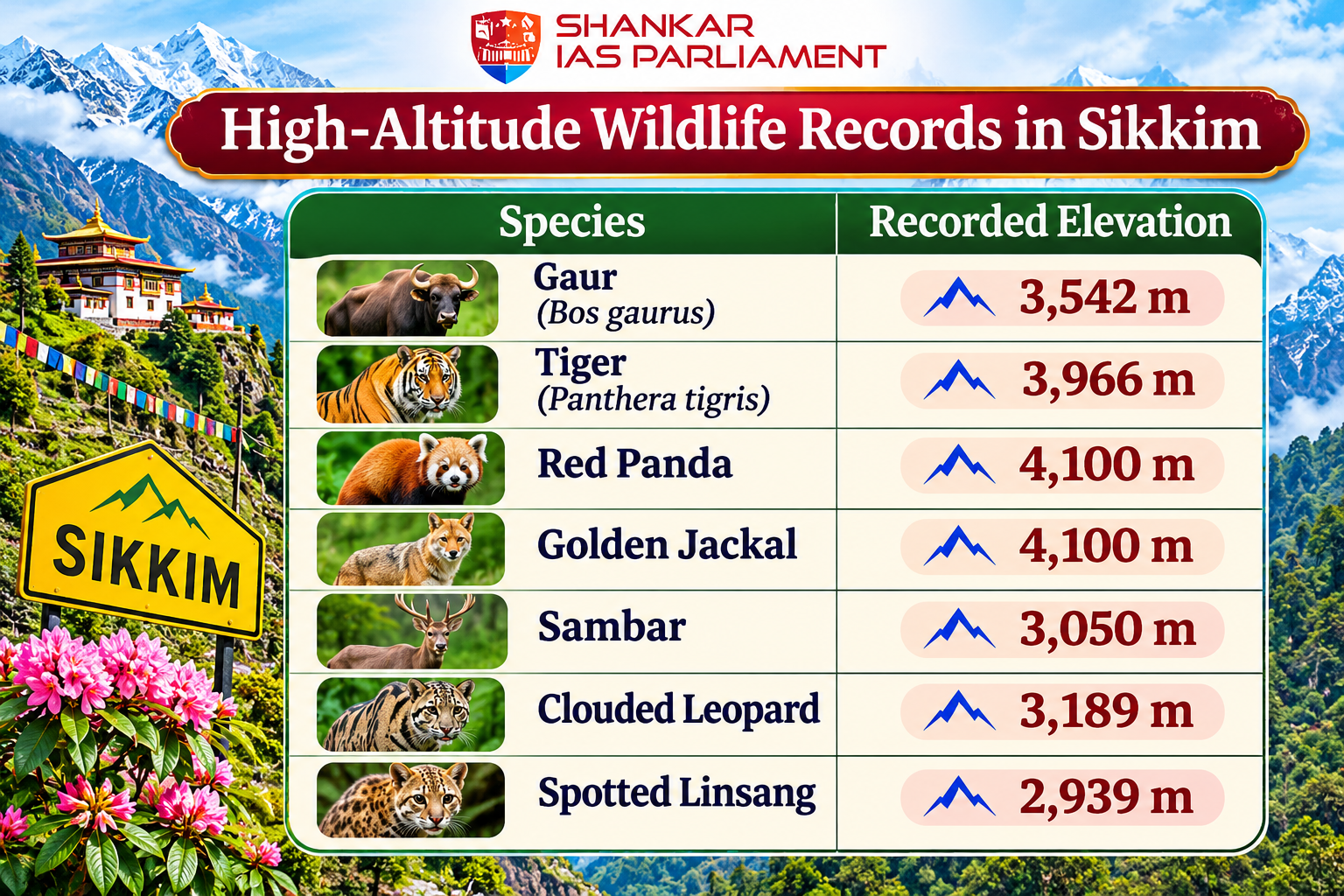
- Key Findings
- Recorded 30 mammal species.
- Identified 5 new elevational range records and 6 first confirmed photographic records for eastern Sikkim.
- Survey covered elevations of 1,800–4,200 m.
- Protected Areas – High-altitude sightings recorded in
- Kyongnosla Alpine Sanctuary,
- Pangolakha Wildlife Sanctuary, and
- Fambonglho Wildlife Sanctuary.
|
|
Tiger Relocation – Buxa Tiger Reserve, West Bengal
West Bengal's first relocated tigress, Dooars Rani (T-138), was captured in Assam's Raimona National Park and returned to Buxa Tiger Reserve on 3 November 2026.
- Tigress Details – Three-year-old tigress translocated from Valmiki Tiger Reserve, Bihar, and released in Buxa on 2 October 2026.
- Movement – Crossed the Sankosh River and entered Assam's Raimona National Park on 25 October 2026 in search of suitable habitat.
- Objective – To restore the tiger population in Buxa through tiger relocation and habitat recovery.
Buxa Tiger Reserve
- Located in – Alipurduar district, West Bengal.
- Declared a Tiger Reserve in 1983.
- Part of – Eastern Himalayan biodiversity landscape.
- Tiger Augmentation and Recovery Project – Initiated by West Bengal in 2018, with support from the National Tiger Conservation Authority (NTCA) and Wildlife Institute of India (WII).
- Monitoring Mechanisms – Telemetry, camera trapping and field-based monitoring to assess tiger movement, adaptation, health and behaviour.
- Future Plan – Three more tigers are proposed to be released in Buxa over the following two months.
|
|
Central Asian White Stork – Okhla Bird Sanctuary
A rare white stork was spotted at Okhla Bird Sanctuary, Uttar Pradesh, in November 2026.
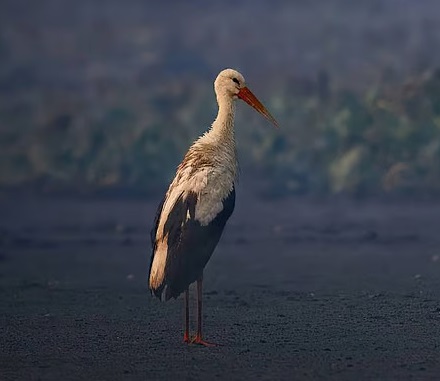
- Scientific Name – Ciconia ciconia asiatica.
- Family – Ciconiidae.
- Habitat – Wetlands, marshes, grasslands and shallow water bodies.
- Migration – Long-distance migratory bird, Migrates south during winter; wintering range extends from Iran to the Indian subcontinent.
- Distribution (Breeding Grounds) – Primarily Uzbekistan and southern Kazakhstan.
- Population – Estimated global population of fewer than 2,000 individuals.
- Previous Sightings in India – Okhla (1992 and 2005), Palwal (2004–05) and Jewar (2019).
- Significance – It highlights the importance of urban wetlands as habitats and stopover sites for migratory birds.
|
|
Security
|
|
MALABAR 2026 – Multilateral Naval Exercise
- Hosted by – Japan, from November 5 to November 12, 2026, in the waters south of Japan's Kanto region, centered around the Yokosuka Naval Base.
- Participating Countries – India, Japan, USA and Australia (Quad countries).
- Participating Indian Ship – INS Sahyadri, an indigenous guided-missile stealth frigate of the Indian Navy's Eastern Fleet.
- Phases
- Harbour Phase – Professional interactions and coordinated planning.
- Sea Phase – Joint naval operations to enhance interoperability and operational coordination.
- Objective – To strengthen maritime cooperation, mutual trust, interoperability and professional expertise among participating navies.
- Significance – To promotes a free, open, secure and stable Indo-Pacific region.
- Strategic Linkage – Supports India's MAHASAGAR Vision – Mutual and Holistic Advancement for Security and Growth Across Regions.
|



