0.1133
7667766266
x

UPI: Transforming India's Payment Landscape

iasparliament Logo
August 25, 2026

Mains: GS III – Economy

Why in News?

Recently, UPI is accepted in 11 countries, with Greece and the Maldives being the latest to adopt India's real-time payment platform.

What is Unified Payments Interface (UPI)?

  • UPI – It is an instant payment system developed by the National Payments Corporation of India (NPCI), an RBI regulated entity.

  • It is built over the IMPS infrastructure and allows you to instantly transfer money between any two parties bank accounts.

  • Aim – To promote caseless economy and encourage digital payments by ensuring they are easy to use, affordable, and widely accepted for daily transactions.

  • Key Features

  • Real-time payment system that powers multiple bank accounts through a single mobile application of any participating bank or payment service provider.

  • Integrates multiple banking services, fund transfers and merchant payments on a single platform.

  • Enables round-the-clock digital payments.

  • Uses two-factor authentication and end-to-end encryption to enhance transaction security.

Immediate Payment Service (IMPS)

  • It is an instant electronic fund transfer system in India managed by the National Payments Corporation of India (NPCI).

  • Key Features

  • Real-Time Transfers – Funds are transferred between bank accounts within seconds.

  • 24/7 Availability – The service operates continuously, including weekends, nights, and public holidays.

  • Multiple Channels – IMPS is accessible through mobile banking applications, internet banking, ATMs, SMS, and bank branches.

  • Transfer Methods – Funds may be transferred using the recipient's mobile number and Mobile Money Identifier (MMID), or their account number and Indian Financial System Code (IFSC).

  • Transaction Limit – The standard per-transaction limit is up to Rs.5 lakh, subject to the specific channel and individual bank policies.

How UPI evolved over the time?

Evolution of UPI

2016


  • Pilot & Rollout – Launched in April 2016 with 21 banks; public rollout in August 2016 via UPI‑enabled apps on Play Store.

  • BHIM App – Introduced in December 2016, enabling direct bank‑to‑bank mobile transactions and driving mass adoption.

2017


  • Dynamic QR Launch – Enabled merchant payments with auto‑filled transaction details (payee info, exact amount), eliminating manual entry and simplifying UPI transactions.

2018


  • Enhanced Features – Introduced simpler, secure, seamless payments with tools like Invoice in Inbox, Signed Intent & QR, Mandates.

  • Expanded Access – Enabled recurring payments via mandates and overdraft account linking, strengthening UPI’s utility and adoption.

2019


  • IPO Integration – SEBI permitted use of UPI for retail investors in IPO applications.

  • Adoption Surge – UPI crossed 1 billion monthly transactions (Oct 2019), marking rapid nationwide acceptance.

2020-2022


  • Recurring Payments – Launch of UPI AutoPay for e‑mandates (subscriptions, bills, SIPs, EMIs).

  • Financial Inclusion – UPI 123PAY brought feature phone users into digital payments (IVR, missed calls, proximity sound).

  • Simplified Transactions – UPI Lite enabled fast, PIN‑less low‑value payments; credit card integration expanded options.

  • Scale & Global Reach – Processed US$1 trillion+ in FY 2021‑22, crossed 5B monthly transactions (Mar 2022), and launched cross‑border in Bhutan.

2023


  • Credit Line – Introduced linking of pre‑sanctioned bank credit lines as funding accounts.

  • Market Share – UPI handled ~70% of India’s digital payment transactions (FY 2023–24).

2024


  • UPI Circle – Allowed primary users to authorise secondary users with predefined transaction limits.

  • Higher Limits – RBI raised tax payment limit to Rs.5 lakh, extended to IPOs, capital markets, loans, insurance, healthcare, education.

  • UPI 123PAY – Per‑transaction limit increased to Rs.10,000, expanding feature‑phone use cases.

  • UPI Lite: Wallet limit raised to Rs.5,000 with Rs.1,000 per transaction, boosting small‑value digital payments.

2025


  • On‑Device Authentication – Enabled payments via smartphone fingerprint/face unlock.

  • Aadhaar Face Authentication – Simplified PIN onboarding for first‑time users, senior citizens, and those without card access.

Now

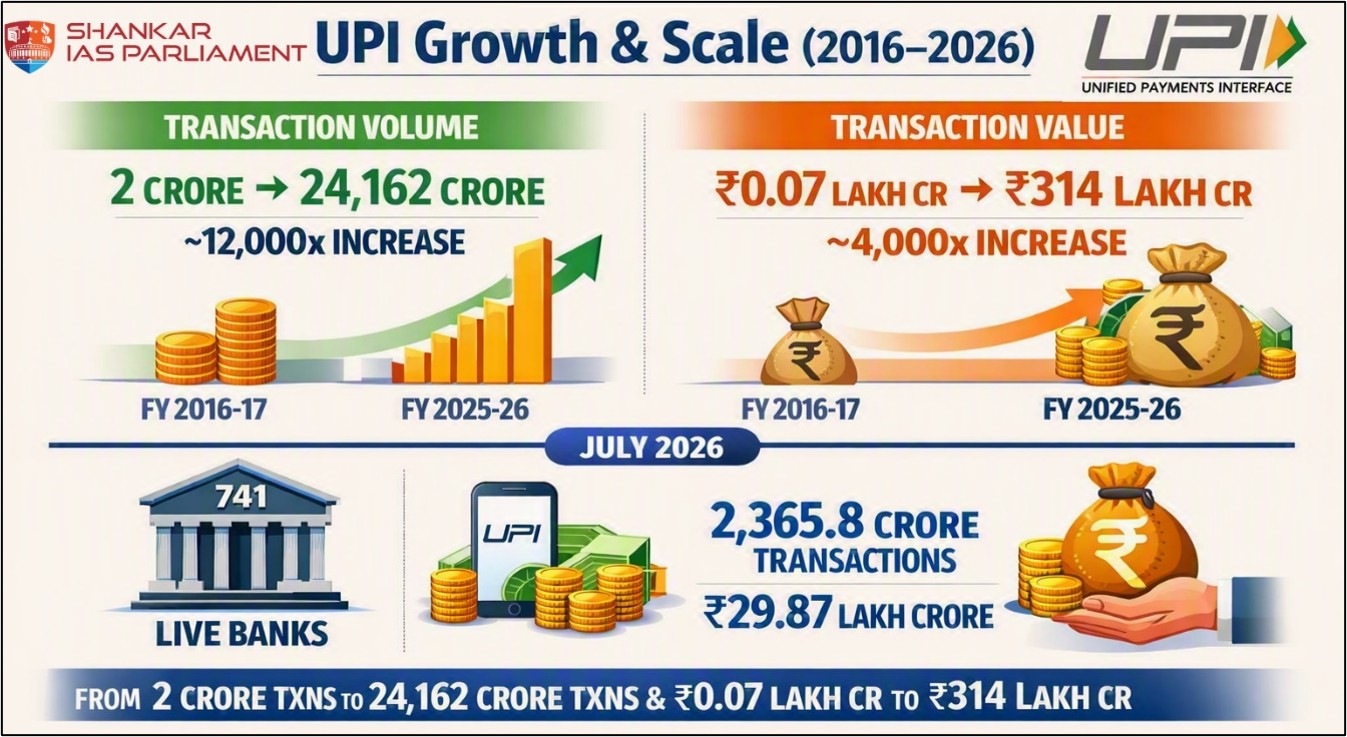
  • UPI has witnessed unprecedented growth in both transaction volume and value, reflecting its widespread adoption by individuals, businesses and financial institutions.

UPI transition UPSC

What is UPI's global footprint?

  • Global Leadership – UPI ranks among the world’s top real‑time payment systems.

  • Global Share – Accounted for ~49% of global real‑time transactions (2024).

  • IMF Recognition – Featured in IMF’s June 2025 report on interoperable digital payments.

  • International Reach – Live in Bhutan, Nepal, Singapore, UAE, France, Sri Lanka, Mauritius, Qatar.

  • 2026 Milestones

    • Cambodia – UPI acceptance via ACLEDA Bank.

    • Greece – Cross‑border remittances through Eurobank.

    • Maldives – Integration with Favara system for instant transfers.

  • Current Status – Operational in 11 countries, showcasing India’s expanding global fintech footprint.

What are the key benefits of UPI's global expansion?

  • Cheaper and Faster Remittances – Remittances refer to funds transferred by migrant workers to their home countries. 

  • UPI significantly reduces the high fees and lengthy processing times associated with traditional banking systems such as SWIFT.

  • Convenience for Travelers – Indian travellers are able to utilize familiar applications such as PhonePe or Google Pay to scan QR codes.

  • Boost to Cross-Border Trade – Both small enterprises and large merchants can send and receive payments rapidly across international borders.

  • This streamlines international trade and reduces associated costs.

  • Global Financial Leadership – The international adoption of India’s digital payment technology demonstrates the nation’s capacity for technological innovation.

  • This fosters robust economic relationships and enhances India’s global influence.

  • A Model for Other Nations – Other countries are examining India’s success as a framework for developing their own secure, efficient, and accessible public digital payment systems.

What lies ahead?

  • UPI has transformed the way India transacts by making digital payments simple, secure and interoperable.

  • Its rapid adoption, continuous innovation and expanding global presence have made UPI a key component of India's Digital Public Infrastructure.

Reference

PIB | Unified Payments Interface (UPI)

Login or Register to Post Comments
There are no reviews yet. Be the first one to review.

ARCHIVES

sidetext