Why in news?
The RBI has announced a proposal to popularise UPI payments on feature phones which would be the third iteration of the feature phone payments push in the country.
What is UPI?
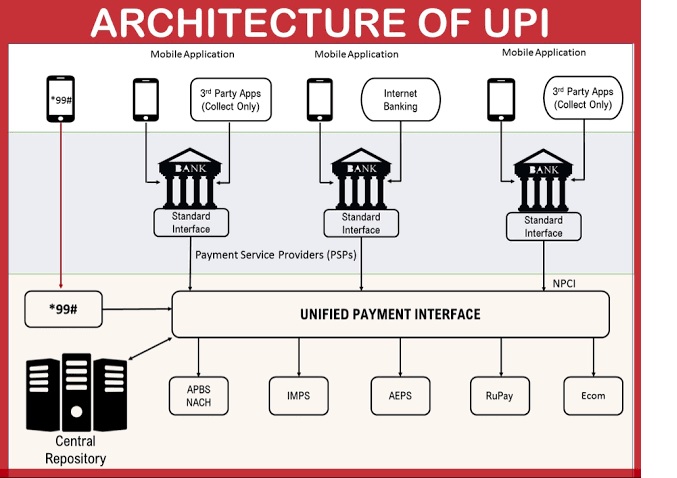
- A Unified Payment Interface (UPI) is a smartphone application thaw was launched in 2016 t0 allows users to transfer money between bank accounts.
- It is a single-window mobile payment system that caters to the “Peer to Peer” collect request which can be scheduled and paid as per requirement and convenience.
- It eliminates the need to enter bank details or other sensitive information each time a customer initiates a transaction making it a safe way to bank.
- The interface is developed by the National Payments Corporation of India (NPCI) and regulated by the Reserve Bank of India (RBI).
- Unique features of UPI
- Immediate money transfer through mobile device round the clock 24*7 and 365 days
- Single mobile application for accessing different bank accounts
- Single Click 2 Factor Authentication
- Virtual address of the customer for Pull (Receive money) & Push (Send money)
- Utility Bill Payments, Over the Counter Payments, QR Code (Scan and Pay) based payments
- Raising Complaint from Mobile App directly
What is UPI 2.0?
- UPI 2.0 was launched in 2018 to shape UPI into an end-to-end digital transacting platform.
- Key features of UPI 2.0
- Linking of overdraft account- In addition to current and savings accounts, customers can link their overdraft account to UPI.
- One-time mandate- UPI mandate could be used in a scenario where money is to be transferred later by providing commitment at present.
- Invoice in the inbox- This feature will help customers to view and verify the credentials and check whether it has come from the right merchant or not.
- Signed intent and QR- This feature is designed for customers to check the authenticity of merchants while scanning QR or quick response code.
What are the benefits of UPI?
- For Banks
- Single click two factor authentication
- Universal application for transaction
- Leveraging existing infrastructure
- Safer, secured and innovative
- Payment basis single/ unique identifier
- Enable seamless merchant transactions
- For customers
- Round the clock availability
- Single application for accessing different bank accounts
- Use of Virtual ID is more secure, no credential sharing
- Single click authentication
- Raise complaint from mobile app directly
- For Merchants
- Seamless fund collection from customers - single identifiers
- No risk of storing customer’s virtual address like in cards
- Tap customers not having credit/debit cards
- Suitable for e-com & m-com transaction
- Resolves the COD collection problem
- Single click 2FA facility to the customer - seamless pull
- In-App Payments (IAP)
What is the need for RBI to popularise UPI payments on feature phones?
- The monthly transactions value by UPI increased from Rs 1.8 lakh crore in November 2019 to Rs 7.6-lakh crore by November 2021.
- While credit and debit card payments flat-lined at Rs 13-lakh crore between FY19 and FY21, the use of UPI payments have jumped from Rs 8.7-lakh crore to Rs 41-lakh crore.
- But usage of cash is still high and UPI commands less than a 10 % share of digital retail payments with considerable scope for growth.
- To expand penetration, RBI plans to deploy innovative solutions allowing feature phone users to onboard UPI.
- Since, about 37 % of India’s mobile phone users are still using basic phones and internet connectivity in the hinterland, this is a good idea.
What is the past experience of feature phone payments push?
- USSD- In 2012, the NPCI had launched a USSD (Unstructured Supplementary Services Data)-based mobile banking service called *99#
- Initially, the facility was only available to MTNL and BSNL users but later expanded to all telecom service providers and linked to Pradhan Mantri Jan Dhan Yojana in 2014.
- USSD 2.0- The USSD 2.0 was launched alongside BHIM in 2016, incorporating all the UPI options, but it hasn’t quite taken off.
- This is because of the low penetration of UPI-linked bank accounts then and the need to remember the beneficiary’s bank details.
- Addressing the flaws- RBI needs to address UPI’s high transaction failure rates which make users hesitant to rely on it for high-value payments.
- Such failures can be attributed to the large volume of transactions below Rs 200 which clogs the banks’ system capacities.
- Such transactions can be routed through an on-device wallet in the UPI app, which works like a prepaid instrument, to avoid multiple debits and credits to the underlying account.
- Holding participant banks more accountable for slow reversal of failed transactions is needed.
- RBI guidelines set a 1 day limit for a beneficiary bank to reverse a failed account-to-account UPI transaction and a 5 day limit for merchant payments, with a penalty of Rs 100 per day for failure to comply, but these rules are often breached.
- The RBI’s plan to issue a discussion paper specifying transaction charges across digital modes must be in such a way that it does not disturb the zero Merchant Discount Rate policy which today renders UPI free of cost to users.
- RBI can use this opppurtunity to redouble efforts to wean the economy away from cash to digital modes.
The merchant discount rate is the rate charged to a merchant for accepting payment from their customers through digital means.
References
- https://www.thehindubusinessline.com/opinion/editorial/upi-booster/article37939817.ece
- https://www.npci.org.in/what-we-do/upi/product-overview
- https://www.livemint.com/Money/Cog3dAvOZka0OsNg8M9S8O/UPI-20-launched-Here-are-its-key-features.html



