Prelims: Current events of national and international importance | Science & Technology
Why in News?
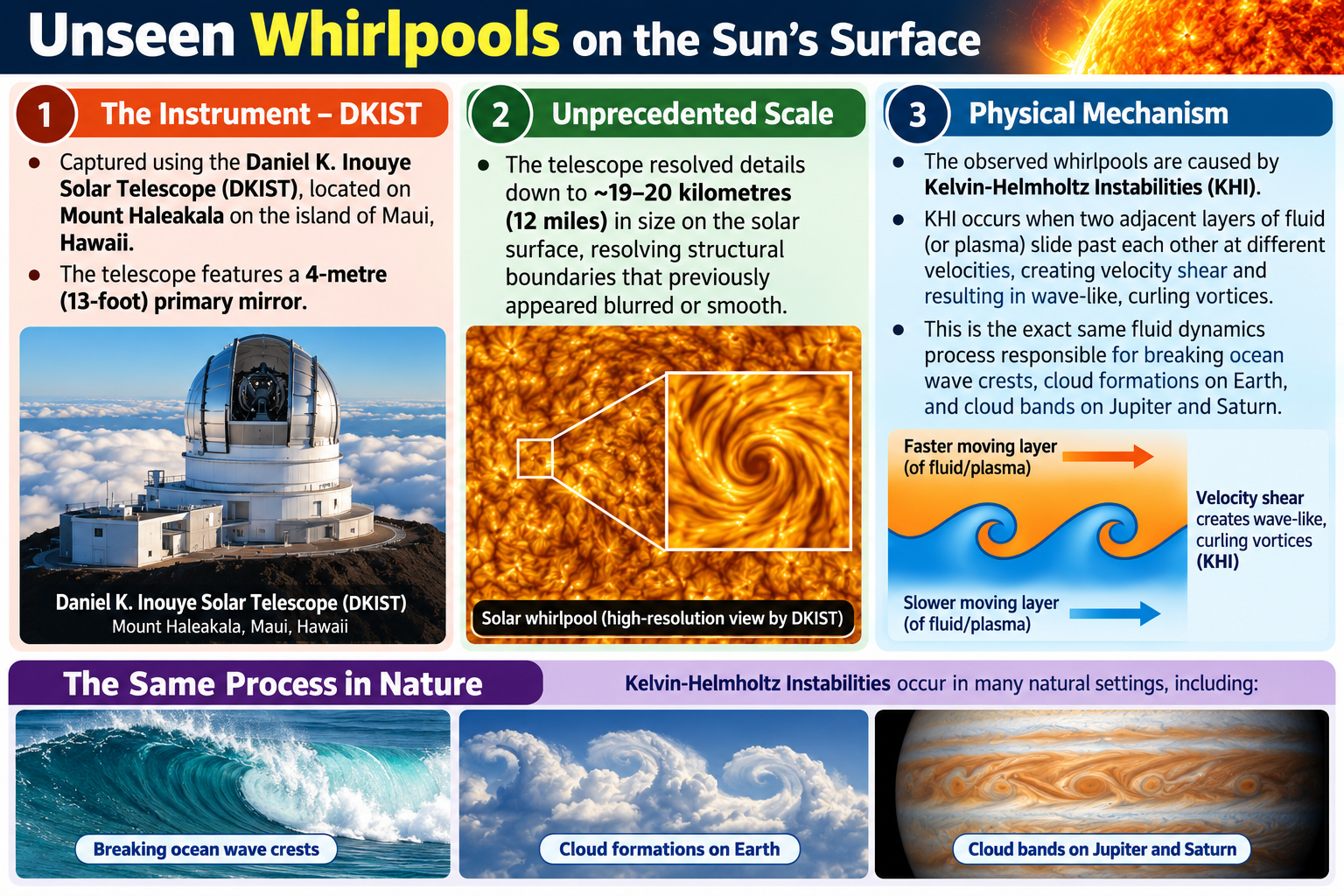
Using the world's largest solar telescope, astronomers has captured the highest-resolution images ever taken of the Sun's visible surface (photosphere).
- Instrument - Captured using the Daniel K. Inouye Solar Telescope (DKIST), located on Mount Haleakala on the island of Maui, Hawaii.
- The telescope features a 4-meter (13-foot) primary mirror.
- Unprecedented Scale - The telescope resolved details down to ~19–20 kilometers (12 miles) in size on the solar surface, resolving structural boundaries that previously appeared blurred or smooth.
- Physical Mechanism
- The observed whirlpools are caused by Kelvin-Helmholtz Instabilities (KHI).
- KHI occurs when two adjacent layers of fluid (or plasma) slide past each other at different velocities, creating velocity shear and resulting in wave-like, curling vortices.
- This is the exact same fluid dynamics process responsible for breaking ocean wave crests, cloud formations on Earth, and cloud bands on Jupiter and Saturn.
Scientific Significance
- While solar physicists had long hypothesized the existence of KHIs on the Sun's surface, this study provides the first direct observational confirmation of their presence in the photosphere.
- Magnetic Field Braiding - As these vortices swirl, they twist and "braid" the Sun's magnetic field lines.
- This continuous twisting stores magnetic energy that can be suddenly released through solar flares, coronal mass ejections (CMEs), and nanoflares.
- Clue to the Coronal Heating Problem
- The Puzzle - The Sun's outer atmosphere (corona) is millions of degrees hotter than its visible surface (photosphere), defying standard thermodynamics expectations.
- The Link - The mixing and twisting caused by these tiny plasma whirlpools provide a mechanism for transferring and dissipating energy from the solar interior into the higher layers of the solar atmosphere.
Reference
The Hindu | Unseen whirlpools



