Mains – GSIII – Environment
Why in News?
Recently the United Nations’ climate convention’s Loss and Damage Fund has approved a $21.6 million pay out (approx. ₹205 crore) to the Nepal.
UN Loss and Damage Fund’s Payout to Nepal
Mains – GSIII – Environment
Why in News?
Recently the United Nations’ climate convention’s Loss and Damage Fund has approved a $21.6 million pay out (approx. ₹205 crore) to the Nepal.
What is the UN Loss and Damage Fund (FRLD)?
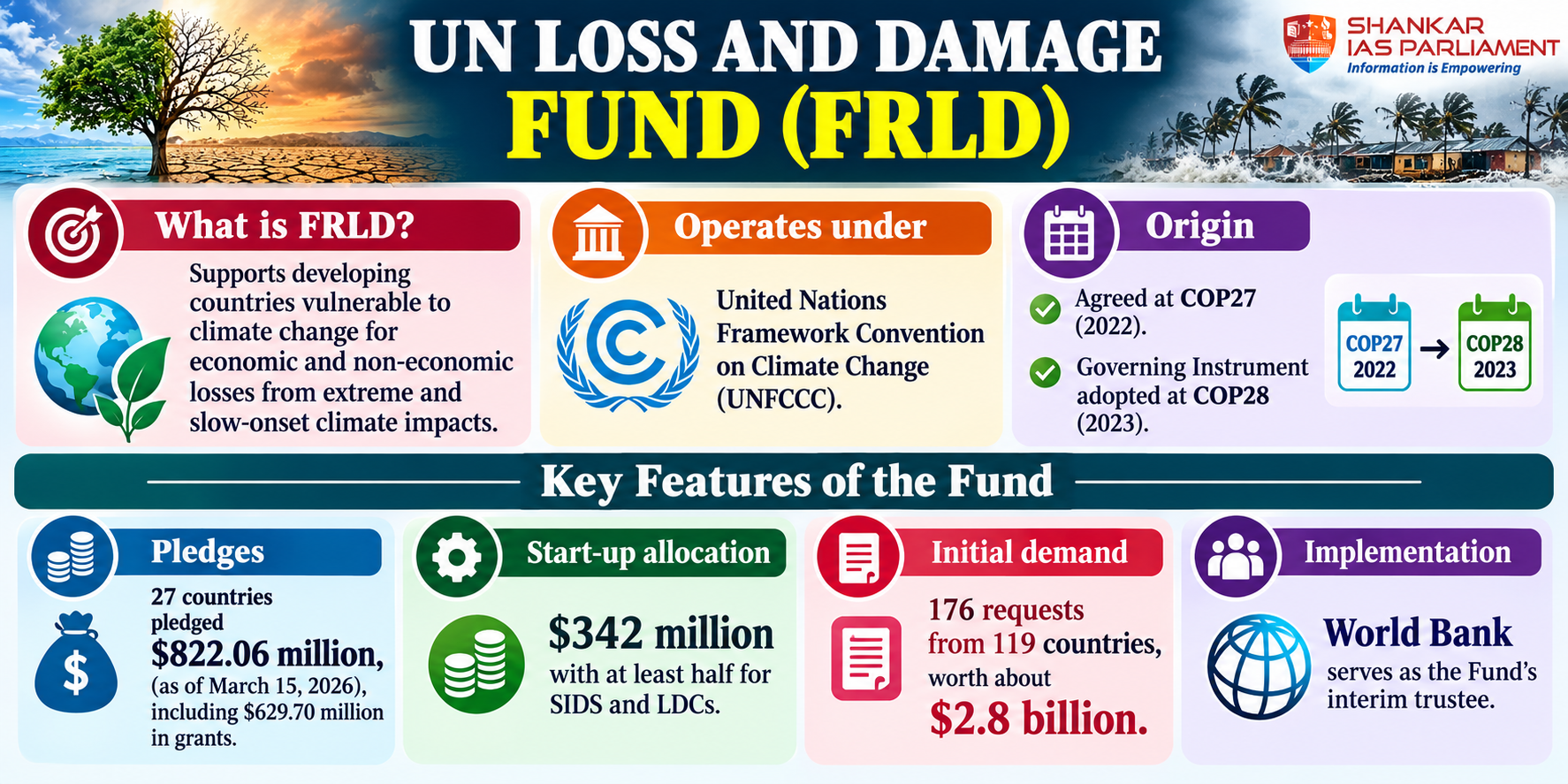
- FRLD – It supports developing countries vulnerable to climate change in addressing economic and non-economic losses caused by extreme weather events and slow-onset climate impacts.
- Operates under – United Nations Framework Convention on Climate Change (UNFCCC).
- It was agreed upon at COP27 (2022), and its Governing Instrument was adopted at COP28 (2023).
- Key Features of the Fund –
- Pledges – As of March 15, 2026, 27 countries had pledged $822.06 million, including $629.70 million in grants.
- Start-up allocation – $342 million, with at least half reserved for Small Island Developing States (SIDS) and Least Developed Countries (LDCs).
- Initial demand – The first funding call received 176 requests from 119 countries, worth approximately $2.8 billion.
- Implementation – The World Bank serves as the Fund’s interim trustee.
What are the Major Climate-Related Losses Faced by Nepal?
- On August 26, 2026, an ice-and-rock avalanche triggered flooding along the Bhotekoshi–Trishuli–Narayani river system.
- The disaster was linked by experts to climate change and human-driven global warming.
- Nepal estimated economic losses of at least $2.69 billion and recovery requirements of at least $4.71 billion.
What is the Significance of the Payout to Nepal?
- Climate justice – Recognises the disproportionate burden of climate change on vulnerable developing countries that have contributed relatively little to historical emissions.
- Disaster recovery – Supports rebuilding infrastructure, restoring livelihoods and addressing climate-related losses.
- Institutional precedent – Demonstrates the Fund’s ability to respond to a specific country’s urgent needs outside its regular funding window.
- International cooperation – Shows the potential for consensus-based climate finance mechanisms to support disaster-affected countries.
- Climate diplomacy – Strengthens discussions on climate finance ahead of COP31 in Turkey.
What are the Major Concerns Regarding the Fund?
- Inadequate funding – The $21.6 million allocation is less than 0.5% of Nepal’s estimated reconstruction costs of around $5 billion.
- Funding delays – Nepal must submit a formal request for Board consideration before the money can be released.
- Unfulfilled pledges – The Fund’s effectiveness depends on donors converting financial pledges into actual contributions.
- Slow procedures – Experts argue that the lengthy funding process is unsuitable for emergency situations requiring immediate assistance.
- Uncertain future model – The Board has not established this exceptional procedure as a permanent mechanism for rapid responses.
What Measures are Needed to Improve the Fund?
- Rapid-response mechanism – Establish permanent procedures for releasing emergency assistance within days rather than months.
- Adequate climate finance – Encourage developed countries to provide predictable, additional and grant-based contributions.
- Simplified procedures – Reduce bureaucratic hurdles while maintaining transparency and accountability.
- Needs-based allocation – Prioritise the most vulnerable countries and communities.
- Transparent disbursement – Publish information on actual contributions, available funds, approvals and payments.
What lies ahead?
- The Nepal allocation is a landmark step towards operationalising climate justice, but its impact will depend on timely disbursement and adequate funding.
- The international community must transform the Loss& Damage Fund from a slow-moving financial mechanism into responsive system that delivers support when climate disasters strike.
Quick facts
|
Major International Climate Funds
|
- Green Climate Fund (GCF) – Established in 2010, it supports developing countries in climate change mitigation and adaptation.
- It is an operating entity of the UNFCCC financial mechanism.
- Global Environment Facility (GEF) – Established in 1991, it provides grants for climate action, biodiversity conservation and other global environmental issues.
- It is an operating entity of the UNFCCC financial mechanism and manages the LDCF and SCCF.
- Adaptation Fund (AF) – Established in 2001 under the Kyoto Protocol framework, it finances concrete climate adaptation projects in vulnerable developing countries.
- Its focus includes climate-resilient agriculture, water management and disaster resilience.
- Least Developed Countries Fund (LDCF) – Established in 2001 under the UNFCCC, it supports climate adaptation in Least Developed Countries (LDCs).
- It is managed by the GEF and supports projects addressing the specific vulnerabilities of LDCs.
- Just Energy Transition Partnerships (JETPs) – These partnerships mobilise international finance to help selected emerging economies transition towards low-carbon energy systems.
- They aim to reduce dependence on coal while supporting a just transition for affected workers and communities.
|
Reference
The Hindu| Importance of the UN Loss and Damage Fund’s payout to Nepal?



