Why in news?
Turkey has launched a military operation against Kurdish fighters in northeast Syria, attacking the YPG militia positions.
Who is the YPG?
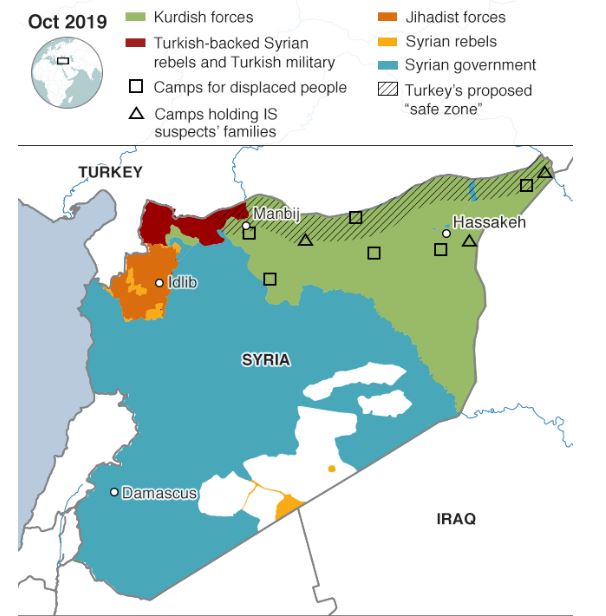
- The Syrian Kurdish region, Rojava, is now run by a semi-autonomous Kurdish government.
- The Kurdish militias, People’s Protection Units (YPG), are guarding the borders.
- The YPG was the dominant player in the U.S.-backed Syrian Democratic Forces (SDF) that destroyed the IS “caliphate”.
- Turkey sees the YPG as an extension of the banned Kurdistan Workers' Party (PKK).
- [PKK has fought for Kurdish autonomy in Turkey for three decades.]
- Given their ties to militants waging an insurgency inside it, Turkey views Kurdish YPG fighters in northeast Syria as terrorists.
- It sees an empowered YPG and a Kurdish autonomous government across the border as a growing security threat to itself.
What is the recent happening?
- The U.S. troops had been fighting in Syria with the Kurds, against the Islamic State.
- The troops recently started to leave the area in an abrupt policy shift by U.S. President Donald Trump.
- Just days after the U.S. troops pulled back, Turkey has launched a military operation against Kurdish fighters in northeast Syria.
- Air strikes and artillery hit the YPG militia positions around the border town of Ras al Ain.
- Turkish President Tayyip Erdogan announced the start of the attack.
- He said that the aim was to eliminate what he called a “terror corridor” on Turkey’s southern border.
- It has also said that there was no other ambition except to neutralise the threat against Turkish citizens and to liberate the local people.
What are the stakeholders’ stances?
- Turkey - Turkey has vowed to push back from its border, members of the Syrian Kurdish militia, the People's Protection Units (YPG).
- Turkey plans to carve out a buffer between the border and the Rojava, which will be controlled by pro-Turkish Syrian rebels.
- It intends to create the “safe zone” in order to return millions of refugees to Syrian soil.
- Syria - Syria had said it was determined to confront any Turkish aggression by all legitimate means.
- Kurds - Kurdish-led forces have denounced the U.S. policy shift as a betrayal.
- The Kurdish-led authority in northern Syria declared a state of “general mobilisation” before the looming attack.
- They have given a call to their institutions and people, to head towards the border region with Turkey.
- People have been asked to fulfil their moral duty and show resistance.
- World powers fear the action could lead to new challenges in Syria’s war and worsen regional turmoil.
- Russia, Syrian President Bashar al-Assad’s strongest foreign ally, urged dialogue between Damascus and Syria’s Kurds.
- It called for solving issues in northeast Syria including border security.
- Another Assad ally, Iran, urged Turkey to show restraint and avoid military action in northern Syria.
- Amid deepening humanitarian concerns, U.N. Secretary-General Antonio Guterres urged all parties in northeast Syria to exercise maximum restraint and protect civilians.
Why is the U.S.’s decision disputed?
- Mr. Trump’s decision to pull back troops has caused concerns among the allies.
- These include France and Britain, two of Washington's main partners in the U.S.-led coalition fighting Islamic State.
- The U.S. cannot be stuck in the Syrian conflict forever.
- However, the problem is the way in which it is abruptly disengaging itself and the potential consequences.
- The Kurds have played a critical role in defeating the Islamic State.
- So, President Trump’s decision to pull U.S. troops out of northeastern Syria is a clear betrayal of the Kurdish forces.
- Mr. Trump could have opted for an orderly exit from Syria with security guarantees from Turkey for the Kurds.
How does the future look?
- It is to be noted that only the IS caliphate was destroyed, and not the IS.
- The remaining IS fighters have retreated to the Iraqi and Syrian deserts waiting for an opportunity to strike back.
- The Turkish incursion into Syria will set back the advances the Kurds have made in Rojava.
- Besides, it could also weaken the most potent anti-jihadist force on the ground, and throw the whole region into chaos.
Source: The Hindu
Related Articles: Withdrawal of US forces from Syria



