Why in news?
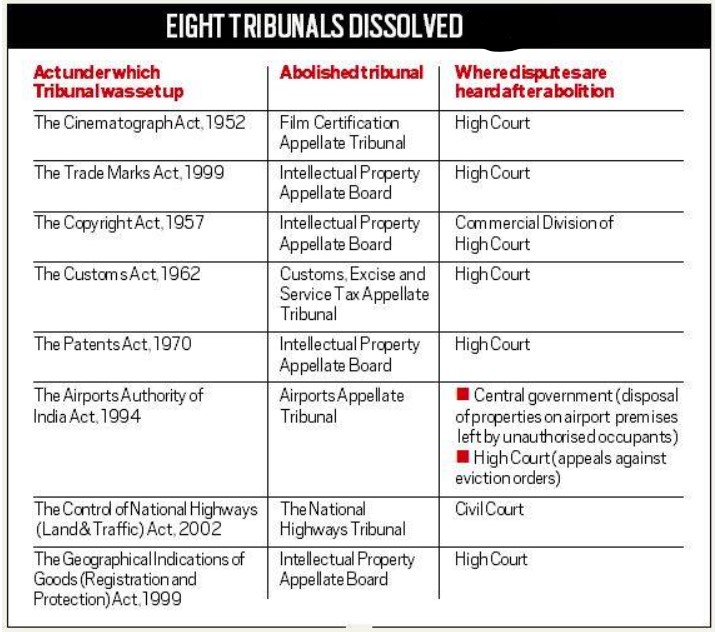
The Lok Sabha recently passed the Tribunals Reforms Bill, 2021to dissolve at least eight tribunals.
What is the Bill about?
- It dissolves 8 tribunals that functioned as appellate bodies to hear disputes under various statutes, and
- Transfer their functions to existing judicial forums such as a civil court or a High Court
- The Chairpersons and Members of the tribunal being abolished shall cease to hold office, with compensation equivalent to 3 months’ pay and allowances for their premature termination.
What are the key provisions?
- It amended Finance Act, 2017 that merged the tribunals based on domain
- Earlier, the Finance Act, 2017 had empowered the central government to notify rules on search-cum-selection committees and term of office.
- Now, these provisions have been included in the Bill itself.
- However, the qualification of members and other terms and conditions of service will still be notified by the central government.
- The Chairperson and Members of the Tribunals will be appointed by the central government on the recommendation of a Search-cum-Selection Committee that will consist of:
- CJI, or a Supreme Court Judge nominated by him, as the Chairperson (with casting vote),
- two Secretaries nominated by the central government,
- the sitting or outgoing Chairperson, or a retired Supreme Court Judge, or a retired Chief Justice of a High Court, and
- the Secretary of the Ministry under which the Tribunal is constituted (with no voting right).
- The central government must decide on the recommendations of selection committees preferably within 3 months.
- State administrative tribunals will have separate search-cum-selection committees which will consist of:
- the Chief Justice of the High Court of the concerned state, as the Chairperson (with a casting vote),
- the Chief Secretary of the state government and the Chairperson of the Public Service Commission of the concerned state,
- the sitting or outgoing Chairperson, or a retired High Court Judge, and
- the Secretary or Principal Secretary of the state’s general administrative department (with no voting right).
- Also, the central government shall, on the recommendation of the Search-cum-Selection Committee, remove from office any Chairperson or a Member, who-
- has been insolvent, or convicted of an offence involving moral turpitude; or
- has become physically/mentally incapable
- has acquired such financial or other interest, or abused the official position compromising public interest
- Age criterion and tenure of office -
- Four-year term of office for Chairperson and Members
- Upper age limit of 70 years for the Chairperson, and 67 years for members
- Minimum age requirement of 50 years for appointment of a chairperson or a member
- The Supreme Court had earlier struck down the Minimum age and the four-year tenure provisions.
- The Court had suggested that advocates with a minimum of 10 years of experience should be entitled to be appointed as members.
Why did government dissolve the tribunals?
- Delay in justice delivery in Tribunals in several sectors
- Cases might get a faster hearing and disposal if taken to High Courts
- Considerable expense to the exchequer in running Tribunals
- Ensuring greater accountability on the functioning of the tribunals
What are the concerns?
- Questions arise over the independence of the Tribunals (given the changed new composition & government’s influence in ita)
- Lack of specialization in regular courts, affecting the decision-making process. E.g., the Film Certification Appellate Tribunal required expertise in art and cinema
- Vacancies in existing Tribunals.
- Legislature-Judiciary - Tribunals Reforms (Rationalisation and Conditions of Service) Ordinance, 2021 that the bill replaces was earlier struck down by the Supreme Court.
- Legislations overriding the court’s directions, in effect, undermine the Rule of Law.
- So, the Court has now challenged the government to produce materials justifying the reasons for introducing the new Tribunal Reforms Bill.
Sources: PRSIndia, The Indian Express, The Hindu



