Mains: GS III – Environment
Why in News?
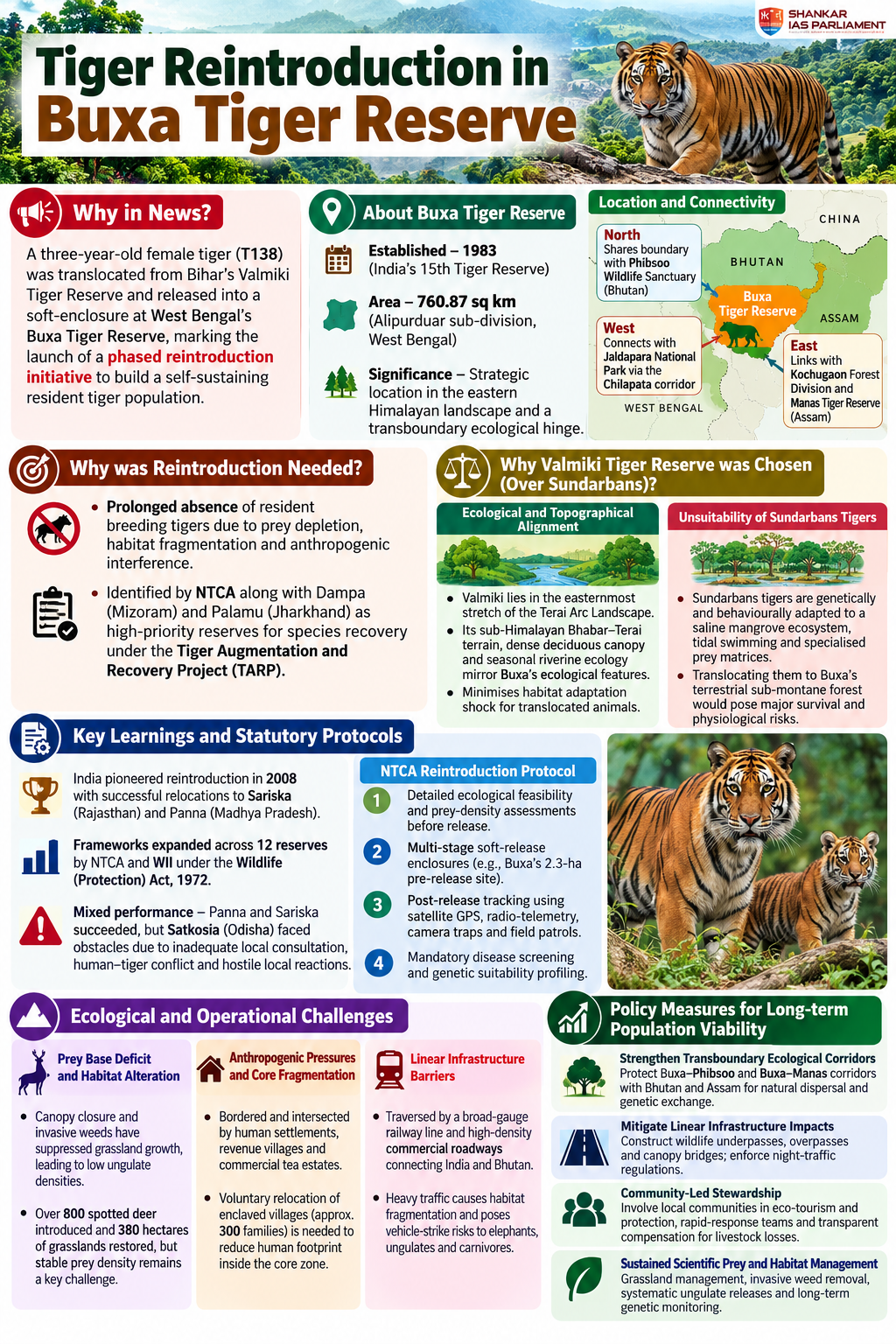
A 3 year-old female tiger (T138) was translocated from Bihar’s Valmiki Tiger Reserve to Buxa Tiger Reserve marking the official launch of a phased reintroduction initiative aimed at building a self-sustaining resident tiger population.
What is the significance of the Buxa Tiger Reserve?
- Strategic Geographic Location – Established in 1983 as India's 15th Tiger Reserve, Buxa spans 760.87 sq km in the Alipurduar sub-division of northern West Bengal.
- Transboundary ecological hinge –
- North – Shares an international boundary with Phibsoo Wildlife Sanctuary in Bhutan.
- East – Links with Kochugaon Forest Division and Manas Tiger Reserve in Assam.
- West – Connects with Jaldapara National Park via the Chilapata forest corridor.
- Correction of Local Extirpation – Buxa experienced a prolonged absence of resident breeding tigers due to prey depletion, habitat fragmentation, and anthropogenic interference.
- The National Tiger Conservation Authority (NTCA) identified Buxa along with Dampa (Mizoram) and Palamu (Jharkhand) as high-priority reserves needing species recovery intervention under the Tiger Augmentation and Recovery Project (TARP).
Why was Valmiki Tiger Reserve chosen over the Sundarbans for donor stock?
- Ecological and Topographical Alignment – Valmiki Tiger Reserve lies in the easternmost stretch of the Terai Arc Landscape.
- Its sub-Himalayan Bhabar-Terai terrain, dense deciduous canopy, and seasonal riverine ecology mirror Buxa's ecological features, this minimizes habitat adaptation shock for the translocated animals.
- Unsuitability of Mangrove Adaptation – West Bengal Sundarbans supports a thriving population of around 100 tigers, its big cats are genetically and behaviourally adapted to a saline mangrove ecosystem, tidal swimming, and specialized prey matrices.
- Moving tigers from the Sundarbans to Buxa's terrestrial sub-montane forest would have posed major survival and physiological adaptation risks.
What key learnings and statutory protocols govern tiger reintroductions in India?
- Evolution of the Reintroduction Framework – India pioneered scientific big-cat reintroduction in 2008 with successful relocations to Sariska (Rajasthan) and Panna (Madhya Pradesh).
- The NTCA and the Wildlife Institute of India (WII) have since expanded reintroduction frameworks across 12 tiger reserves under statutory mandates of the Wildlife (Protection) Act, 1972.
- Mixed Historical Performance – While Panna and Sariska rebuilt breeding populations, attempts such as the Satkosia Tiger Reserve (Odisha) translocation ran into severe obstacles.
- Satkosia highlighted the risks of inadequate local consultation, severe human-tiger conflict, livestock depredation, and hostile local reactions.
- Statutory NTCA Reintroduction Protocol –
- Detailed ecological feasibility and prey-density assessments before release.
- Multi-stage soft-release enclosures (e.g., Buxa's 2.3-hectare pre-release acclimatization site).
- Continuous post-release tracking using satellite GPS radio-telemetry, camera trapping, and field patrols.
- Mandatory disease screening and genetic suitability profiling.
What ecological and operational challenges face tiger recovery in Buxa?
- Prey Base Deficit and Habitat Alteration – Decades of canopy closure and the spread of invasive weeds have suppressed natural grassland growth, leading to low ungulate densities.
- While forest authorities have introduced over 800 spotted deer (chital) and restored 380 hectares of grasslands, establishing a stable prey density remains a primary ecological bottleneck.
- Anthropogenic Pressures and Inviolate Core Fragmentation – Buxa is bordered and intersected by human settlements, revenue villages, and commercial tea estates.
- Voluntary relocation of enclaved villages (approx. 300 families relocating) is necessary to reduce human footprint inside the core zone.
- Linear Infrastructure Barriers – The reserve is traversed by a broad-gauge railway line and high-density commercial roadways connecting India and Bhutan.
- Heavy traffic along these routes causes habitat fragmentation and poses ongoing vehicle-strike risks to elephants, ungulates, and carnivores.
What policy measures are needed for long-term population viability?
- Strengthening Transboundary Ecological Corridors –Establish integrated landscape-level protection protocols with Bhutan's Royal Government and Assam's Forest Department.
- Safeguarding the Buxa–Phibsoo and Buxa–Manas corridors allows natural dispersal, prevents genetic isolation, and supports regional meta-population dynamics.
- Mitigating Linear Infrastructure Impacts – Construct eco-friendly mitigation structures, such as dedicated wildlife underpasses, overpasses, and canopy bridges, alongside night-traffic regulations on key transit routes.
- Fostering Community-Led Stewardship – Integrate local forest-dwelling and fringe communities into eco-tourism and protection roles.
- Establish rapid-response anti-depredation teams and transparent, fast-tracked compensation schemes for livestock losses to prevent retaliatory actions.
- Sustained Scientific Prey and Habitat Management – Grassland management, invasive weed removal, and systematic ungulate releases alongside long-term genetic tracking to build a balanced prey-predator ratio.
Reference
The Hindu | Buxa



