Mains: GS II – International relations
Why in News?
Recently, The Third India–Nordic Summit, held in Oslo on 19 May 2026, marked a significant step in strengthening India’s partnership with the Nordic countries.
What are the significance of India – Nordic relations?
- Nordic countries – Nordic Countries are a group of countries in northern Europe consisting of Denmark, Finland, Iceland, Norway, and Sweden.
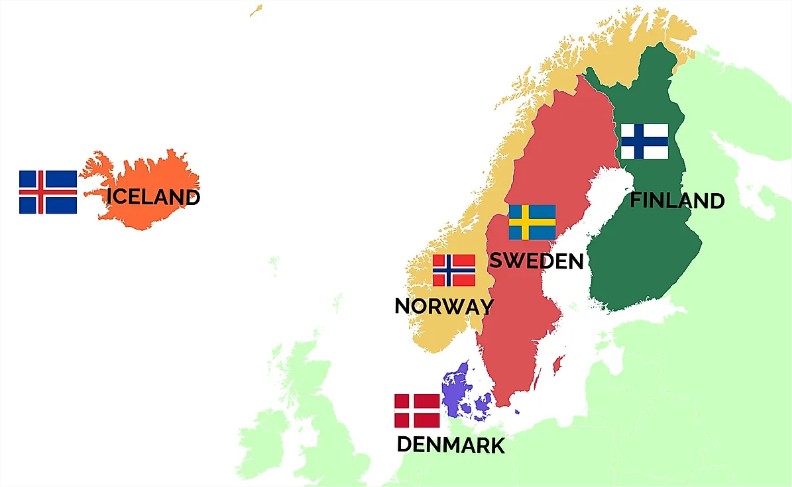
- Significance of India–Nordic Relations – India’s engagement with the Nordic countries is based on complementarity.
- Nordic countries possess advanced technological capabilities, high innovation standards, and expertise in sustainable development.
- India offers a large market, skilled human resources, manufacturing potential, and growing digital infrastructure.
- This partnership is important for India for several reasons:
- It supports India’s transition towards a green and sustainable economy.
- It strengthens India’s digital and technological capabilities.
- It promotes investments, innovation, and employment generation.
- It enhances cooperation in climate action and renewable energy.
- It contributes to resilient global supply chains and maritime security.
- The Nordic countries have also emerged as significant economic partners.
- Bilateral trade and investment have increased substantially over the past decade.
- Sweden alone recorded bilateral trade of nearly USD 7 billion in 2024, while Norway’s sovereign wealth fund has invested heavily in Indian capital markets.
- Denmark, Finland, Iceland, and Norway are also expanding investments in sectors such as renewable energy, information technology, shipping, urban development, and clean manufacturing.
- India’s Arctic Policy and Nordic Cooperation – An important dimension of India–Nordic cooperation is the Arctic region.
- India’s Arctic Policy, titled “India and the Arctic: Building a Partnership for Sustainable Development”, focuses on six pillars:
- Scientific research and cooperation
- Climate and environmental protection
- Economic and human development
- Transportation and connectivity
- Governance and international cooperation
- National capacity building
- The Arctic is strategically significant for India because climate changes in the Arctic directly influence monsoon patterns, weather systems, food security, and coastal sustainability.
- Melting Arctic ice and rising sea levels pose risks to India’s island territories and coastal regions.
- Cooperation with Nordic countries in Arctic research, climate monitoring, and environmental sustainability therefore assumes long-term importance for India’s ecological and economic security.
What are the key outcomes of the third India–Nordic summit?
- Green Technology and Innovation Strategic Partnership – The most significant outcome of the summit was the elevation of relations into a “Green Technology and Innovation Strategic Partnership.”
- The partnership aims to strengthen cooperation in renewable energy, green hydrogen, sustainable manufacturing, digital innovation, and climate mitigation technologies.
- Expansion of Trade and Investment – India and the Nordic countries acknowledged the rapid growth in bilateral trade and investment over the last decade.
- Both sides agreed to further strengthen economic cooperation through improved market access, investment promotion, and resilient supply chains.
- The India–European Free Trade Association (EFTA) Trade and Economic Partnership Agreement (TEPA) is expected to further deepen India–Nordic economic relations by reducing trade barriers, integrating value chains, and promoting sustainable economic development.
- The partnership is likely to encourage investments in sectors such as:
- Renewable energy
- Maritime infrastructure
- Advanced manufacturing
- Telecommunications
- Digital technologies
- Health-tech and biotechnology
- Cooperation in Climate Action – Climate action emerged as a major area of collaboration during the summit.
- India and Nordic countries agreed to cooperate in areas such as:
- Renewable energy
- Carbon reduction technologies
- Sustainable water management
- Circular economy practices
- Green urban infrastructure
- This cooperation is important because it simultaneously addresses environmental concerns and economic growth.
- It can support India’s sustainable development goals while creating jobs and attracting investment.
- Blue Economy and Maritime Cooperation – The summit also emphasized cooperation in the blue economy, which focuses on the sustainable use of ocean resources for economic growth and environmental protection.
- India’s collaboration with Nordic countries in maritime sectors can strengthen:
- Sustainable fisheries
- Maritime connectivity
- Ocean research
- Port infrastructure
- Marine environmental protection
- This cooperation is also strategically important for ensuring stability and security in the Indo-Pacific region.
- Norway, in particular, has emerged as a key partner in blue economy initiatives and Arctic cooperation.
- Research Collaboration in STEM and Emerging Technologies – The summit highlighted the importance of collaboration in science, technology, engineering, and mathematics (STEM).
- India and Nordic countries agreed to expand research partnerships in areas such as:
- Artificial intelligence
- 6G technologies
- Cybersecurity
- Quantum technologies
- Health-tech
- Sustainable innovation
- Academic and research collaboration can improve the quality of research output, encourage innovation, and strengthen technological competitiveness.
- Talent Mobility and Education – The Nordic countries have increasingly become destinations for Indian students, researchers, and professionals.
- Finland, Sweden, and Denmark host large Indian communities, particularly in the IT and research sectors.
- The summit emphasized expanding mobility partnerships, educational exchanges, and research opportunities. Such initiatives can:
- Enhance skill development
- Promote innovation ecosystems
- Encourage start-ups and entrepreneurship
- Strengthen people-to-people ties
- Talent mobility is likely to become a major pillar of future India–Nordic cooperation.
- Defence and Strategic Cooperation – Another significant outcome was the emphasis on defence industrial collaboration.
- India’s policy allowing 100% FDI in the defence manufacturing sector offers opportunities for Nordic investments and technology partnerships.
- Cooperation in defence production can contribute to:
- Technology transfer
- Indigenous defence manufacturing
- Research and innovation
- Employment generation
- Export growth
- National security preparedness
- This aligns with India’s broader objective of achieving self-reliance in defence production under the “Atmanirbhar Bharat” initiative.
- Role of Soft Power in India–Nordic Relations – Apart from economic and strategic cooperation, India has effectively used soft power diplomacy to deepen relations with Nordic countries.
- Yoga, Indian festivals, classical music, dance, cinema, Ayurveda, and cultural exchanges have enhanced India’s image across the Nordic region.
- Events such as International Day of Yoga celebrations, Namaste Stockholm festival, and cultural exchange programmes have strengthened people-to-people ties.
- The Indian diaspora in Nordic countries also plays a significant role in promoting cultural engagement and strengthening bilateral relations.
What are the challenges and the future action plan?
- Challenges:
- Geographical distance and logistics constraints
- Limited awareness among businesses
- Need for faster technology transfer mechanisms
- Regulatory and market access barriers
- Future action plans:
- Expand institutional cooperation frameworks
- Promote innovation-driven joint ventures
- Strengthen academic and research networks
- Enhance maritime and Arctic collaboration
- Facilitate easier mobility for students and professionals
What lies ahead?
- The Third India–Nordic Summit marks an important milestone in India’s evolving engagement with the Nordic region.
- The transformation of bilateral ties into a Green Technology and Innovation Strategic Partnership reflects the growing convergence of interests in sustainability, innovation, climate action, digital transformation, and resilient economic growth.
- Nordic technological expertise combined with India’s scale, talent, and market potential creates strong opportunities for mutually beneficial cooperation.
- The partnership is likely to emerge as an important model of inclusive, technology-driven, and sustainable global collaboration in the coming decades.
- As global challenges such as climate change, energy transition, technological disruption, and geopolitical uncertainty intensify, a stronger India–Nordic partnership can contribute significantly to sustainable development, strategic stability, and economic resilience at both regional and global levels.
Reference
The Hindu| 3rd India – Nordic Summit



