Why in news?
The critical voices have grown in strength against the Kerala government’s SilverLine rail project.
What is the SilverLine rail project?
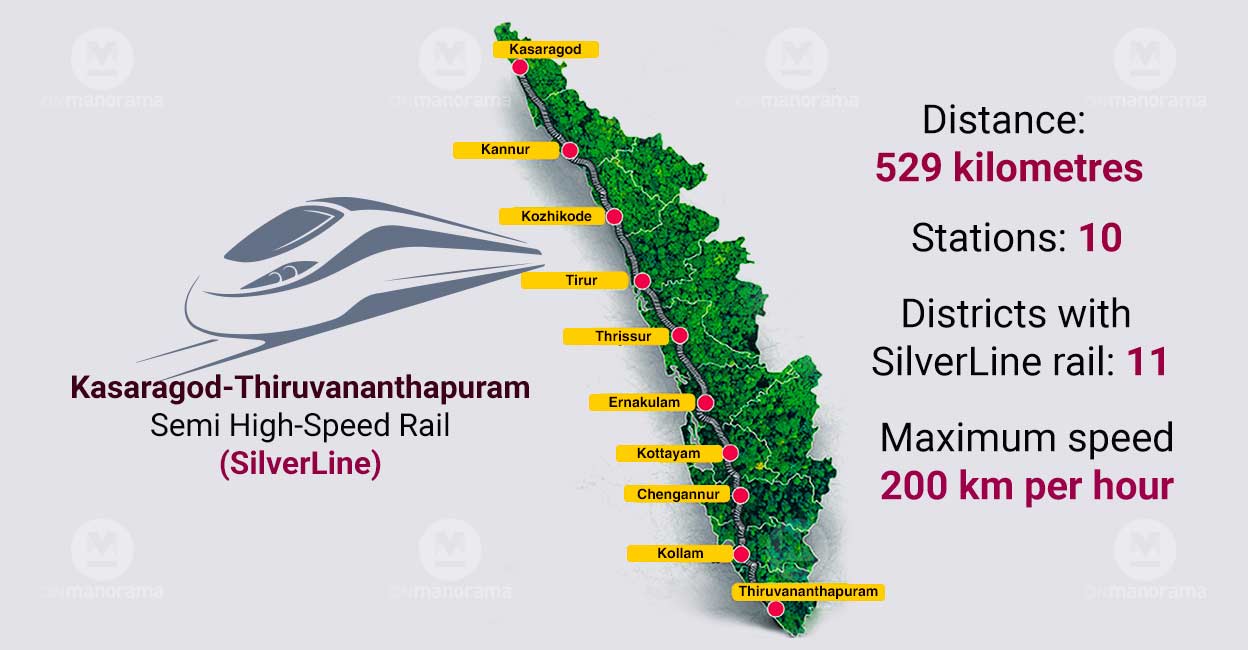
- The proposed 529.45-km line will link Thiruvananthapuram in the south to Kasaragod in the north, covering 11 districts through 11 stations.
- When the project is completed, one can travel from Kasaragod to Thiruvananthapuram in less than four hours at 200 km/hr compared to 12 hours now.
- The deadline for the project, being executed by the Kerala Rail Development Corporation Limited (KRDCL), is 2025.
- KRDCL, or K-Rail, is a joint venture between the Kerala government and the Union Ministry of Railways created to execute big railway projects.
What are the positives of the proposed project?
- Reduces the pressure on Kerala’s heavily choked 1,800 km highways
- Fast high quality connectivity
- Substantial reduction in road accidents due to decongestion on road
- Benefits the tourism industry due to the efficient movement of visitors between destinations at economic rates
- Savings in fuel consumption
- Clean mode of transport with reduction in Greenhouse gas emissions due to a shift from conventional transport to SilverLine
- Introduction of RORO facilities leads to transport of vehicles such as trucks, lorries, etc. in an environment friendly manner
- Last mile connectivity by providing cab feeder services, share auto services, eBus services, bicycle/bike rental schemes
- E-charging facilities for individual electric vehicles
- Connecting IT corridors – Technopark and Infopark
- Direct and indirect employment opportunities during construction period and post project operation period
What are the concerns related to the project?
- The burden of debt financing of the project could impact State finances substantially.
- The displacement and generous rehabilitation of about 10,000 families from the 1,200 hectares of private land is a major concern.
- Environmental concerns exist over the embankments elevating the track approximately for 300 km and availability of construction material aggregates.
- Kerala’s steep drainage is oriented east to west and many speculate that the embankment may enhance the intensity of ambient flooding although the project provides leeways every 500 metres.
- The SilverLine is, however, exclusively insufficient to answer the State’s traffic crisis.
- The Government has not yet made the detailed project report public, a standard practice which brings transparency to large-scale public infrastructure projects.
What approach is needed?
- Kerala needs an integrated sectoral appraisal and synthesis of its competing traffic corridor proposals viewed simultaneously as civic amenities and investment projects.
- An integrative approach might address the concerns.
- Kerala also needs to harmoniously develop its eco-friendly waterways which can decongest the clogged highways by another 15%.
- A progressive and knowledgeable society like Kerala should engage in meaningful discussions rather than highly polarised debates.
References
- https://www.thehindu.com/opinion/op-ed/the-silverline-project-is-anti-development/article38288549.ece
- https://www.thehindu.com/opinion/op-ed/a-train-to-unite-kerala/article38284064.ece
- https://keralarail.com/projects/thiruvananthapuram-kasaragod-semi-high-speed-rail-shsr-project/



