Why in News?
In recent years, India’s tea giants face rising competition from cheaper alternatives.
What is the status of tea production in India?
- Global position – India is the second-largest tea producer in the world.
- The country produces over 1.3 billion kilograms of tea annually, consuming roughly 80% domestically while exporting the rest.
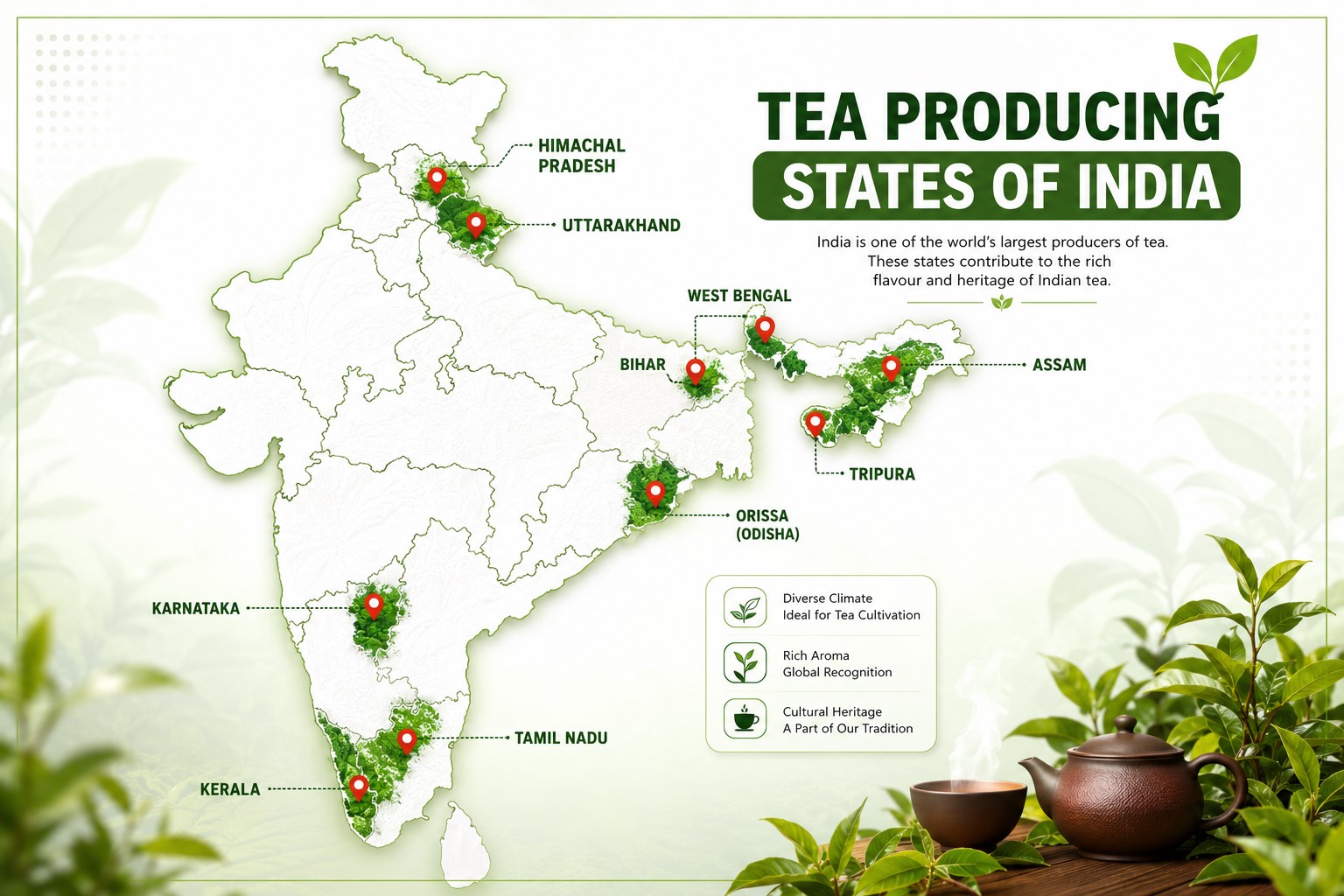
- Major Producing Regions
- Assam – Yields over 50% of national production (~687 million kg), famous for bold, malty black and CTC teas from the Brahmaputra Valley.
- West Bengal – Accounts for about 30% of output (~411 million kg), home to famous growing areas like Darjeeling, Dooars, and Terai.
- Southern India – Contributes the remaining share via Tamil Nadu (~171 million kg) and Kerala (~58 million kg) with smooth Nilgiri teas.
What are the climatic requirements?
- Temperature – 20°C to 30°C for optimal growth.
- Temperatures above 35°C or below 10°C can damage the bush and stunt leaf growth.
- Sunlight – Requires at least 5 hours of bright sunlight daily.
- Annual rainfall – 150 cm to 300 cm, evenly distributed across the year.
- Moisture – Needs high relative humidity and frequent showers to support continuous flushing of tender leaves.
- Drainage – Waterlogging harms roots, making sloped terrain or well-drained soil vital.
- Soil Requirements
- Acidity – Prefers slightly acidic soils with a pH between 4.5 and 5.5.
- Composition – Rich in organic matter, humus, and iron, and free of calcium with a porous sub-soil.
What is the performance of organised tea companies?
- Tata Consumer Products Ltd – It owns brands such as Tata Tea and Tetley, reported only 2% volume growth in its tea and coffee segment, while segment revenue declined by 4%.
- Although coffee recorded 24% growth, tea operations weighed on overall performance. The company attributed the decline in revenue to passing on lower tea costs to consumers.
- Hindustan Unilever Ltd. (HUL) – It markets brands such as Lipton and Brooke Bond, reported only low single-digit underlying volume growth in its premium tea segment.
- Goodricke – It is a Kolkata-based tea producer with plantations in Darjeeling and Assam, reported a nearly 14% decline in revenues during 2025–26, citing higher operating costs and weakness in the overall tea market.
What are the factors behind the slowdown in the tea market?
- Deflationary Market Conditions – The tea market has remained in a deflationary phase for the past four to five quarters.
- Falling tea prices have reduced revenues for organised players despite modest volume growth.
- Adverse Weather Conditions – Weather-related disruptions have significantly affected tea production.
- Prolonged summer heatwaves led to higher pest infestations, reducing crop quality.
- Extreme heat also weakened consumer demand for tea.
- Erratic monsoon rainfall over successive years caused both shortages and landslides in tea-growing regions, reducing the availability of high-quality tea.
- These factors affected tea auctions, where major companies such as Tata Consumer and HUL procure tea leaves.
- Rise in Cheaper Imports – Imports of lower-priced tea from countries such as Nepal and Kenya have increased competition in the domestic market.
- These imports have contributed to falling tea prices in India.
- Growth of the Unorganised Sector – Tea is largely a commodity business with relatively low brand loyalty.
- Falling prices have encouraged consumers to shift towards lower-priced products offered by the unorganised sector or cheaper sub-brands.
- This has compelled organised companies to reduce prices, leading to lower realisations.
- Temporary LPG Shortage – Tea retailers also faced a temporary setback due to shortages of liquefied petroleum gas (LPG) associated with the West Asia conflict.
- According to Tata Consumer’s management, fuel shortages in households discouraged tea purchases during the period.
- Challenges in Premiumisation – In response to market pressures, organised companies have increasingly focused on premiumisation.
- Tata Consumer has expanded its premium portfolio through products such as Tetley Premium and Tata Tea Gold.
- HUL has strengthened premium offerings under the Brooke Bond portfolio.
Premiumisation is a business strategy where companies make products or services feel more expensive, special, and high-quality so people will pay more money for them.
- According to industry analysts, Tata Consumer offers products ranging from ₹250 per kg to ₹3,000 per kg, reflecting its long-term strategy of expanding premium offerings.
- However, premiumisation remains difficult because tea consumption is strongly influenced by established consumer preferences.
- Consumers are generally more willing to shift to lower-priced alternatives during periods of financial pressure than to adopt premium products.
- Consequently, while premiumisation may create long-term value, its benefits are expected to materialise gradually.
How the companies have reacted to this challenges?
- Diversification Beyond Tea – Recognising the limitations of a commodity-linked business, major companies have diversified into faster-growing segments.
- For Tata Consumer, revenue from growth businesses—including Tata Sampann, Soulfull, and cold beverages—surpassed tea and coffee revenues for the first time in the first quarter.
- Goodricke has expanded beyond tea plantations into dairy, alternative crops, solar energy, and selective hospitality.
- Diversification has become an important strategy for reducing dependence on the volatile tea business.
- Emerging Trends and Outlook – Following the prolonged deflationary cycle, tea prices have recovered since late June, with inflation estimated at 7–10%.
- Tata Consumer implemented a 1–2% price increase in June and indicated that additional price hikes may follow if inflation continues.
- HUL also acknowledged similar inflationary trends in the tea market.
- However, analysts remain uncertain whether higher prices will significantly improve revenues.
- If inflation remains moderate while local players continue selling lower-cost tea stocks, organised companies may find it difficult to pass higher costs on to consumers.
- In addition, the adverse effects of the expected El Niño during late 2026 and 2027 could further affect tea production and prices.
What lies ahead?
- India's organised tea industry is facing multiple challenges arising from adverse weather, cheaper imports, growing competition from the unorganised sector, and changing market dynamics.
- While premiumisation and diversification offer avenues for long-term growth, consumer preferences and the commodity nature of tea continue to limit rapid transformation.
- The future performance of the sector will depend on the evolution of tea prices, companies' ability to manage cost pressures, and the impact of climatic conditions on production.
Reference
The Indian Express| Tea Production and Challenges



