Why in News?
China’s Ambassador to India Xu Feihong recently posted on X about the historic Tea Horse Road.
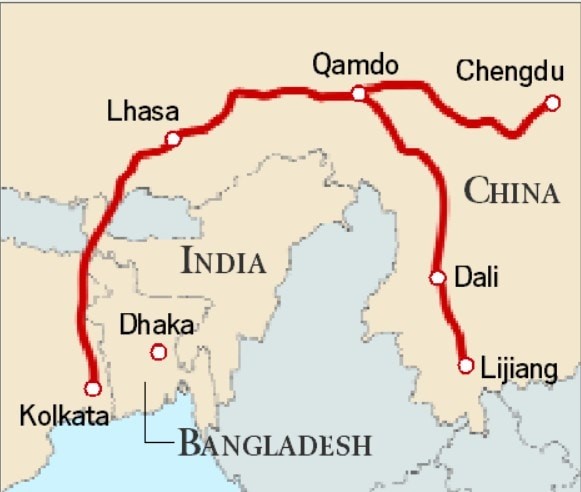
- It spanned more than 2,000 km, and connected China to India via Tibet.
- It witnesses the exchanges and interaction between China and India.
- Origin – It can be traced to the rule of the Tang dynasty in China (618-907 CE).
- The Tea Horse Road does not refer to a single road but a network of branching paths that began in southwest China and ended in the Indian subcontinent.
- Pathways - The 2 main pathways passed through cities like Dali and Lijiang in Yunnan province, and reached Lhasa in Tibet, before entering the Indian subcontinent.
- They branched into present-day India, Nepal, and Bangladesh.
- These routes were perilous to travel on, passed through difficult terrain, and reached an elevation of up to 10,000 feet.
- Buddhist monk Yijing (635-713 CE) mention
- Products like sugar, textiles, and rice noodles being transported from southwestern China to Tibet and India while
- Horses, leather, Tibetan gold, saffron and other medicine herbs went to China.
- Over time, the trade focused on teas and horses during Song dynasty (960-1279 CE).
- The main driver for the road is believed to be the demand for tea among Tibetan nomads.
- In 1912, as the time of the Qing dynasty came to an end, the Horse Tea Road would continue to remain significant.
- Cultural and technological exchanges over 800 years have created unique local architecture, art, landscape, culture and social life.
- These incorporate the quintessence of Han, Bai, Tibetan and other ethnic groups.
- Declination - With the establishment of the People’s Republic in 1949, the Tea Horse Road witnessed a gradual decline.
Reference
The Indian Express | Tea Horse Road



