Why in news?
Supreme Court's evolving standards ensure that due process remains substantive, non-arbitrary, and procedurally rigorous at every stage of a capital case from trial sentencing to post-conviction remedies.
What is the core pillar?
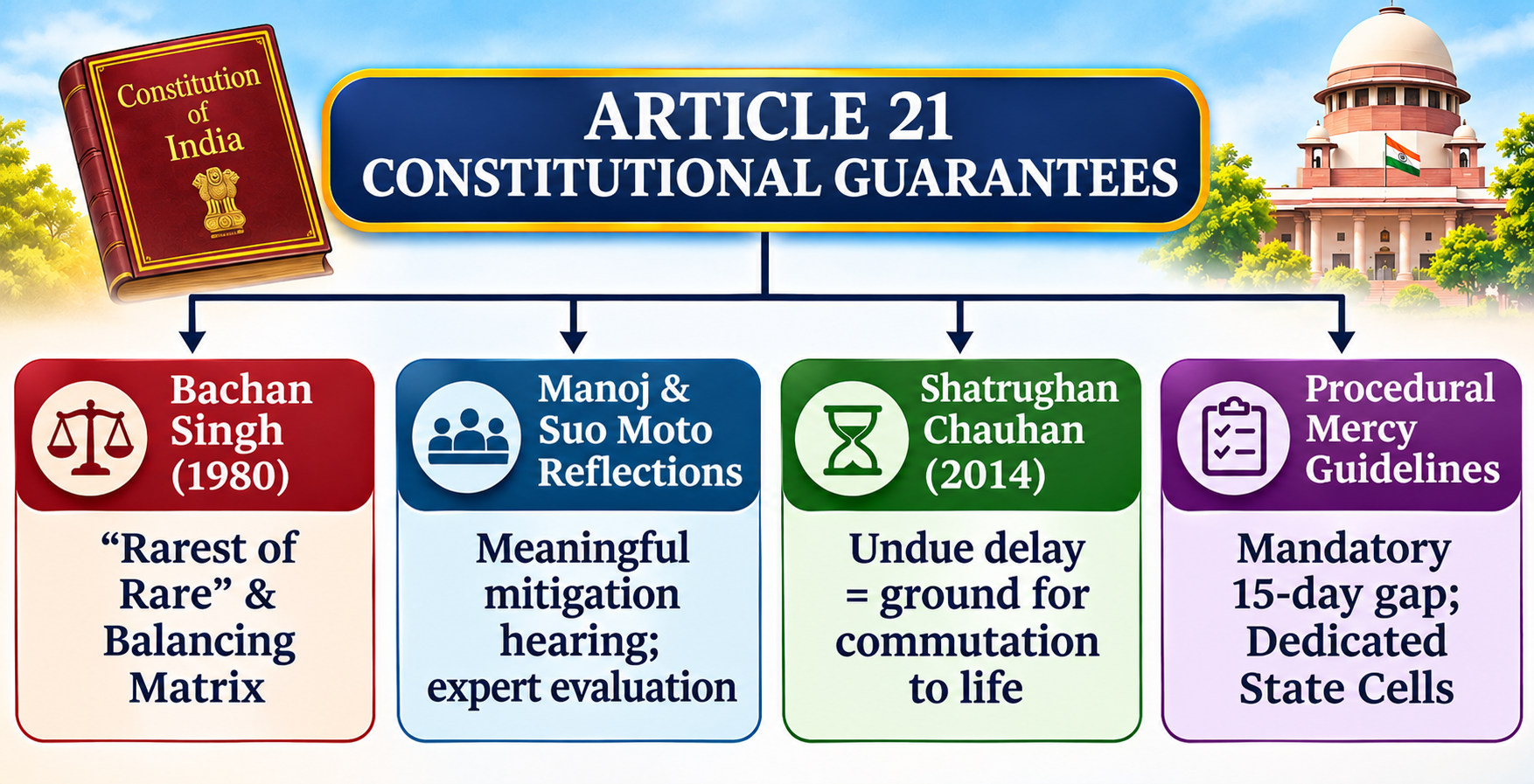
- The foundation of modern death penalty jurisprudence in India was laid in the landmark Bachan Singh v. State of Punjab (1980) case.
- Rarest of Rare Principle- The death penalty should be awarded only in the most exceptional circumstances where the alternative option of life imprisonment is unquestionably foreclosed.
- Balancing Aggravating and Mitigating Circumstances - Courts are mandated to draw a balanced sheet weighing the circumstances of the crime (aggravating factors) against the circumstances of the criminal (mitigating factors).
- Focus on Reformation - Capital punishment can only be considered if the prosecution conclusively proves that the convict is beyond reform or rehabilitation.
What is the evolution of due process standards in capital cases?
- Mandatory Separate & Meaningful Sentencing Hearing - Under Section 235(2) of the CrPC (now section under BNSS), sentencing cannot be a mere mechanical formal step.
- The Supreme Court has repeatedly deprecated "same-day sentencing" (convicting and sentencing an accused on the same day), emphasizing that defense counsel needs adequate time and resources to gather mitigating background material.
- Institutionalizing Mitigation Investigation - The Court has mandated that trial courts collect comprehensive social-investigation reports, psychological evaluations, and prison conduct reports before deciding on a death sentence.
- Multi-disciplinary assessments examining early childhood trauma, socio-economic deprivation, and mental state—are now vital to determining rehabilitative potential.
- Protection Against Executive & Inordinate Delay (Shatrughan Chauhan v. Union of India, 2014) - Inordinate, unexplained, and excessive delay by the executive in deciding mercy petitions causes severe mental torture to death row prisoners.
- The apex court held that such delay violates Article 21 and constitutes a valid ground for commuting a death sentence to life imprisonment.
- Procedural Guidelines for Execution & Mercy Petitions - Mandatory minimum 15-day gap between the rejection of a mercy petition/issuance of an execution warrant and the actual execution to allow convicts to settle affairs and seek legal remedies.
- Directives to establish dedicated cells within Home/Prison departments to handle mercy petitions efficiently, alongside mandatory legal aid provision at every post-conviction stage.
Comparative Framework
|
Dimension
|
Early Jurisprudence (Pre-1980)
|
Modern Substantive Due Process
|
|
Primary Focus
|
Nature and brutality of the crime committed
|
Dual focus: Nature of crime AND background/rehabilitative potential of offender
|
|
Sentencing Stage
|
Often conducted immediately after conviction on the same day
|
Separate, structured hearing with adequate time for mitigation evidence collection
|
|
Evidence for Sentencing
|
Limited to basic trial records and prosecution arguments
|
Comprehensive reports: psychiatric assessments, jail conduct, socio-economic history
|
|
Executive Delays
|
Considered an administrative outcome with minimal judicial review
|
Recognized as a constitutional violation of Article 21, leading to commutation
|
What are the key constitutional provisions?
- Article 21 - Guarantees protection of life and personal liberty, establishing that no person shall be deprived of life except according to procedure established by law (interpreted as fair, just, and reasonable procedure).
- Article 72 & Article 161- Executive clemency powers of the President and State Governors, respectively, which are subject to judicial review against arbitrary delay or political bias.
- Section 354(3) CrPC / BNSS Equivalent- Requires judges to state "special reasons" in writing when awarding a sentence of death instead of life imprisonment.
What are the challenges in implementing mitigation standards?
- Capacity Constraints at Trial Court Level- Subordinate courts often lack access to trained mitigation specialists, social workers, or psychological experts to compile thorough reports.
- Inconsistent Application- Lack of uniform application of the "rarest of rare" doctrine across different benches and courts has historically led to concerns over "judge-centric" sentencing.
- Delayed Processing- Administrative delays in gathering background material can prolong pre-sentencing periods if not managed efficiently.
What is the way forward?
- Institutionalizing Mitigation Specialists - Establish defense mitigation units under Legal Services Authorities (NALSA/SALSA) to assist trial courts with background reports.
- Standardized Sentencing Guidelines- Finalize clear, objective procedural benchmarks via larger Supreme Court Constitution Bench rulings to harmonize death penalty sentencing across state judiciaries.
- Sensitization of Trial Judiciary - Conduct regular judicial training programs on psychological evaluation techniques and human rights frameworks in capital sentencing.
Reference
The Hindu | Death Penalty in SC



