Prelims: Current events of national and international importance | Science and Technology
Why in News?
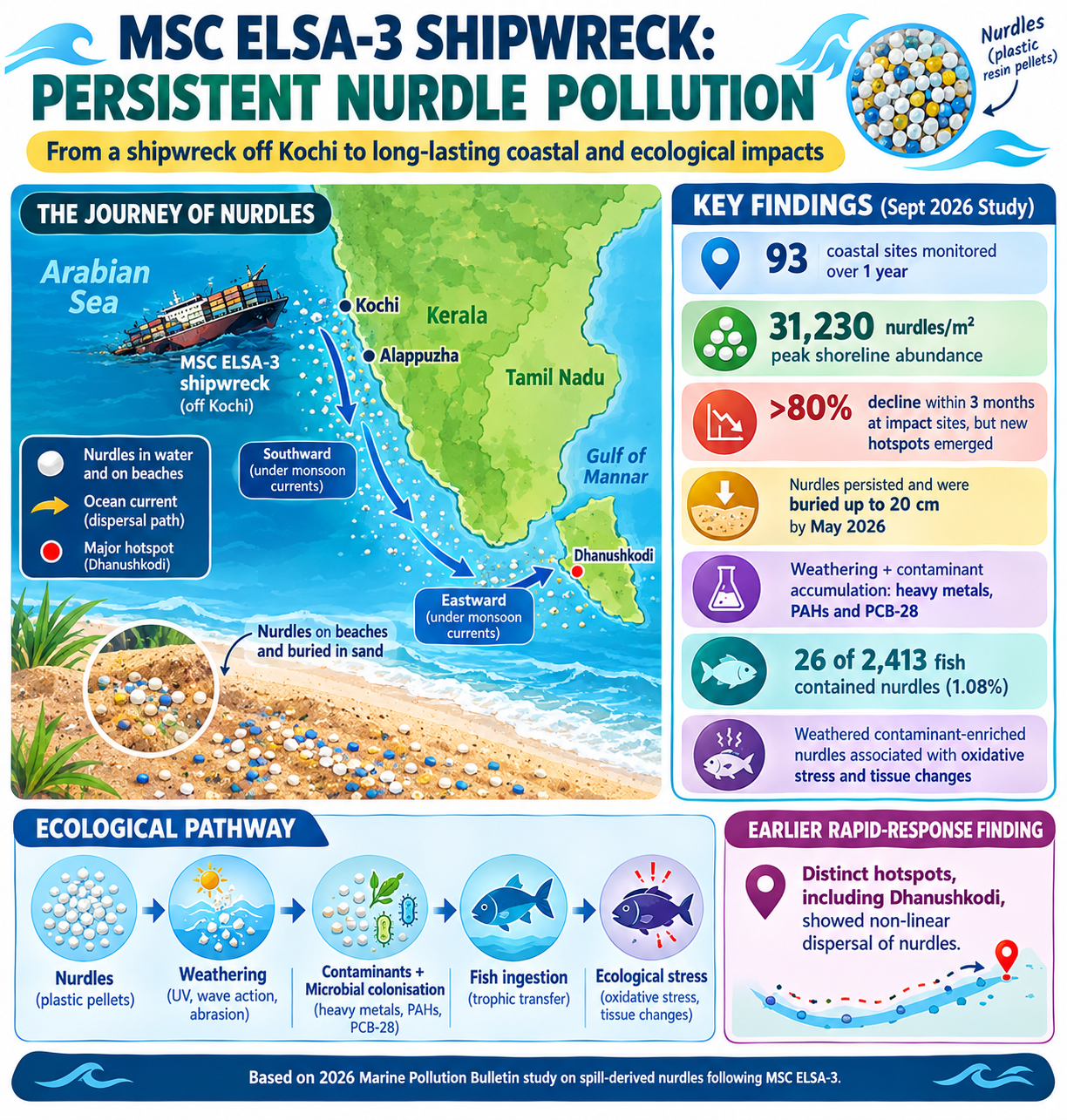
A recent study by researchers highlighted the long-term, evolving environmental impacts of marine resin pellet spill following the sinking of the container vessel MSC ELSA-3 off the Keralam coast.
- Incident - The ship carried hundreds of metric tonnes of plastic resin pellets (nurdles), industrial materials, hazardous calcium carbide, and substantial quantities of heavy fuel oil.
- Impact - Ocean currents and monsoon winds transported the spilled nurdles across state boundaries, washing them ashore along the coastlines of Keralam and Tamil Nadu.
|
Nurdles
|
- Definition - Tiny, lentil-sized pre-production plastic resin pellets (typically 2 to 5mm in size) used as raw material in the manufacturing of commercial plastic products.
- Classification – It is categorized as a primary source of microplastic pollution due to their small initial size.
- Ecological Danger –It has a buoyant nature and it resembles like fish eggs.
- Thus, they are easily mistaken for food by marine life, while acting as persistent chemical sponges in aquatic ecosystems.
|
Key Scientific Findings of the Study
- Sediment Burial - While surface abundance on beaches declined by >80% in initial months, nurdles became deeply buried up to 20 cm into beach sediments.
- Buried pellets act as a long-term secondary pollution source, susceptible to re-mobilization during monsoonal storms, coastal erosion, and sediment reworking.
- Chemical Weathering - Spectroscopic analysis (FTIR and SEM) revealed physical surface degradation, yellowing, and photo-oxidation.
- Weathered nurdles adsorb toxic persistent organic pollutants (POPs).
- It includes
- Polycyclic Aromatic Hydrocarbons (PAHs),
- Polychlorinated Biphenyls (PCBs),
- Petroleum hydrocarbons, and
- Toxic heavy metals concentrating them on pellet surfaces.
- Weathered pellets developed a dense, specialized microbial ecosystem called a plastisphere.
- Bacterial loads on aged nurdles reached 10^5 " to " 10^6 " colony-forming units per gram" ("CFU/g"), harboring potential opportunistic marine pathogens.
- Trophic Impact - Demonstrated evidence of gastrointestinal ingestion and gill entrapment across multiple marine fish species.
- Fish ingesting weathered, contaminant-laden nurdles exhibited elevated oxidative stress and histopathological tissue damage compared to those exposed to pristine pellets.
Reference
The Hindu | Study on Keralam ELSA-3 shipwreck



