Mains: GS III - Environment
Why in News?
The onset of the peak post-monsoon stubble burning season in North India (particularly Punjab and Haryana), which coincides with the worsening Air Quality Index (AQI) and smog crisis in Delhi.
What are the historical and legal triggers behind stubble burning?
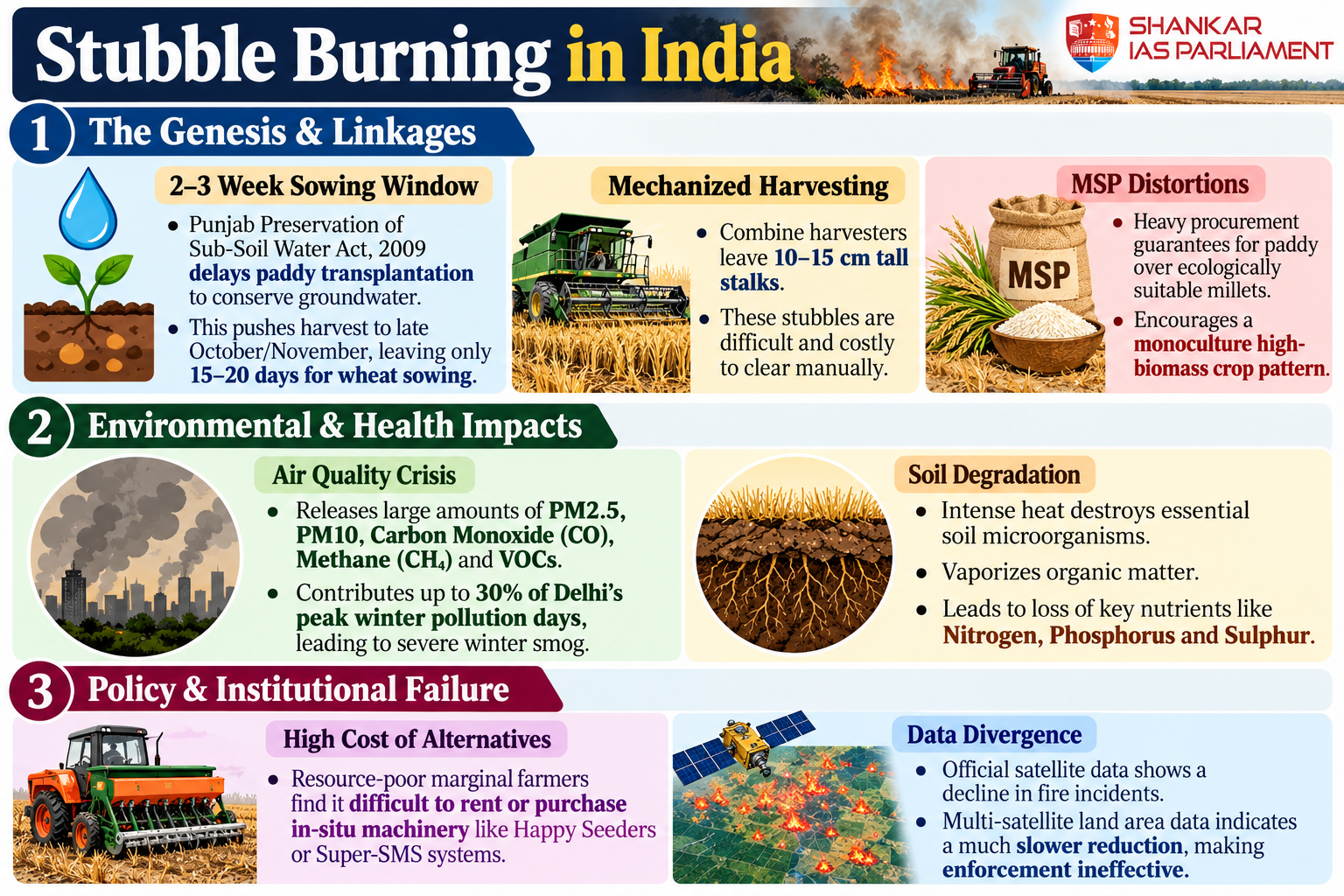
- Introduction of Combine Harvesters – Stubble burning began in Punjab during the late 1970s and early 1980s following the introduction of mechanical combine harvesters, which leave the lower portion of the plant embedded in the soil.
- Groundwater Crisis and PPSSWA 2009 – Rapid depletion of groundwater tables highlighted by a landmark 2009 NASA GRACE study showing a loss of 109 cubic kilometres of groundwater across Punjab, Haryana, and Rajasthan between 2002 and 2008, which prompted the enactment of the Punjab Preservation of Sub-Soil Water Act (PPSSWA), 2009.
- Narrow Harvesting-Sowing Window – The PPSSWA 2009 prohibited early paddy sowing before May 10 and transplantation before June 10 to align with the monsoon, pushing harvest to late October and early November.
- This left farmers with a compressed 10 – 15 day window to prepare fields for the succeeding wheat crop, making residue burning an expedient necessity.
How do economic incentives perpetuate the paddy wheat cycle?
- Skewed Minimum Support Price (MSP) Procurement – Between 2012 and 2024, average paddy procurement nationally stood at 37%, whereas procurement in Punjab and Haryana reached 87% and 74%, respectively.
- Similarly, wheat procurement reached 70% in Punjab and 63% in Haryana (compared to a 30% national average), creating assured incomes that discourage crop diversification.
- Free Electricity and Water Extraction – Free power provision for agriculture in Punjab (and near-free in Haryana) heavily incentivizes continued cultivation of water-intensive paddy and wheat through unhindered groundwater extraction.
What are the technical and economic limitations of in-situ and ex-situ management solutions?
- In-Situ Machinery Constraints – Crop Residue Management (CRM) tools like Happy Seeders, Super Seeders, and Rotavators require expensive 60-horsepower (HP) tractors that remain idle for most of the year, while hiring them costs more alongside long waiting periods.
- Ex-situ Economic Burdens – Ex-situ alternatives such as utilizing straw for bio-ethanol, compressed biogas (CBG), or industrial energy cost per acre is higher, which represents a heavy financial burden.
- Divergent State Approaches – While Punjab primarily pursued in-situ CRM machinery support with limited ex-situ initiatives, Haryana implemented a direct incentive model providing financial transfers.
What are the data discrepancies and measurement challenges in tracking stubble burning?
- Limitations of Polar Satellites – The standard CREAMS protocol uses NASA’s MODIS and VIIRS polar-orbiting satellites, which observe India only during fixed daytime windows (10 –30 am to 1 –30 pm) and capture only active fires, missing 24-hour totals.
- Behavioral Shifts and Diurnal Evasion – A November 2025 Current Science study by ISRO scientists revealed that farmers shifted burning to evening hours to evade polar satellite passes. Consequently, while official reports cited a 90% reduction in burning incidents in 2025 compared to 2022, multi-satellite and geostationary analyses indicate a more gradual decline of around 30%.
What policy measures and institutional reforms are required?
- Promoting Viable Crop Diversification – Build robust economic incentive structures supported by assured procurement and remunerative pricing for alternative non-paddy crops to permanently break the paddy-wheat lock-in.
- Guaranteed Pricing for Ex-Situ Residue – Implement parliamentary panel recommendations to set a minimum floor price covering all costs for selling stubble to ex-situ industrial units, ensuring a guaranteed supplementary income for farmers.
- Integrated Satellite Measurement Protocols – Upgrade monitoring frameworks by combining polar satellite data with geostationary observations to capture 24-hour fire activity accurately, avoiding distorted metrics caused by timing evasion.
Reference
The Hindu | Stubble Burning



