Prelims – General issues on Environmental ecology, Bio-diversity and Climate Change.
Why in news?
Recently, 600-million-year-old stromatolite outcrop has been discovered in Chambaghat, Solan district, Himachal Pradesh.
- Stromatolites – They are reef-like bio sedimentary structures formed by cyanobacteria (blue-green algae) in ancient shallow seas.
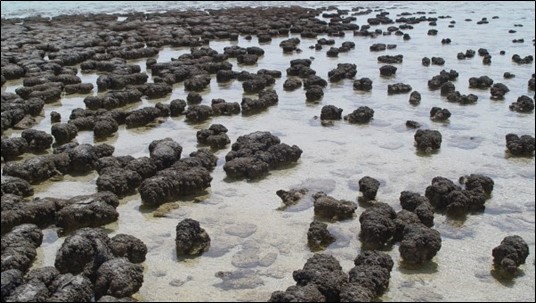
- Time period – It dates from 3.6 billion years old (Australia) to 600 million years old (recent Himalayan discovery).
- Distinction from fossils – If original organism is preserved, it's technically a fossil; if only the mineralised structure (calcium carbonate precipitates) is preserved, it's a biosedimentary structure.
Recent Discovery in the Himalayas
- Location – Pine-clad ridges of Chambaghat in Solan district, Himachal Pradesh.
- Age – 600 million years old.
- It is found at 5,000-6,000 feet above sea level in entire hill covered with stromatolites, not just isolated samples.
- Younger stromatolites – This is the youngest stromatolites in India.
Oldest stromatolites are found in Dharwad in Karnataka, which are at least 2,500 million years old.
- Geological significance – It is part of the Krol Group of sedimentary rocks that is formed in shallow marine environment of the ancient Tethys Sea.
- It helps to reconstruct the theory of a vanished Tethys Sea in the Himalayan region.
- These structures indicate the shallow marine conditions that once existed before the Indian plate collided with Eurasian plate.
- Historical significance – Earth’s atmosphere doesn’t contain oxygen when it is formed and it is composed of carbon dioxide, methane, and water vapor.

- Oxygen production – Cyanobacteria in stromatolites began producing oxygen through photosynthesis around 3.5 billion years ago.
- This contributed to the Great Oxygenation Event, making Earth habitable for complex life.
Great oxidation event occurred around 2.4 billion years ago, transforming Earth's atmosphere and enabling multicellular life.
- Threat – Risk of permanent loss due to development and natural processes such as mining activities, construction and erosion.
|
Other Stromatolite Sites in India
|
- Uttarakhand – Mussoorie, Nainital (Krol Belt formations)
- Haryana – Morni Hills (dolomite formations)
- Uttar Pradesh – Chitrakoot (Vindhyan limestones), Salkhan (fossil park)
- Rajasthan – Jhamarkotra (mining threatened), Zawar, Jaisalmer Fossil Park, Bhojunda, Bilara Group
- Andhra Pradesh – Kadapa Basin (Cuddapah Supergroup)
- Madhya Pradesh – Kadapa mountains
- Chhattisgarh – Chandi Formation
- Sikkim – Buxa Formation (declared Geoheritage site)
|
Reference
Indian Express| 600-million-year-old stromatolites found in Himalayas