Why in News?
The government is reportedly considering a decade-long strategic-fuel programme involving about 28 million tonnes (MT) of crude-oil storage, 9 MT of LNG storage and 4 MT of LPG storage.
What is the Background?
- Energy security – It is fundamental to India’s economic growth, national security and strategic autonomy.
- With India being heavily dependent on imports for crude oil, natural gas and LPG, disruptions in global energy markets—particularly those arising from instability in West Asia and vulnerabilities along critical maritime chokepoints—can have significant economic consequences.
- Steps taken – India has already taken steps towards building strategic petroleum reserves (SPRs).
- Challenges – However, the emerging challenge is broader: Can India build an integrated strategic-fuel system covering crude oil, LNG and LPG, supported by ships, pipelines, storage infrastructure and effective governance?
What is India’s Existing Strategic Storage Capacity?
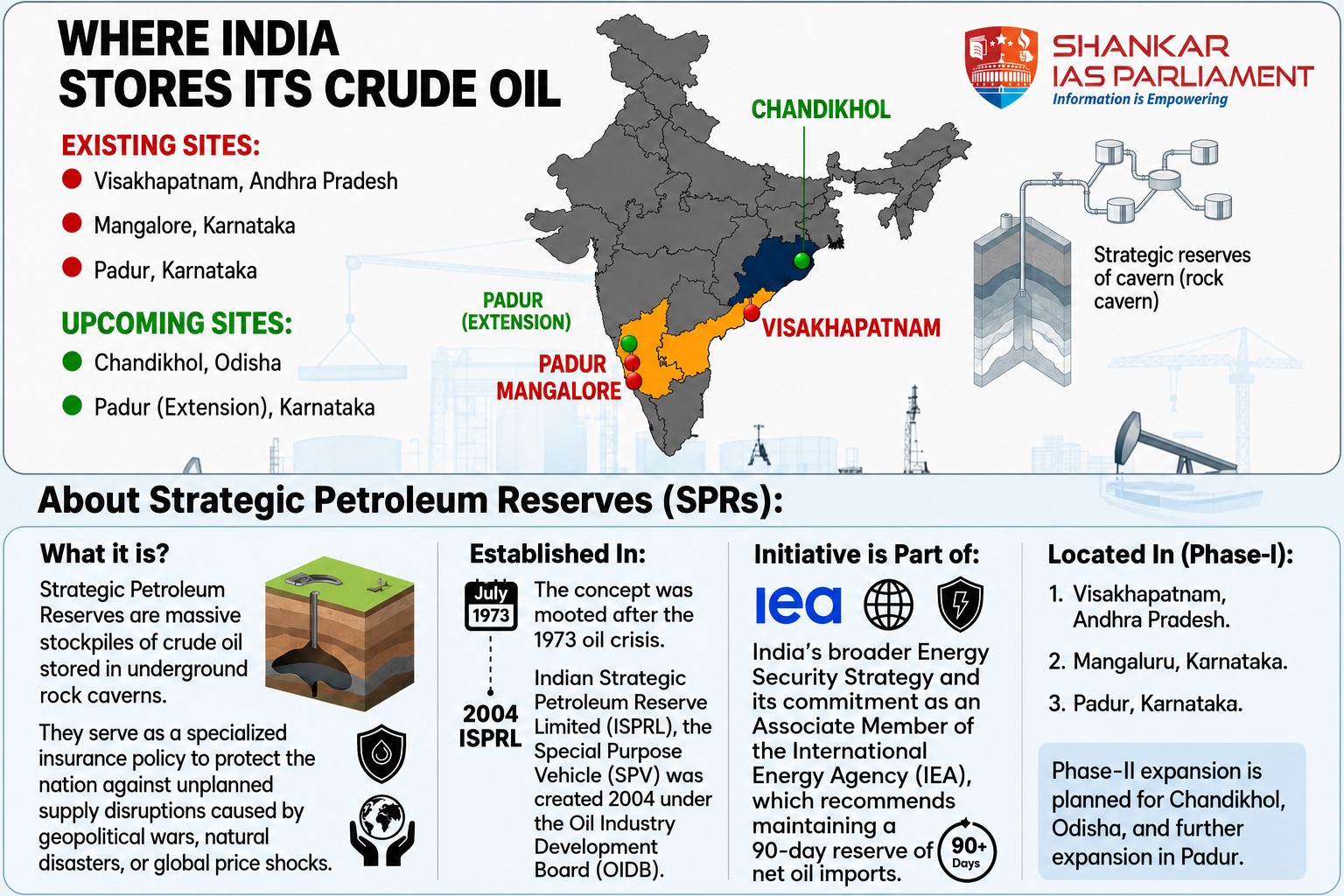
- Crude Oil – For crude oil, Phase I of the Strategic Petroleum Reserve provides 5.33 MT of underground storage capacity at Visakhapatnam, Mangaluru and Padur.
- Actual inventory is around 3.37 MT, implying utilisation of roughly 63–64%.
- A further 6.5 MT has been approved under Phase II at Chandikhol and Padur, although execution of the Chandikhol project has faced delays relating to land acquisition and finalisation of commercial PPP arrangements.
- Liquefied Petroleum Gas – LPG has a much smaller underground storage base.
- The Visakhapatnam and Mangaluru caverns together provide approximately 0.14 MT of capacity.
- A proposed 4 MT strategic LPG reserve would therefore represent roughly a thirty-fold expansion.
- Natural gas – India currently has no operational underground natural-gas storage facility.
- Gas security instead depends upon domestic production, LNG imports, import terminals, commercial inventories and the pipeline network.
- This highlights an important distinction between storage capacity and usable inventory.
- A cavern or tank may have a particular physical capacity, but the quantity stored and the rate at which it can be withdrawn can vary.
- Therefore, during a crisis, the critical question is not merely how much fuel India can store, but how quickly that fuel can reach consumers.
What is the LNG Storage Challenge?
- Technological requirement – LNG requires specialised infrastructure because it is stored as a cryogenic liquid at approximately –162°C.
- Import terminals can receive and regasify LNG, but their regasification capacity should not be confused with strategic inventory.
- A PNGRB–ICF stress assessment for 2030 examined the additional LNG infrastructure required to supply priority consumers for 20 days during a supply disruption.
- It estimated a requirement of roughly 0.56–0.6 MT of LNG equivalent, along with additional LNG tanks.
- This was a scenario-specific assessment rather than an estimate of India's overall strategic LNG requirement.
- The proposed 9 MT LNG inventory is considerably larger.
- Against an estimated annual LNG import requirement of around 58 MT, 9 MT represents roughly 56 days of imports.
- However, this does not imply two months of India's total natural-gas consumption.
- It represents approximately two months of LNG import cover.
- India could adopt a portfolio approach, combining surface LNG tanks with underground natural-gas storage.
- LNG tanks can provide readily accessible strategic stocks at import terminals, while depleted oil and gas reservoirs or salt caverns could potentially provide larger-scale underground storage.
What are the Opportunity and Constraints of Underground Gas Storage?
- Enhance resilience – Underground natural-gas storage can enhance resilience against sudden supply disruptions and seasonal fluctuations.
- Containing hydrocarbon – Depleted reservoirs are particularly attractive because they have previously demonstrated their ability to contain hydrocarbons.
- However, a depleted field cannot automatically be converted into a storage facility.
- Factors such as cap-rock integrity, reservoir characteristics, pressure behaviour, cushion-gas requirements, existing wells and pipeline connectivity must be assessed.
- India’s Potential – India's sedimentary basins—including the Krishna-Godavari, Cambay, Mumbai Offshore and Rajasthan basins—may offer potential sites.
- Yet moving from geological potential to operational storage requires extensive geological investigation, engineering, construction, testing, filling and grid integration.
- Salt caverns offer another possibility because of their potentially high injection and withdrawal rates.
- However, their feasibility depends on geological conditions such as salt thickness, depth, purity, geometry, groundwater conditions and mechanical properties.
- Thus, underground gas storage should be viewed as a long-term infrastructure programme, rather than a quick solution to energy insecurity.
- Maritime Security and Supply Diversification – India's energy security is inseparable from maritime security.
- A significant share of its energy requirements arrives through sea routes, making chokepoints such as the Strait of Hormuz strategically important.
- Diversification of suppliers and shipping capacity can reduce vulnerability.
- State-run oil refiners and the Shipping Corporation of India are reportedly considering investments of $1.5–2 billion in a joint venture to acquire 59 ships.
- Indian companies are also diversifying crude and LNG sourcing, including greater engagement with suppliers outside West Asia.
- Such measures demonstrate that strategic reserves should be viewed as part of a wider energy-security architecture, encompassing supply diversification, shipping capacity and strategic partnerships.
- Importance of pipelines – A strategic reserve is valuable only when stored fuel can be delivered rapidly to consumers.
- The recent authorisation of approximately 1,800 km of LPG pipelines across six States, involving investment of around $0.7 billion, can improve connectivity between supply sources and inland markets.
- Similarly, natural-gas storage must be connected to the gas grid.
- LNG tanks require regasification facilities and downstream pipelines, while LPG caverns need links to bottling plants and distribution networks.
- Thus, deliverability is as important as storage capacity.
- A reserve that cannot be transported during an emergency provides limited strategic value.
- Financing and Governance – The reported $42-billion programme—which has not been officially confirmed—would involve both infrastructure expenditure and the purchase and maintenance of strategic fuel inventories.
- The financial challenge extends beyond construction. Strategic stocks must be purchased, stored, financed and periodically replenished.
- If stocks are released during a crisis, replenishment may have to occur when global commodity and freight prices are exceptionally high.
- Therefore, India needs clear rules on:
- Ownership and financing of strategic inventories.
- Minimum stock requirements.
- Emergency-release authority.
- Replenishment responsibilities.
- Price and inventory risk.
- Public-private participation.
- Coordination among the Centre, regulators, oil and gas companies and States.
- A commercial-cum-strategic model, in which commercially operated infrastructure is simultaneously available for emergency use, could reduce the fiscal burden while ensuring strategic access.
What could be done?
- Diversified storage – Expand crude, LPG and LNG storage while developing underground natural-gas storage.
- Strong logistics – Integrate reserves with ports, shipping, pipelines, refineries, regasification terminals and distribution networks.
- Supply diversification – Reduce excessive dependence on any single geography, supplier or maritime route.
- Strategic governance – Establish transparent rules for ownership, release, replenishment and financing of reserves.
- Technology and domestic capability – Develop expertise in cavern engineering, reservoir management, LNG technology, forecasting and digital monitoring.
What lies ahead?
- The proposed expansion of strategic crude, LNG and LPG reserves therefore represents an opportunity to move from a stock-based approach to an integrated energy-resilience architecture.
- For a rapidly growing economy aspiring to strategic autonomy and developed-country status, the ultimate measure of energy security will not be the number of tonnes stored underground, but India's ability to maintain uninterrupted energy supply when global markets and geopolitical conditions are under maximum stress.
Reference
The Hindu| Strategic Energy Reserve



