Why in News?
The ECI announced the SSR schedule on October 15, 2026, for 17 States/UTs, including five facing Assembly elections in early 2027, using January 1, 2027, as the qualifying date after skipping the 2026 annual revision due to SIR.
What is Special Summary Revision (SSR)?
- Constitutional Basis – Article 324 of the Constitution empowers the ECI to prepare electoral rolls.
- The Representation of the People Act, 1950, and Registration of Electors Rules, 1960, govern their preparation and revision.
- Legal Provision – Section 21(2) of the Representation of the People Act, 1950, provides for the revision of electoral rolls before general elections and periodically as directed by the ECI.
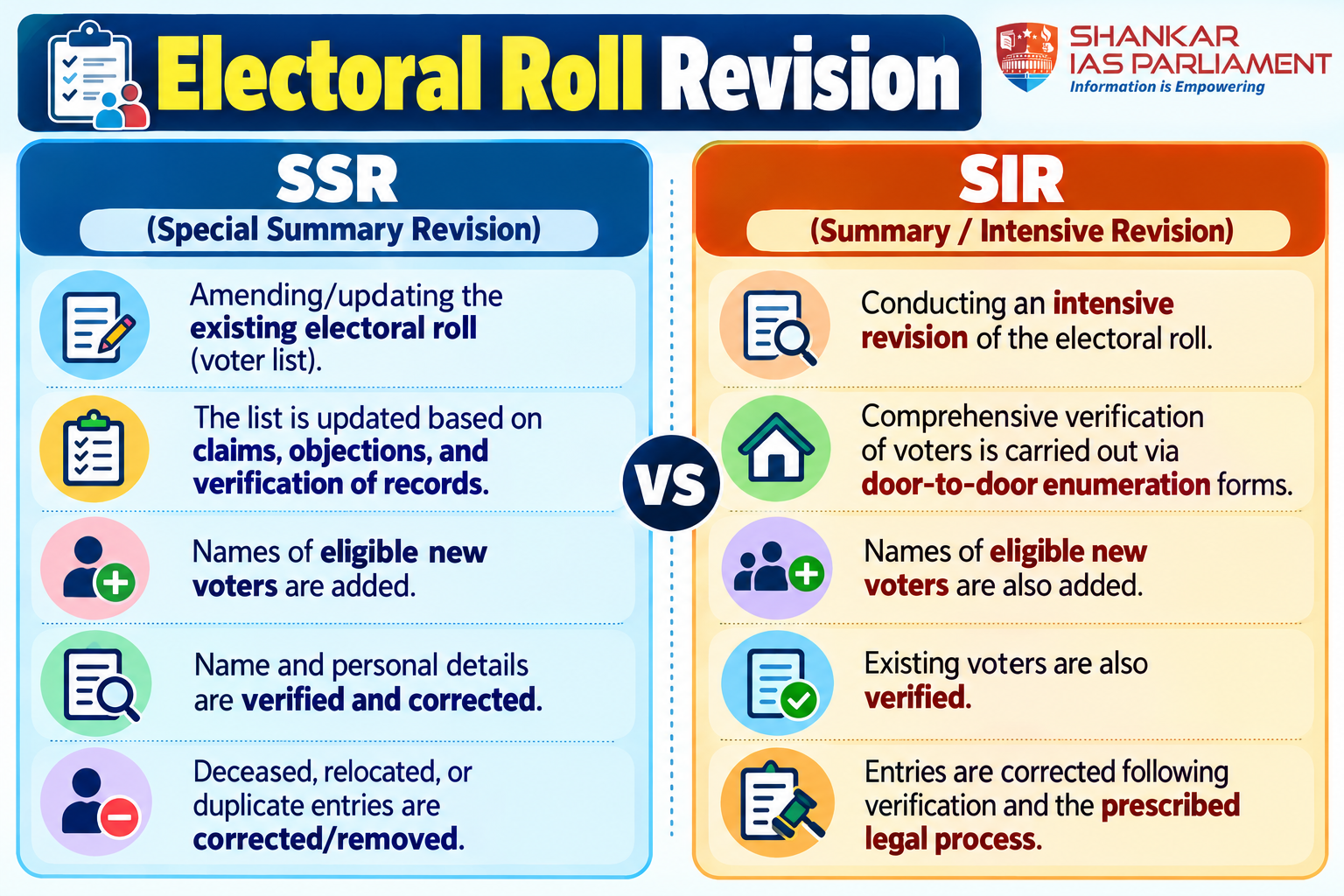
- Purpose – SSR is a routine exercise to update existing electoral rolls by adding eligible voters and removing deceased, shifted or duplicate electors.
- Qualifying Date – January 1 is the annual qualifying date. Individuals who turn 18 by this date are eligible to register as voters.
- Latest ECI Announcement – The ECI announced the SSR schedule for 17 States/UTs where the SIR has been completed in 2025–26, along with Assam.
- In Assam SIR was not conducted.
- States/UTs covered (17) – Andaman and Nicobar Islands, Assam, Bihar, Chhattisgarh, Goa, Gujarat, Kerala, Lakshadweep, Madhya Pradesh, Manipur, Puducherry, Punjab, Rajasthan, Tamil Nadu, Uttar Pradesh, Uttarakhand and West Bengal.
- Form 6 – For new voter registration.
- Form 8 – For shifting electoral enrolment or correcting voter details.
- The SSR schedule for States where SIR is still underway will be announced later.
Special Intensive Revision (SIR) is a massive nationwide voter verification and electoral roll cleanup drive conducted by the Election Commission of India (ECI).
How is SSR Different from SIR?
|
Basis
|
Special Summary Revision (SSR)
|
Special Intensive Revision (SIR)
|
|
Nature
|
Routine updating of existing electoral rolls
|
Intensive revision involving fresh verification
|
|
Existing voters
|
Automatically included in the draft roll
|
Required to submit enumeration forms
|
|
Documentation
|
No fresh documentation requirement for every existing voter
|
Documents required to establish eligibility, including citizenship
|
|
Deletion of names
|
Deceased or duplicate voters may be removed through the prescribed legal process, including notices and hearings
|
Additional verification and hearings may be required for voters flagged for discrepancies
|
|
Claims and objections
|
Voters can seek additions or deletions after draft publication
|
Claims, objections and additional verification follow draft publication
|
|
Objective
|
Maintain accurate and updated electoral rolls
|
Reassess electoral eligibility and prepare revised rolls
|
|
Basis
|
Special Summary Revision (SSR)
|
Special Intensive Revision (SIR)
|
- Key distinction – In SSR, existing electors automatically remain on the draft roll, whereas SIR requires every existing elector to submit an enumeration form to be included in the draft roll.
What are the Concerns Associated with SIR?
- Risk of exclusion – More than 13 crore names were deleted at the draft stages of SIR across States, raising concerns about eligible voters being left out.
- Documentation burden – Requiring existing voters to establish their eligibility afresh may create difficulties for people lacking adequate documents.
- Procedural concerns – Notices, hearings and additional verification can increase the administrative burden on election officials and voters.
- Electoral integrity – Accurate electoral rolls are essential to prevent duplicate entries and ineligible registrations while protecting the voting rights of eligible citizens.
What is the Significance of SSR?
- Inclusive democracy – Automatic inclusion of existing electors in the draft roll reduces the risk of inadvertent exclusion.
- Electoral accuracy – Updating deceased, shifted and duplicate entries improves the reliability of electoral rolls.
- Voter participation – Form 6 and Form 8 facilitate new registrations and corrections ahead of elections.
- Procedural safeguards – Statutory notices and hearings help ensure that deletions follow due process.
What lies ahead?
- SSR and SIR serve the common objective of maintaining accurate electoral rolls but differ in their verification requirements.
- The ECI must balance electoral integrity with inclusiveness, transparency and the protection of eligible citizens’ voting rights.
Reference
The Indian Express| Special Summary Revision



