What is the issue?
The recent siege of an upscale hotel in the capital Mogadishu killing at least 20 people is a grave reminder of the security challenges the country is facing.
What is the current siege about?
- The Hayat, a popular spot in Mogadishu where several other hotels are located and frequented by government officials and civilians has come under the attack.
- The assault in the Somali capital came after two car bomb blasts and gunfire.
- The Al-Qaeda-linked Al-Shabab armed group claimed responsibility for the attack.
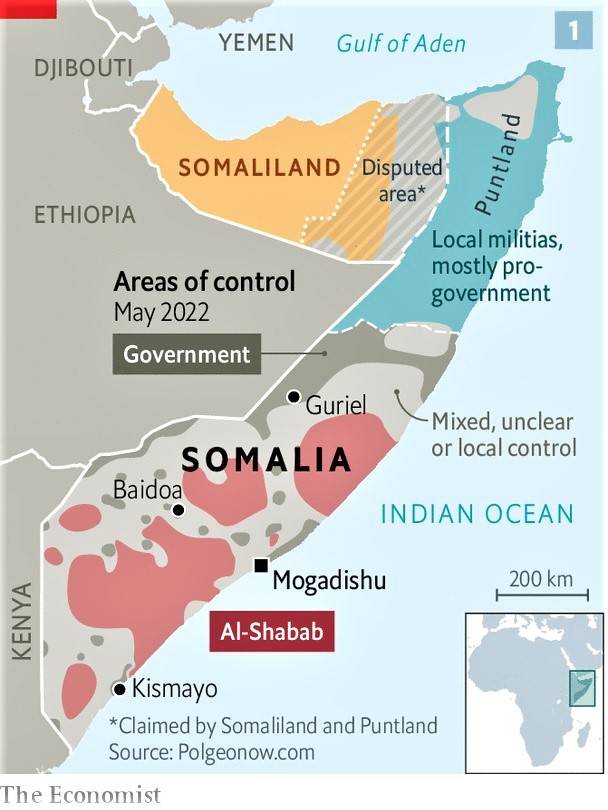
Who are Somalia's al-Shabab?
- Al-Shabab means “The Youth” in Arabic.
- It emerged as the radical youth wing of Somalia's now-defunct Union of Islamic Courts, which controlled Mogadishu in 2006, before being forced out by Ethiopian forces.
- Al-Shabab advocates the Saudi-inspired Wahhabi version of Islam, while most Somalis are Sufis.
- It has imposed a strict version of Sharia in areas under its control, including stoning to death women accused of adultery and amputating the hands of thieves.
- It is banned as a terrorist group by both the US and the UK.
- There have been numerous reports that al-Shabab may have formed some links with other militant groups, such as Boko Haram in Nigeria and al-Qaeda.
- According to a 2020 report, it collects more revenue than the government and is now seeking to expand its influence across the Horn of Africa.
What is happening in Somalia?
- Fragile state- Somalia has long been called a failed or fragile state that has seen one of the biggest failures of international counter-terror operations.
- Political instability- Somalia has not had an effective national government for more than 20 years, during which much of the country has been a war-zone.
- Al-Shabab gained support by promising people security, but its credibility was knocked when it rejected Western food aid to combat a 2011 drought and famine.
- Mogadishu and other towns are now under government control.
- In 2022, there was a peaceful transition of power in Somalia after the successful completion of the legislative and presidential elections.
- Security crisis- In recent years, despite international counter-terror measures, al-Shabab has grown in strength, cashing in on the humanitarian crisis in Somalia and the security crises in neighbouring countries.
- Humanitarian crisis- The country is also witnessing a massive humanitarian crisis amid a severe drought.
What is the way ahead?
- The federal government in Mogadishu and its regional and international backers should have a comprehensive security and crisis-response approach.
- The government’s focus should be on providing essential services, goods and relief to the people while at the same time establishing an effective security architecture through a broad-based political consensus.
- Both state-building and counter-terror operations should be carried out side-by-side and the international community should generously back Somalia in its fight for survival.
References
- https://www.thehindu.com/todays-paper/tp-opinion/fight-for-survival/article6579574ece
- https://www.bbc.com/news/world-africa-15336689



