Prelims: Current events of national and international importance | World Geography
Why in News?
Recently, a 6.7-Magnitude earthquake hits Solomon Islands' Kirakira.
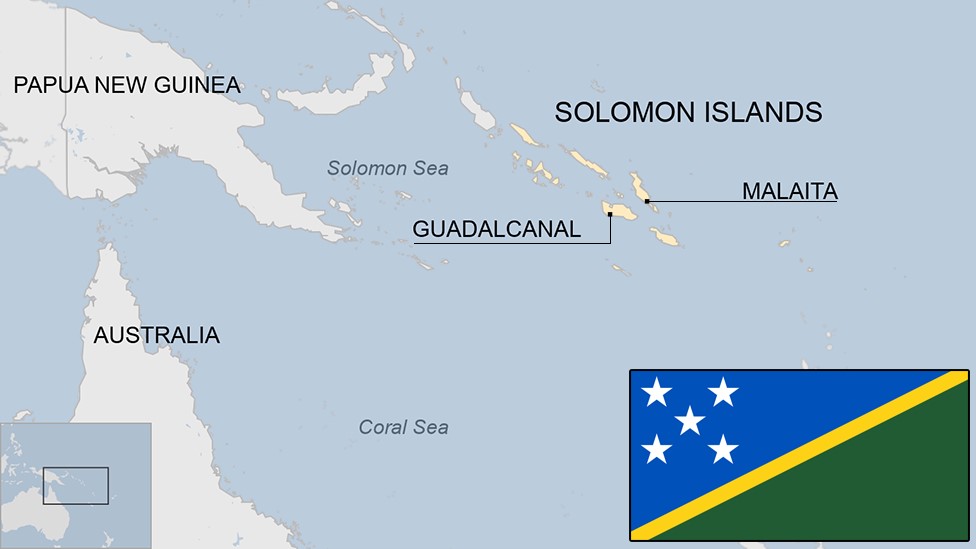
- Solomon Islands is an independent nation in the South Pacific, part of Oceania.
- Capital - Honiara on Guadalcanal, situated along the Mataniko River.
- Independence- Gained from the United Kingdom in 1978.
- Climate - Tropical, with mountainous, heavily forested terrain.
- Highest Point - The highest point is Mount Popomanaseu on Guadalcanal, reaching 2,332 meters.
- It is an archipelago of nearly 1,000 volcanic islands and coral atolls located east of Papua New Guinea and northwest of Vanuatu.
- Atolls and Lagoons - The country is home to the Marovo Lagoon in New Georgia, one of the world's largest saltwater lagoons, and Ontong Java, one of the largest atolls on Earth.
- Archipelago- Comprises 992 islands, including 6 large volcanic islands (Guadalcanal, Choiseul, New Georgia, Santa Isabel, Malaita, and Makira).
- The Coral Triangle - The western islands sit within the Coral Triangle, the global center of marine biodiversity.
- Tectonic Activity - The geography is defined by its position on the boundary of the Pacific and Australian tectonic plates.
- Lifestyle - Largely rural (90% outside urban areas) with a subsistence economy.
- Currency - Solomon Islands dollar (SBD).
- Economy - Often called the "land of gold," with active Chinese-funded gold prospecting.
- Renowned sites - Renowned for diving, WWII sites, and diverse culture (93% Melanesian).
- Geopolitics - As of early 2026, the nation is in a state of "economic and strategic turmoil" with increased security concerns, including a controversial, recently established temporary police post funded by a Chinese community organization.
Reference
Live Mint | Solomon Islands



