Why in News?
Astronomers from the Indian Institute of Astrophysics (IIA) recently accurately characterised the latitude dependence of temperature and magnetic field strengths within the coronal holes.
Coronal holes
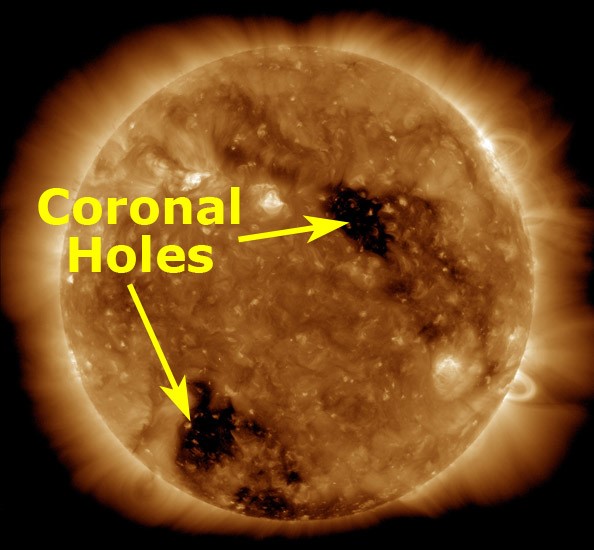
- Coronal holes are large, dark areas on the sun that are cooler and less dense than the surrounding plasma.
- They are regions of open magnetic fields that allow solar wind to escape into space.
- These phenomena are intense sources of fast solar wind, streams of charged particles escaping the sun at high speeds.
- First discovered in - 1970s by X-ray satellites.
- These holes may appear at any time of the solar cycle but they are most common during the declining phase of the cycle.
Solar and Heliosphere Observatory (SOHO), a joint project between NASA and the European Space Agency (ESA) is a spacecraft that orbits the Sun, studying the Sun's interior, atmosphere, and solar wind.
Key findings of the study
- Uniform Temperature - There is no significant variation in the temperature structure of coronal holes across different latitudes.
- Magnetic field structure - The strength of the magnetic field structure within coronal holes varies with latitude, increasing from the solar equator to the poles.
- These results suggest that coronal holes likely originate from the deep solar interior and may form from the superposition of Alfven wave perturbations, respectively.
- Understanding the thermal structure, estimate the depths of origin of coronal holes, while radiative flux and energy estimations help quantify the thermal energy input into interplanetary space.
- Significance of the Findings - Improved monsoon predictions which benefit agriculture and disaster management.
- Deepen the knowledge of how solar phenomena influence Earth’s weather systems.
Reference
India Today |New Findings of Coronal Holes



