Prelims: Current events of national and international importance | Science & Technology
Why in News?
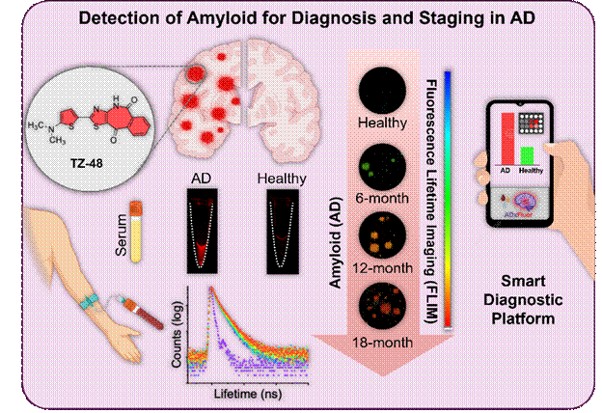
Scientists at the Jawaharlal Nehru Centre for Advanced Scientific Research (JNCASR) have developed a molecular probe for early-stage detection of Alzheimer’s Disease (AD).
- Molecule Probe (TZ-48) - A smart, tiny fluorescence lifetime-responsive probe that selectively binds to misfolded Amyloid-β (Aβ) fibrils.
- It produces a "turn-on" fluorescence response and distinct lifetime signatures.
- ADxFluor - Uses a dedicated smartphone application to capture and quantify changes in fluorescence intensity, enabling rapid, objective, and point-of-care biofluid testing.
- Features –
- Exhibited high Blood-Brain Barrier (BBB) permeability and robust labeling of Aβ plaques in animal models, demonstrating utility in both brain tissue imaging and biofluid detection (blood serum and cerebrospinal fluid).
- Provides a low-cost alternative to conventional, high-cost diagnostic tools such as
- Positron Emission Tomography (PET),
- Magnetic Resonance Imaging (MRI), and
- Complex laboratory-bound immunoassays.
Alzheimer’s Disease & Biomarker Amyloid-β (Aβ)
- Alzheimer's Disease – It is a progressive neurodegenerative disorder marked by memory loss, cognitive decline, and behavioral changes.
- Role of Amyloid-β (Aβ)- Caused by the misfolding and aggregation of Aβ peptides into extracellular amyloid plaques, which trigger neurotoxic cascades, synaptic dysfunction, and neuronal cell death.
- Diagnostic Significance- Aβ pathology is recognized as an early and highly specific hallmark biomarker, essential for timely intervention before irreversible cognitive damage occurs.
Reference
PIB | New smart technology can make diagnosis of AD more accessible



