Mains: GS II – International Organisations
Why in News?
Recently, the 26th Summit of SCO, held in Bishkek, Kyrgyz Republic, on August 31–September 1, 2026, assumed particular significance as it marked 25 years of the organization.
What is SCO?
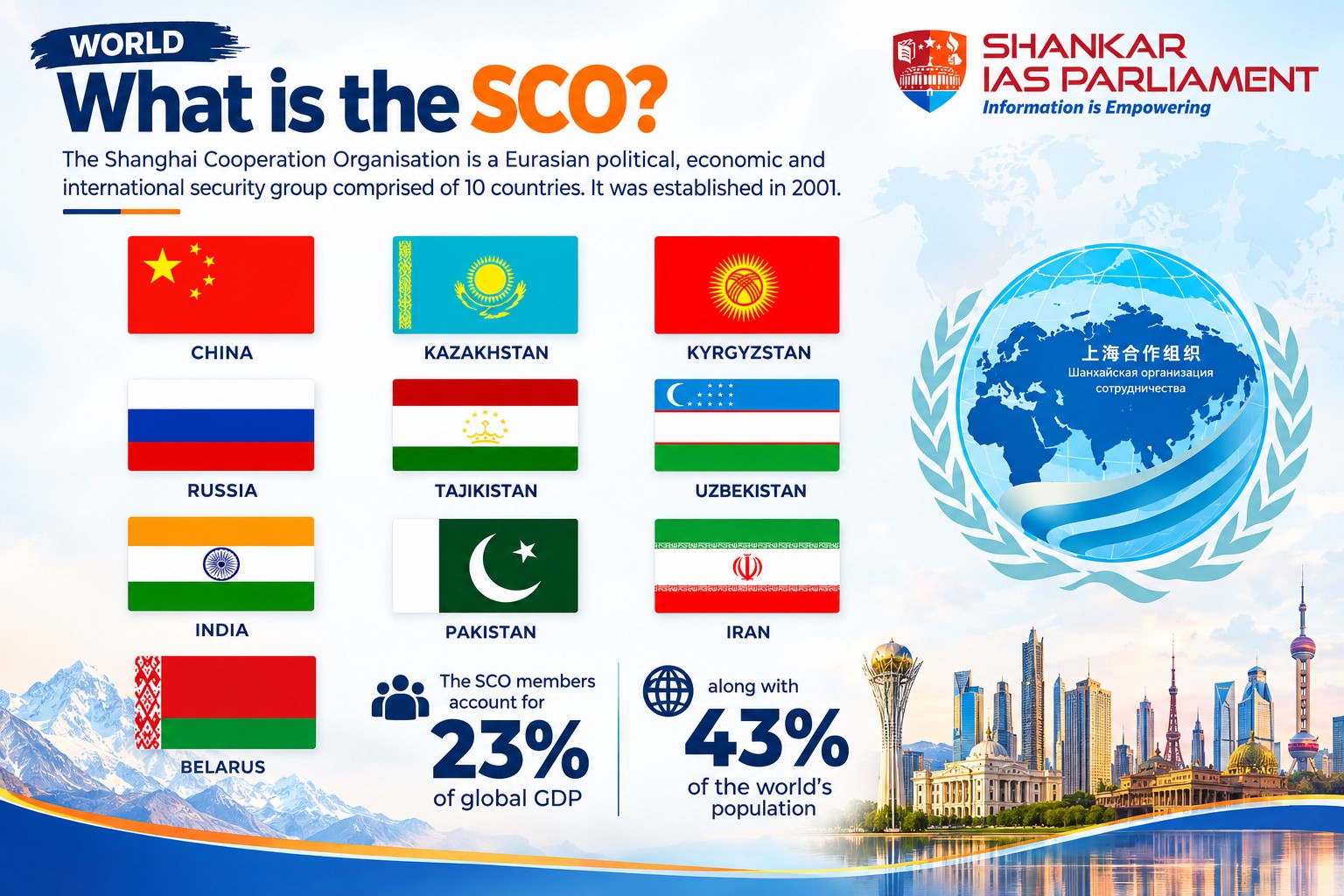
- SCO – The Shanghai Cooperation Organisation (SCO) is a Eurasian political, economic, and security alliance made up of ten member countries.
- Evolution – The SCO was established on June 15, 2001, by China, Russia, Kazakhstan, Kyrgyzstan, Tajikistan and Uzbekistan.
- Members – China, Russia, Kazakhstan, Kyrgyzstan, Tajikistan, Uzbekistan, India, Pakistan, Iran, Belarus.
What is the Significance of SCO?
- Massive Demographic and Economic Weight – The SCO includes 10 member states (China, Russia, India, Pakistan, Iran, Belarus, and four Central Asian nations).
- Together, they cover over 60% of Eurasia, represent about 40% of the world's population, and account for roughly a quarter of the global GDP.
- Regional Security and Counterterrorism – The group focuses heavily on fighting the "Three Evils" of terrorism, separatism, and extremism.
- Its specialized body, the Regional Anti-Terrorist Structure (RATS) based in Tashkent, helps coordinate intelligence and security responses.
- Geopolitical Balance – The alliance gives emerging economies and Eurasian nations a collective platform.
- It promotes a multipolar world order and offers an alternative forum to Western-led institutions.
- Diplomatic Bridge – The SCO brings together rival regional powers—including India, Pakistan, China, and Russia—providing a neutral space for dialogue despite bilateral tensions.
- Energy and Economic Ties – It links resource-rich Central Asian nations and Russia with major energy-importing consumer markets like China and India, boosting regional trade and infrastructure.
- It evolved from the earlier Shanghai Five mechanism, which had focused primarily on confidence-building and border security.
- India and Pakistan became full members in 2017, substantially expanding the organisation's geopolitical importance.
- The SCO today represents a significant part of the Eurasian landmass and provides a platform for cooperation in areas such as counter-terrorism, connectivity, energy, trade, culture and regional security.
- Unlike a military alliance, the SCO does not contain a collective-defence commitment.
- Its significance therefore lies principally in dialogue, consultation and confidence-building among states that often have competing strategic interests.
What are the Issues and Concerns with SCO?
- Internal Rivalries and Bilateral Tensions
- India-China Disputes – Unresolved border conflicts create constant friction between two of the bloc's largest members.
- India-Pakistan Hostility – Deep-seated historical and political tensions between New Delhi and Islamabad spill into the forum.
- Competing Influences – Russia and China share leadership, but potential friction exists over economic dominance in Central Asia.
- Consensus-Based Inefficiency
- Stalled Action – The requirement for absolute consensus among diverse member states makes fast or substantive collective decisions difficult.
- Diverging Foreign Policies – Members hold widely different views on international conflicts, such as the war in Ukraine or developments in West Asia.
- Weak Security and Practical Outcomes
- Symbolic vs. Concrete – The [SCO] is often criticized as being high on geopolitical symbolism—serving as an anti-Western alternative platform for the Global South—but low on tangible security or economic results.
- Vague Counter-Terrorism Mandate – The Regional Anti-Terrorist Structure (RATS) framework relies on a broad definition of the "three evils" (terrorism, separatism, and extremism).
- Critics argue this broad framing allows authoritarian governments to suppress legitimate political opposition and religious expression.
- Economic and Institutional Friction
- Financial Hesitation – Initiatives like proposed internal development funding mechanisms face internal friction and member skepticism over financial exposure.
- Limited Secretariat Capacity – The organization operates with a relatively small budget and restricted analytical infrastructure compared to its massive geographic and demographic scope.
What is the Significance of the Bishkek Summit?
- Highlighting of International conflicts – The Bishkek Summit was the first SCO summit after the outbreak of the U.S.-Israel war with Iran in February 2026.
- The Bishkek Declaration expressed deep concern over the military strikes on Iran, condemned attacks on its territory and reaffirmed support for Iran's sovereignty and territorial integrity.
- The declaration also criticised violations of international law and the principles of the UN Charter.
- SCO members expressed condolences over the assassination of Iran's Supreme Leader Ayatollah Ali Khamenei and other senior officials.
- The summit also supported diplomatic efforts to resolve the conflict and emphasised the importance of peaceful negotiations.
- In the context of Iran's nuclear negotiations, the declaration reaffirmed the member states' inalienable right to develop and use atomic energy for peaceful purposes, consistent with international obligations.
- On the broader West Asian crisis, the SCO maintained that durable peace and stability require a just settlement of the Palestine question.
- Such a position reflects the organisation's broader emphasis on sovereignty, territorial integrity and multilateral approaches to international disputes.
- The Ukraine War and Strategic Ambiguity – Interestingly, the Bishkek Declaration did not directly address Russia's role in the Ukraine conflict.
- This illustrates one of the central characteristics of the SCO: it is a platform where countries with divergent interests seek to cooperate without necessarily resolving their fundamental disagreements.
- The declaration also criticised the unilateral and unlimited expansion of global missile-defence systems, arguing that such developments could negatively affect international security and strategic stability.
- The SCO's position on satellite-based internet services also reflected emerging debates over sovereignty, technology and international law, particularly regarding unauthorised satellite internet services operating within member states.
- India-Pakistan Dimension – The conclusion of the Bishkek Summit is particularly important for India because Pakistan has assumed the SCO chairmanship, with the next summit scheduled to be held in Pakistan.
- Whether Prime Minister Modi will travel to Pakistan for the summit remains a matter of diplomatic calculation. India-Pakistan relations have deteriorated significantly following the Pahalgam terror attack of April 22, 2025, Operation Sindoor and India's decision to place the Indus Waters Treaty in abeyance.
- Nevertheless, the SCO offers India and Pakistan a valuable platform for structured and sustained engagement. Such engagement need not imply normalisation of bilateral relations; rather, it can help maintain channels of communication and reduce the risk of misunderstandings escalating into larger conflicts.
What are the India's Priorities at the Bishkek Summit?
- Combating Terrorism – India reiterated that there should be no double standards in combating terrorism.
- This remains particularly important given India's concerns over cross-border terrorism and the use of terrorist organisations as instruments of state policy.
- The SCO's strong condemnation of terrorism, separatism and extremism is therefore significant for India.
- However, the effectiveness of such declarations ultimately depends upon translating them into concrete cooperation against terrorist financing, safe havens, radicalisation and cross-border networks.
- Afghanistan – India also stressed the importance of peace and stability in Afghanistan and highlighted its humanitarian assistance to the Afghan people.
- The SCO called for the establishment of an inclusive government in Afghanistan.
- For India, a stable Afghanistan is important because instability can contribute to terrorism, drug trafficking, refugee flows and regional insecurity.
- Connectivity and Sovereignty – Prime Minister Modi advocated greater connectivity among SCO economies while emphasising respect for the sovereignty and territorial integrity of states.
- This is significant in the context of China's Belt and Road Initiative (BRI) and the China-Pakistan Economic Corridor (CPEC).
- India has consistently opposed projects that pass through territories under Pakistan's control but claimed by India.
- Consequently, India refrained from endorsing the China-led BRI, even though other SCO members supported the initiative and called for greater coordination between the BRI and the Eurasian Economic Union.
|
SCO as a Platform for Indian Diplomacy
|
- Since joining the SCO in 2017, India has used the organisation to pursue important diplomatic objectives.
- The Kazan Summit of 2024 provided an opportunity for Prime Minister Modi and President Xi Jinping to re-engage after tensions arising from the Galwan episode.
- This was followed by their meeting at the Tianjin Summit in 2025, where the two sides discussed measures relating to the boundary issue and the restoration of border trade.
- These interactions demonstrate the value of multilateral institutions such as the SCO in maintaining dialogue even when bilateral relations are strained.
- The SCO also enables India to engage Russia, China, Iran and Central Asian states within a common institutional framework. At a time when India seeks strategic autonomy and diversified partnerships, such platforms are particularly valuable.
|
What India should do?
- Strengthen cooperation against terrorism and terror financing,
- Promote connectivity while insisting on sovereignty and territorial integrity,
- Deepen economic and energy cooperation with central asia,
- Use the sco to maintain dialogue with china and Pakistan,
- Support diplomatic solutions to regional conflicts,
- Promote greater use of national currencies while protecting india's economic interests,
- Strengthen institutional mechanisms such as the proposed sco development bank, and
- Utilise the organisation to advance india's vision of a multipolar and rules-based international order.
What lies ahead?
- The SCO's survival for 25 years despite serious differences among its members demonstrates the continuing value of institutionalised dialogue.
- Its importance lies less in its ability to function as a unified strategic bloc and more in its capacity to bring together competing powers within a common diplomatic framework.
- For India, the SCO represents an important instrument of strategic autonomy.
- It enables New Delhi to engage China and Russia, maintain dialogue with Pakistan, strengthen relations with Central Asia and participate in discussions on Afghanistan, terrorism, connectivity and global security.
- The Bishkek Summit therefore reaffirmed that in an increasingly fragmented world, multilateral platforms that preserve communication among rivals can be valuable instruments of conflict management and regional stability.
- India's challenge is to use the SCO not merely as a forum for declarations, but as a practical platform to advance its security, economic and diplomatic interests while contributing to a more balanced Eurasian order.
Reference
The Hindu| SCO



