Prelims: Current events of National and International Importance | Species
Why in News?
Recently, the world's oldest living land animal, at 193 years, Jonathan, a nearly 200-year-old tortoise, trended globally after death rumours on the island of St. Helena.
- Scientific name – Aldabrachelys gigantea hololissa
- Family – Testudinidae
- It is a rare subspecies of the Aldabra giant tortoise native to the granitic islands of the Seychelles.
- Commonly known as – the Seychelles giant tortoise or the Seychelles domed giant tortoise.
- Habitat – They inhabit grasslands, scrub forests, and coastal dunes.
- Distribution – Native to the Seychelles, its largest surviving population today is found on the Aldabra Atoll, a UNESCO World Heritage Site.
- It was once found on many islands of the Indian Ocean.
- For conservation purposes, they have also been introduced to other islands of Seychelles to safeguard their survival.
- Size – Males can weigh up to 250 kg, females around 150–160 kg.
- Physical Appearance – It has a broad, brownish-grey carapace that is flattened on the back with raised scutes.
- This distinguishes it from the more roundly-domed A. g. gigantea and the saddle-backed A. g. arnoldi.
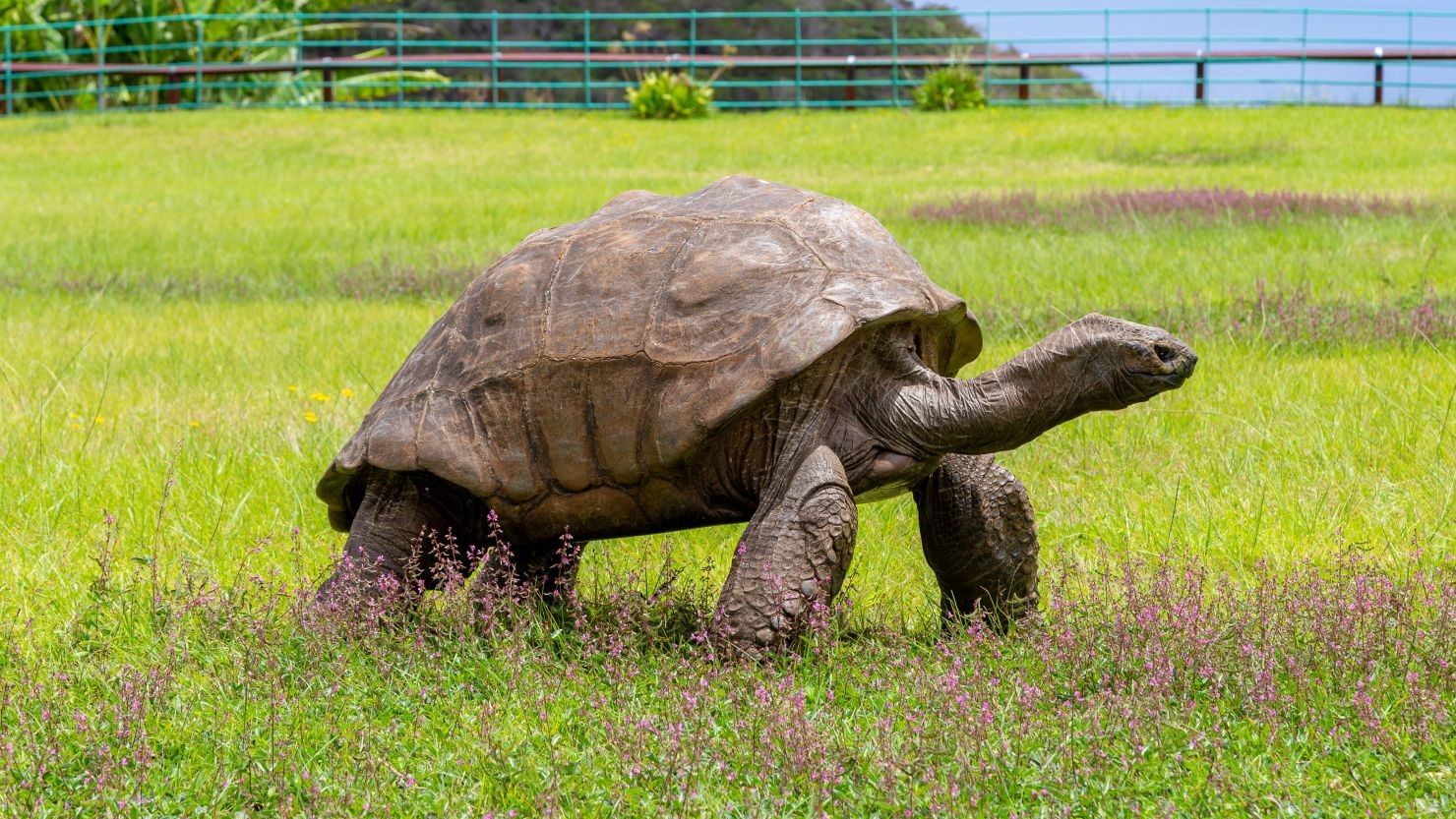
- Morphology – Dome-shaped shell, strong limbs, herbivorous diet, slow-moving reptile with an extraordinary lifespan.
- Reproduction – Females lay clutches of 9–25 eggs. Hatchlings are vulnerable to predation, requiring conservation efforts for survival.
- Adaptation – Adapted to arid island ecosystems, capable of surviving on limited vegetation and water, their slow metabolism supports longevity.
- Diet – Primarily herbivorous, feeding on grasses, leaves, fruits, and woody plant stems.
- Conservation Status
- IUCN – Vulnerable
- CITES – Appendix II
- Threats – Habitat loss, illegal hunting, and climate change.
References
- The Hindu | Jonathan
- Nature seychelles | Aldabra-giant-tortoise



