Why in News?
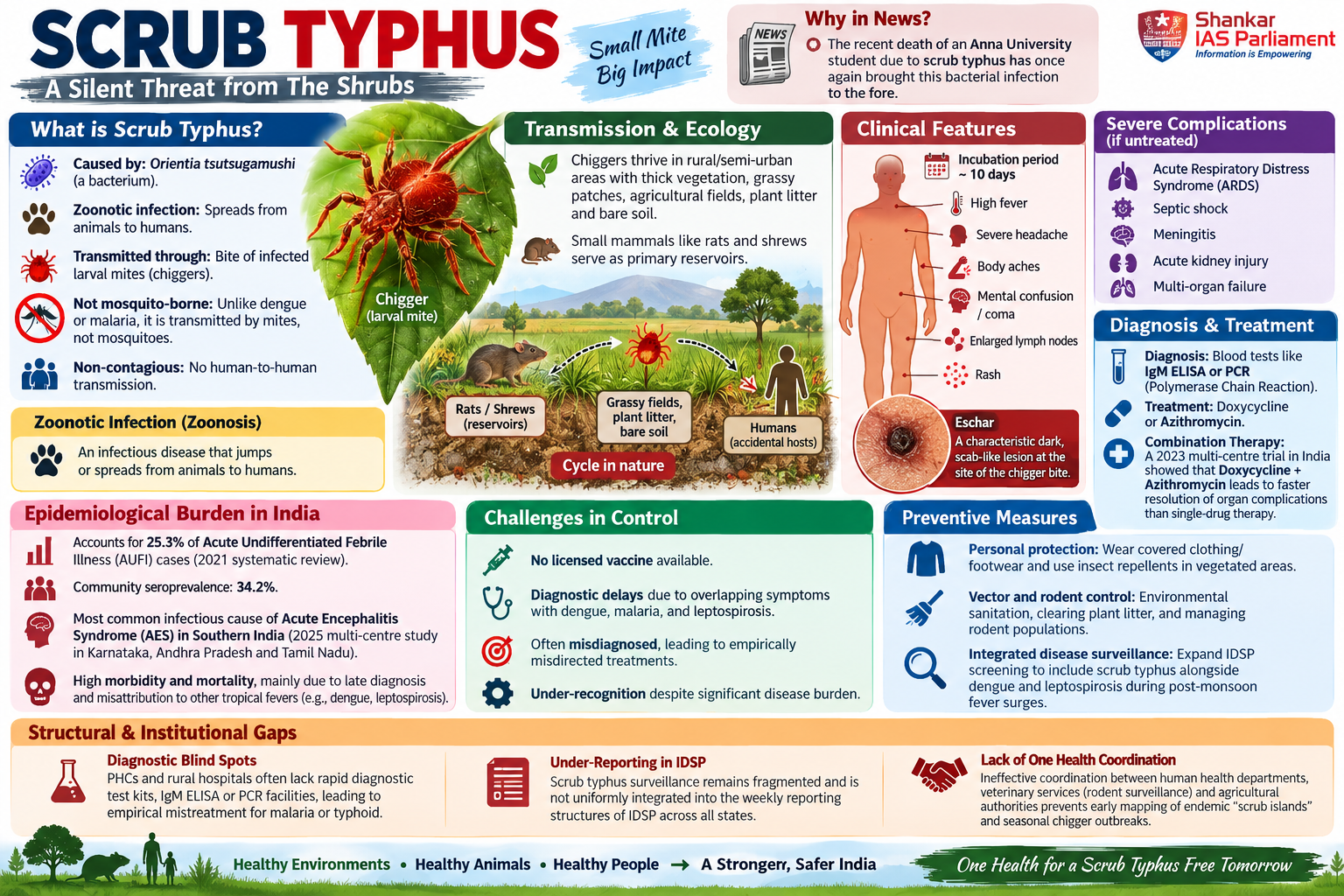
Recently, death of an Anna University student, due to scrub typhus, has once again brought this bacterial infection to the fore.
What is Scrub Typhus and what is its transmission mechanism?
- Pathogen and Vector – Scrub typhus is a bacterial zoonotic infection caused by the bacterium Orientia tsutsugamushi.
Zoonotic Infection (zoonosis) is an infectious disease that jumps or spreads from animals to humans
- It is transmitted to humans through the bite of infected larval mites (commonly called chiggers).
- Not Mosquito-Borne – Unlike dengue or malaria, it is vector-borne via mites, not mosquitoes. It is non-contagious (no human-to-human transmission).
- Ecological Niche – Chiggers thrive in rural/semi-urban areas with thick vegetation, grassy patches, agricultural fields, plant litter, and bare soil. Small mammals like rats and shrews serve as primary reservoirs.
What is the current epidemiological burden and public health impact of Scrub Typhus in India?
- Acute Undifferentiated Febrile Illness (AUFI) – A 2021 systematic review identified scrub typhus as a grossly under-recognized public health issue in India, accounting for 25.3% of AUFI cases with a community seroprevalence of 34.2%.
- Emerging Cause of Acute Encephalitis Syndrome (AES) – A 2025 multi-centre study across Karnataka, Andhra Pradesh, and Tamil Nadu revealed that scrub typhus has become the most common infectious cause of AES in Southern India.
- High Morbidity and Mortality – India sees high mortality rates primarily driven by late diagnosis and misattribution to other common tropical fevers (e.g., dengue, leptospirosis).
What are the clinical manifestations, diagnostic hurdles, and treatment protocols?
- Symptoms and Pathognomonic Signs –
- Incubation period of 10 days; Symptoms include high fever, severe headache, body aches, mental confusion/coma, enlarged lymph nodes, and rash.
- Eschar – A characteristic dark, scab-like lesion at the site of the chigger bite serves as a key clinical sign.
- Severe Complications – Untreated infection escalates to multi-organ failure, including Acute Respiratory Distress Syndrome (ARDS), septic shock, meningitis, and acute kidney injury.
- Diagnostics – Confirmed via blood tests like IgM ELISA or PCR (Polymerase Chain Reaction).
- Therapeutic Regimen –
- Effective early treatment relies on antibiotics like Doxycycline or Azithromycin.
- Combination Therapy – A landmark 2023 multi-centre trial in India showed that a combination of Doxycycline and Azithromycin resulted in faster resolution of organ complications compared to single-drug monotherapy.
What are the primary challenges in controlling Scrub Typhus, and what preventive measures are required?
- Lack of Vaccine – Currently, there is no licensed vaccine for scrub typhus.
- Diagnostic Delay – Overlapping clinical presentations with dengue, malaria, and leptospirosis lead to empirically misdirected treatments.
- Preventive and Surveillance Strategy –
- Personal Protection – Wearing covered clothing/footwear and applying insect repellents in high-risk vegetated environments.
- Vector and Rodent Control – Environmental sanitation, clearing plant litter, and managing rodent (rat/shrew) populations.
- Integrated Disease Surveillance – Urgent expansion of Integrated Disease Surveillance Programme (IDSP) screening to include scrub typhus alongside dengue and leptospirosis during post-monsoon fever surges.
What structural and institutional gaps hinder the integration of Scrub Typhus control into India's public health system?
- Diagnostic Blind Spots – Primary Health Centres (PHCs) and rural community hospitals often lack rapid diagnostic test (RDT) kits, IgM ELISA, or PCR capabilities, leading to empirical mistreatment for malaria or typhoid.
- Under-Reporting in IDSP – Scrub typhus surveillance remains fragmented and is not uniformly integrated into the weekly reporting structures of the Integrated Disease Surveillance Programme (IDSP) across all states.
- Lack of One Health Coordination – Ineffective inter-sectoral coordination between human health departments, veterinary services (rodent surveillance), and agricultural authorities prevents early mapping of endemic "scrub islands" and seasonal chigger outbreaks.
Reference
The Hindu | Scrub Typhus



