Prelims: Current events of national and international importance | Science & Technology
Why in News?
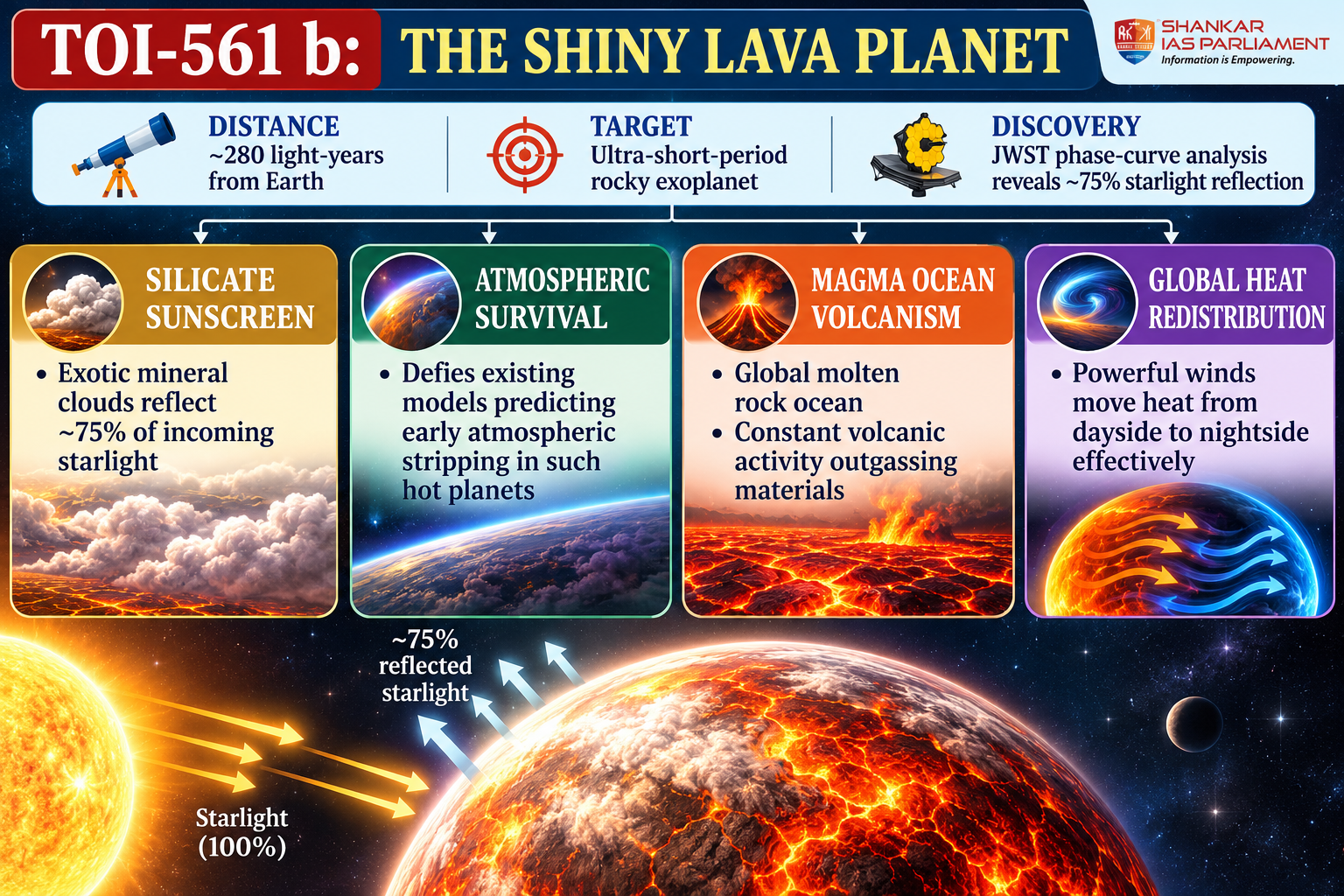
Recently, astronomers utilizing observations from the James Webb Space Telescope (JWST) revealed that TOI-561 b—a scorching, ultra-short-period lava planet maintains a thick, highly reflective atmosphere.
- Despite extreme stellar radiation, the planet reflects approximately 75% of incoming starlight and an exotic silicate-mineral clouds acting as a "giant sunscreen."
- Distance - Located roughly 280 light-years from Earth.
Key Highlights
- The "Giant Sunscreen" Effect
- Using JWST's Near-Infrared Spectrograph (NIRSpec) to map the planet's orbital phase curves, scientists discovered that TOI-561 b reflects nearly three-quarters of the starlight hitting it.
- This immense reflectivity is driven by dense layers of silicate-mineral clouds suspended high above the surface, shielding the molten world from even harsher thermal loading.
- Sustaining an "Impossible" Atmosphere
- Under standard astrophysical models, intensely irradiated rocky worlds orbiting close to their host stars lose their volatile gas envelopes early in their history.
- The Replenishment Hypothesis- Scientists hypothesize that TOI-561 b's global ocean of molten lava acts as a planet-wide volcanic engine, continually venting gases (such as carbon dioxide or sulfur dioxide analogs) to replenish the upper atmosphere as fast as stellar winds erode it.
Strategic Significance
- Planetary scientists are intensely studying ultra-hot lava worlds because Earth itself likely passed through a molten magma-ocean phase during its earliest history.
- Understanding how atmospheres behave and survive under extreme stellar bombardment provides vital clues to terrestrial planet evolution across the galaxy.
Reference
Science Daily | Scorching lava planet with a “giant sunscreen”



