Prelims: Current events of national and international importance | Environment & Ecology
Why in News?
Shanghai Cooperation Organisation (SCO)
- Formation - A permanent intergovernmental international organisation founded in June 2001 in Shanghai, China.
- Genesis - Evolved from the 'Shanghai Five' mechanism (China, Russia, Kazakhstan, Kyrgyzstan, Tajikistan) that was established in 1996 for border demilitarization and security.
- Charter - The SCO Charter was signed in June 2002 and entered into force in September 2003.
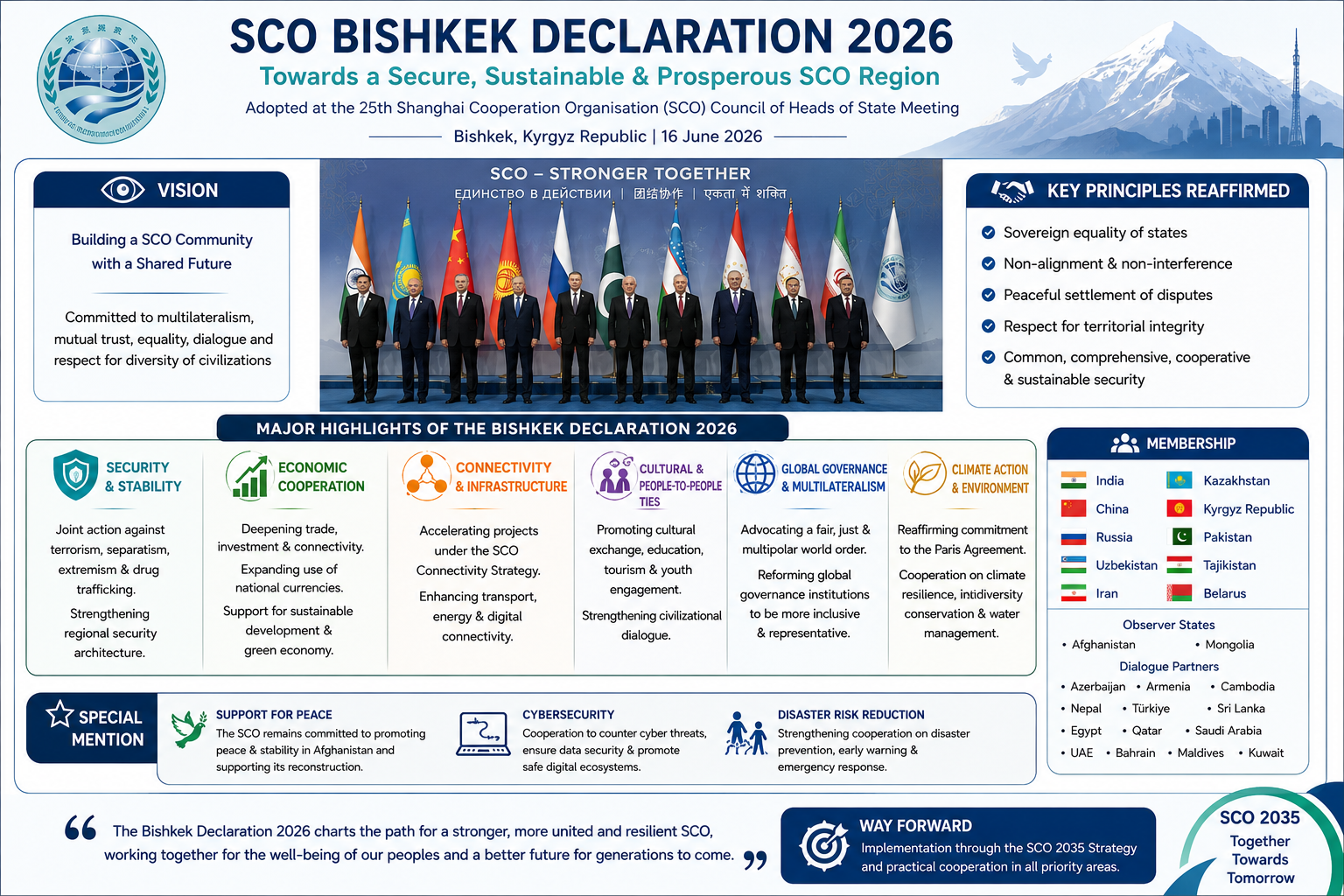
Key Highlights of the Bishkek Declaration 2026
- Regional Security and Counter-Terrorism
- Combating the 'Three Evils' - The declaration reaffirmed the uncompromising commitment to jointly fight Terrorism, Separatism, and Extremism.
- SCO-RATS Enhancement - Member states emphasized strengthening the Regional Anti-Terrorist Structure (SCO-RATS) as a pivotal mechanism for intelligence sharing and unified operations.
- Stability in Afghanistan- SCO called for the establishment of an inclusive government in Afghanistan as vital for regional security, emphasizing the territory should not become a sanctuary for terror outfits.
- Drug Trafficking and Cybercrime - Identified the illicit drug trade (originating from the Golden Crescent) and misuse of information technologies for radicalization as priority security challenges requiring immediate collaborative action.
- Economic Connectivity and Development
- Multilateral Trade Facilitation- Focus on deepening economic cooperation, reducing non-tariff barriers, and utilizing national currencies for trade settlements to mitigate dependency on the US Dollar.
- Transport and Energy Corridors - Prioritized the development of robust regional transport networks, infrastructure (like the International North-South Transport Corridor), and energy grids to foster integration.
- Multilateralism and UN Reform
- Upholding International Law- Championed a multipolar world order based on the principles of the UN Charter, sovereignty, and non-interference in internal affairs.
- Rejecting Unilateralism - Firmly opposed unilateral economic sanctions that violate international law and disrupt global supply chains.
- Reforming the UN- Emphasized the comprehensive reform of the United Nations, including the Security Council, to ensure it reflects contemporary realities.
India’s Stance and Contribution at the Summit
- Focus on 'SECURE' Concept – PM reiterated India's visionary 'SECURE' formula: Security, Economic development, Connectivity, Unity, Respect for sovereignty, and Environmental protection.
- Connectivity with Sovereignty - India, while supporting regional connectivity, maintained its consistent refusal to endorse China's Belt and Road Initiative (BRI) due to violations of Indian territorial integrity and sovereignty.
- Focus on DPI and Tech - Highlighted India's leadership in developing scalable, low-cost Digital Public Infrastructure (DPI) to foster financial inclusion in other SCO states.
- Tackling Pakistan and China on Terror- Strongly reiterated India's demand to cease state-sponsored cross-border terrorism and oppose 'double standards' in labeling terrorists.
Reference
Indian Express | What does the Bishkek Declaration say?



