Mains: GSII – Governance| Social Justice
Why in News?
The Allahabad High Court held that religious conversion does not automatically end Scheduled Tribe (ST) status, but continuing tribal affiliation may be examined where such status is disputed.
What is the Background of the Case?
- Context – The case involved three agricultural land transactions in Sonbhadra, Uttar Pradesh, in 2011, 2017 and 2018.
- The petitioner (Land buyer) claimed ST status by birth as a member of the Bhuiyan tribe.
- Authorities questioned her status after records showed that she had married a Muslim man and converted to Islam.
- The Deputy Collector declared the transactions void under Section 157-B of the U.P. Zamindari Abolition and Land Reforms Act, 1950,
- It restricts transfer of protected ST land to non-ST persons.
- Court’s Key Observations – Conversion alone cannot extinguish ST status.
- The Constitution (Scheduled Tribes) Order, 1950 does not prescribe a religion-based exclusion from ST status.
- Whether ST status continues after conversion is primarily a question of fact, to be determined from evidence.
- The Court relied on
- State of Kerala v. Chandramohanan (2004) and
- Chinthada Anand v. State of Andhra Pradesh (2026).
- A person need not follow every tribal custom throughout life, and a single document indicating another religion cannot by itself determine ST status.
- The Court ultimately upheld cancellation of the transactions as the petitioner failed to establish sufficient continuing connection with the Bhuiyan community.
Why is the Issue Important?
- Question of identity – The judgment distinguishes religious identity from tribal identity.
- Religion based exclusion – The ST framework does not prescribe a general religion-based exclusion, unlike the constitutional framework governing Scheduled Castes.
- ST status – It provides access to affirmative action and protective measures, including safeguards against alienation of tribal land.
- Therefore, determining continuing tribal affiliation can become important when ST status is disputed.
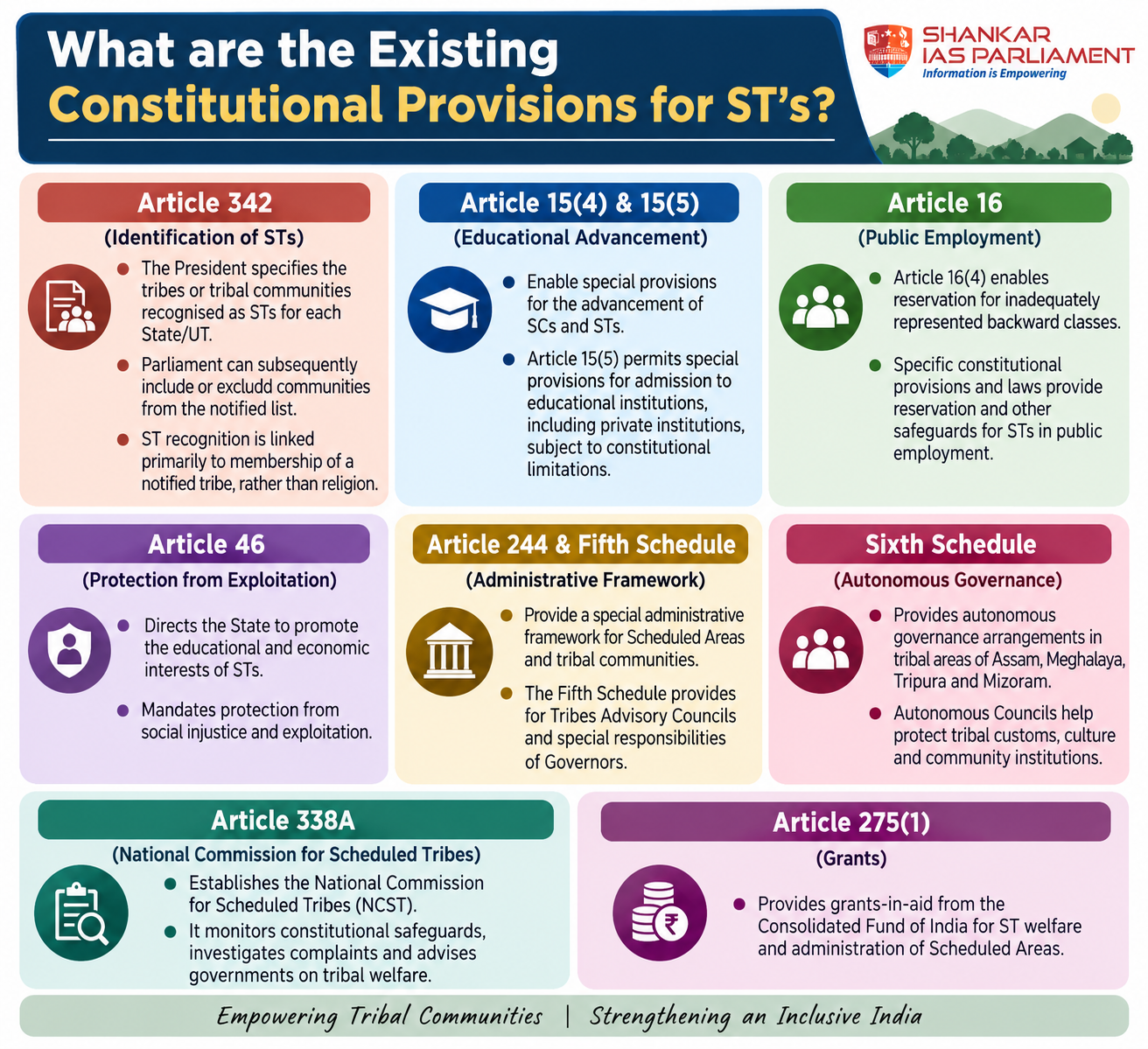
What are the Existing Constitutional Provisions for ST’s?
- Article 342 (Identification of STs) – The President specifies the tribes or tribal communities recognised as STs for each State/UT.
- Parliament can subsequently include or exclude communities from the notified list.
- ST recognition is therefore linked primarily to membership of a notified tribe, rather than religion.
- Article 15(4) and 15(5) – Educational Advancement – Enable special provisions for the advancement of SCs and STs.
- Article 15(5) permits special provisions for admission to educational institutions, including private institutions, subject to constitutional limitations.
- Article 16 – Public Employment – Article 16(4) enables reservation for inadequately represented backward classes.
- Specific constitutional provisions and laws provide reservation and other safeguards for STs in public employment.
- Article 46 (Protection from Exploitation) – Directs the State to promote the educational and economic interests of STs.
- Mandates protection from social injustice and exploitation.
- Article 244 and Fifth Schedule – Provide a special administrative framework for Scheduled Areas and tribal communities.
- The Fifth Schedule provides for Tribes Advisory Councils and special responsibilities of Governors.
- 6th Schedule – Provides autonomous governance arrangements in tribal areas of Assam, Meghalaya, Tripura and Mizoram.
- Autonomous Councils help protect tribal customs, culture and community institutions.
- Article 338A (NCST) – Establishes the National Commission for Scheduled Tribes (NCST).
- It monitors constitutional safeguards, investigates complaints and advises governments on tribal welfare.
- Article 275(1) (Grants) – Provides grants-in-aid from the Consolidated Fund of India for ST welfare and administration of Scheduled Areas.
What are the Existing Legal and Policy Measures?
- Protection of Tribal Land – State laws restrict transfer of tribal land to non-tribals to prevent land alienation and exploitation.
- In this case, Section 157-B of the U.P. Act, 1950 was central to determining the validity of the transactions.
- Forest Rights Act, 2006 – Recognises individual and community forest rights of forest-dwelling STs and other eligible forest dwellers.
- Gives the Gram Sabha a central role in recognising forest rights.
- PESA Act, 1996 – Extends Panchayati Raj to Scheduled Areas with safeguards for tribal self-governance.
- Empowers Gram Sabhas to safeguard customs, traditions, cultural identity and community resources.
What are the Key Challenges Existing?
- Defining continuing tribal identity – Conversion may alter religious affiliation without necessarily ending social or cultural links with the tribe.
- Overly rigid tests – Requiring strict adherence to every tribal custom may fail to reflect social change and diversity within tribal communities.
- Potential misuse – ST status provides several safeguards and benefits, creating a need to prevent fraudulent claims.
- Tribal diversity – Different tribes have distinct customs, traditions and social structures; a uniform test may therefore be inappropriate.
What could be done?
- Clear Tribal Affiliation Criteria – Develop evidence-based guidelines to determine continuing tribal affiliation.
- Avoid Automatic Disqualification – Treat religious conversion as one factor, not an automatic loss of ST status.
- Multiple Indicators – Consider community recognition, social participation, cultural practices and documentary evidence.
- Avoid Single-Factor Tests – Do not treat one document or religious identity as conclusive.
- Strengthen ST Verification – Improve ST certificate verification while protecting genuine claimants.
- Protect Tribal Land – Ensure effective implementation of laws preventing alienation of tribal land.
What lies ahead?
- The judgment reinforces that religious conversion and tribal identity are legally distinct.
- Conversion alone cannot automatically terminate ST status where the constitutional framework does not prescribe such exclusion.
- When continuation of ST status is disputed, a fact-based assessment of the individual's connection with the tribal community may be necessary.
- The objective should be to balance protection of tribal identity and resources, prevention of misuse of ST safeguards, and respect for the evolving nature of tribal communities.
Reference
The Hindu| Does religious conversion affect Scheduled Tribe status?



