Mains: GS I – Social Issues
Recently, the Supreme Court, delivered a judgment in Prajwala v. Union of India, addressing trafficking for commercial sexual exploitation (CSE) and victim rehabilitation.
Sex Workers – They are adult who receives money or goods in exchange for consensual sexual services, erotic performances, or adult entertainment.
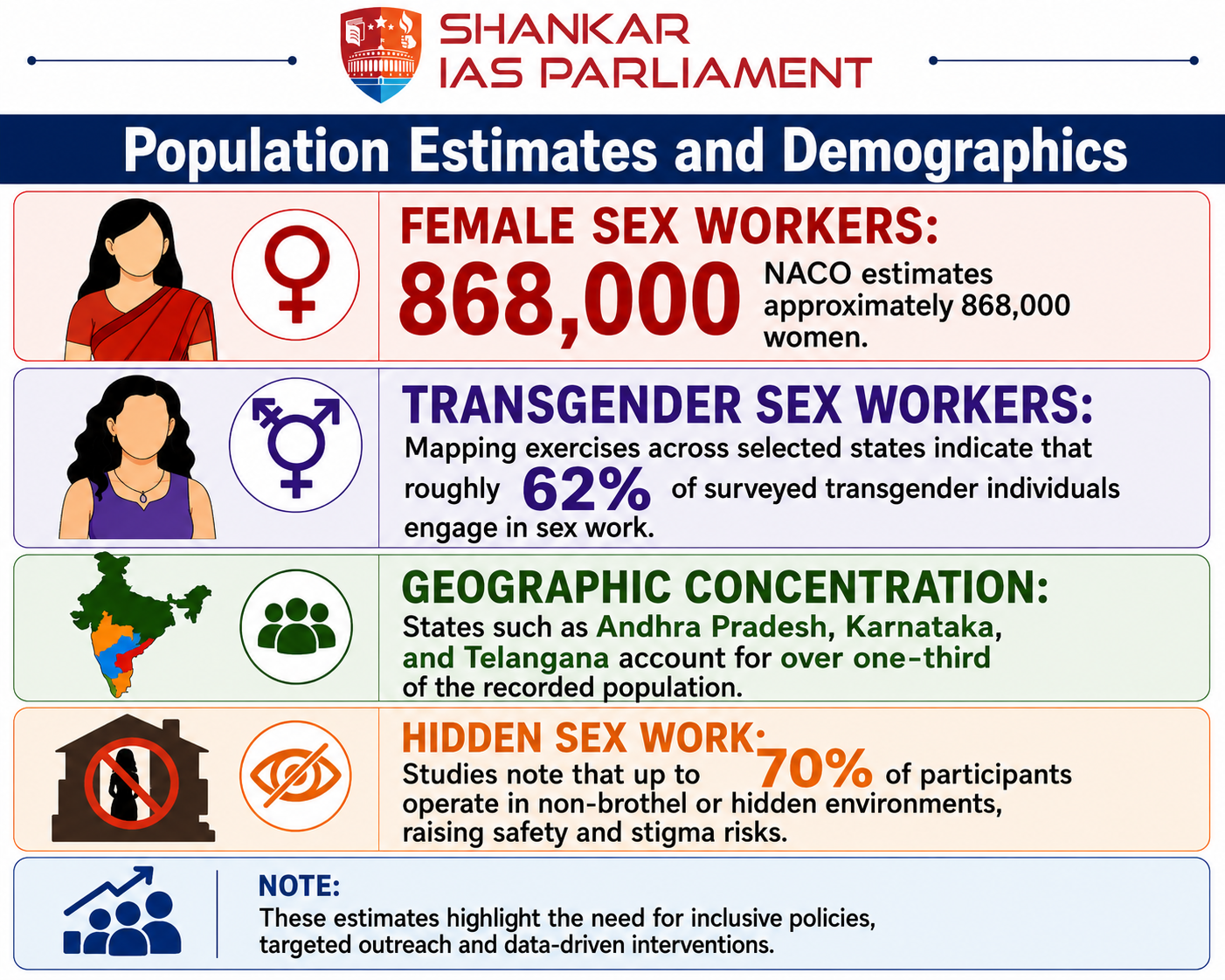
India’s demographic share – National AIDS Control Organisation (NACO) identified approximately 800,000 sex workers through its tracking programs.
Non-governmental organizations and UN-affiliated groups estimate the total population to be between 2 million and 3 million individuals.
Forced Rescue – The Supreme Court observed that anti-trafficking raids often result in forced rescue, placement in protective homes, and indefinite confinement, which undermines genuine rehabilitation.
Criminalisation and stigma – The Supreme Court observed that sex workers experience moral stigma, police harassment, social exclusion, and discrimination, all of which impede their access to justice and public institutions.
Separation from Children – SC noted that rescue operations often cause traumatic separation of women from their children, causing insecurity and distress.
Institutional Accountability – The Supreme Court cautioned that protective homes may become spaces of control if residents are
Denied legal aid,
Subjected to excessive restrictions,
Have their preferences disregarded, or experience inadequate monitoring.
Economic Vulnerability – SC recognized that poverty, few job opportunities, and limited social support reduce choices, increasing sex workers’ dependence and insecurity.
Caste Discrimination – The SC noted that caste and socioeconomic marginalisation push people into sex work.
These factors also shape how police, courts, and bureaucracy treat them.
Voluntary vs. Trafficking – The Supreme Court distinguished voluntary adult sex work from trafficking, recognising that consensual sex work is not exploitative and affirms adult agency.
Consent & Autonomy – SC held that rehabilitation must be guided by consent and individual autonomy, affirming sex workers’ agency.
Constitutional Rights – The SC affirmed that Articles 21 and 23 apply to sex workers, ensuring their rights to life, liberty, and protection from forced labour remain intact despite social disapproval.
No Forcible Rescue – SC ruled that voluntary adult sex workers cannot be subjected to forced rescue or detention, and any intervention must first establish consent.
Victim Protection Plan – SC issued a detailed plan under Articles 32 & 142, covering all stages includes pre‑rescue, rescue, post‑rescue, rehabilitation, and reintegration.
SC shifted from paternalistic rescue‑rehabilitation to a rights‑based, dignity, autonomy, and consent framework, recognising sex workers as citizens with agency.
Pre‑Rescue – Ensure Anti-Human Trafficking Units (AHTUs) are adequately trained, employ victim-sensitive methods, avoid mass raids, include female personnel, and maintain sensitivity to HIV-related issues.
Rescue – Treat victims as individuals in need of assistance rather than as criminals, ensure their separation from traffickers, recover identification documents, provide protection for children, and enforce penalties for police misconduct.
Post‑Rescue – Provide humane living conditions, ensure access to sanitation facilities, offer translation services, guarantee legal aid, maintain confidentiality, and facilitate early transfer to protective homes.
Rehabilitation and Reintegration – Recognize rehabilitation as a constitutional right, ensure all processes are guided by informed consent, prohibit forced rehabilitation, and avoid mechanical placement in homes or families.
Gap Between Rights and Implementation – Court recognition of rights does not necessarily lead to changes in police or bureaucratic behavior.
Risk of Institutional Bias – Police, magistrates, and shelter authorities may continue to view sex workers from a moralistic or paternalistic perspective.
Anti-Trafficking–Rescue Complex – A key concern is that institutions involved in anti-trafficking operations may prioritize rescue and confinement instead of autonomy and rehabilitation.
Marginalised Communities – Caste, class, and gender inequalities can affect how effectively individuals exercise their legally recognized rights.
Participation Deficit – Implementation should be developed in consultation with sex workers, rather than without their involvement.
Affected communities and their collectives should play a meaningful role in developing guidelines, monitoring shelters, and evaluating police practices.
Inclusion of Collectives – It prioritize the inclusion of sex worker collectives in policymaking and monitoring processes.
Strengthen AHTUs – It enhances Anti-Human Trafficking Units (AHTUs) through specialized training, increased sensitivity, and strengthened accountability.
Operationalize Consent – It ensures that consent is operationalized as informed, freely given, voluntary, and continuous.
Reform Shelter Homes – By instituting regular monitoring, providing legal aid, establishing grievance redressal mechanisms, and upholding the dignity of residents.
Address Structural Causes – By improving access to livelihoods, housing, education, healthcare, and social security.
NGO Accountability – It promotes through transparent funding practices, regular audits, and accessible grievance mechanisms.
Leverage Welfare Schemes – Sex workers should be granted access to existing social programmes as rights-holders rather than as recipients of charity.



