Mains: GS III – Infrastructure
Why in News?
Recently, the Union Government approved Samudra Manthan – National Offshore Exploration Scheme, with a Phase-I, to accelerate offshore hydrocarbon exploration and production.
What is Samudra Manthan?
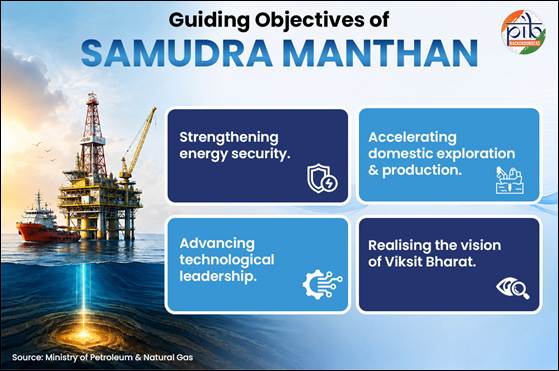
- Samudra Manthan – It is a Central Sector Scheme of the Ministry of Petroleum & Natural Gas.
- Funds – Phase-I outlay of Rs.84,084 crore up to FY 2030‑31.
- Objective – To facilitate the development of reserves totalling 600 Million Metric Tonnes of Oil Equivalent (MMTOE) and to strengthen domestic energy security.
|
India’s Energy Dependence
|
- India is the 3rd largest consumer of crude oil globally.
- Import Cost – Annual crude oil imports amount to approximately USD 144 billion, equivalent to about ₹13 lakh crore.
- Risk – Disruptions in global supply highlight the critical need for robust energy security measures.
- Need – Expanding domestic energy production is vital to sustain rapid economic growth.
|
What are the four key components of Samudra Manthan?
- Seismic Data Acquisition, Processing, and Interpretation
- Large-scale 2D and 3D seismic surveys
- Advanced technology and Artificial Intelligence will speed up processing and interpretation.
- Older data in the National Data Repository will also be re-processed with modern tools.
- Accelerated Offshore Exploration
- It planned to drill 60 deepwater and ultra-deepwater wells.
- Financial support – up to 50 percent of eligible drilling cost, or ₹675 crore per well, whichever is lower.
- Both public and private Exploration and Production (E&P) operators to increase oil and gas reserves.
- Common Offshore Infrastructure – It scheme provides fund for shared production and evacuation facilities in select basins.
- It lowers project costs and turns idle finds into producing fields.
- Oil and Gas Manufacturing and Services Zone – It will build domestic capabilities in manufacturing, repair, warehousing, engineering, and services.
- It directly advances Make in India across the supply chain by supporting monitoring, digital interventions, evaluation, human resources, awareness, outreach, events, and media.
Mahanadi Basin – India began drilling its first appraisal well (MN‑DWN18‑1‑HD) in the Mahanadi Offshore Basin, using advanced deepwater technology under a four‑well programme to evaluate one of its most prospective hydrocarbon basins.
What are the challenges of Deepsea Exploration?
- Execution delay – Exploration and production is a prolonged process, typically requiring five to ten years from block award to commencement of production.
- High capital – Deepwater wells require significant capital investment, with costs ranging from approximately USD 125 to 150 million per well.
- Risk & uncertainties – The high-risk profile associated with offshore projects further deters potential investment.
- Output decline – Production from existing fields typically declines at a rate of 6 to 7 percent per year further deters potential investment.
- Environmental Concerns – Deepwater drilling introduces significant ecological risks and necessitates the implementation of rigorous environmental safeguards.
What are the advantages of the Deepsea Exploration?
- Larger Reserves – Increase of over 600 MMTOE of hydrocarbon reserves, expanding the resource base from 1.6 billion to 2.2 billion Tonnes of Oil Equivalent (TOE).
- Higher Output – Annual domestic production is targeted to rise from around 62 MMTOE to 80 MMTOE.
- Incremental production of 10–15 MMTOE is expected, with a peak potential of 20 MMTOE.
- Lower Import Bill – Additional output can cut crude imports by nearly Rs.1 lakh crore every year, generating significant foreign exchange savings.
- Investment and Growth – It will promote investments across the value chain and drive strong GDP expansion.
- Employment – Large-scale jobs will be created in exploration, production, and allied activities.
- Indigenous Strength – Domestic manufacturing will deepen under Make in India and Atmanirbhar Bharat, fostering a globally competitive ecosystem for offshore technologies.
|
Geoscientific Databases
|
- Seismic surveys send sound waves into the earth to map rock layers below the seabed.
- India has made sustained investments in such geoscientific knowledge through several national initiatives. Such as
- Mission Anveshan,
- the National Seismic Programme,
- the Extended Continental Shelf Survey,
- the National Data Repository, and
- the Hydrocarbon Resource Assessment Study.
- Together, these have created one of the world’s most comprehensive geoscientific databases.
|
What lies ahead?
- India’s energy future depends on ongoing reforms, scientific advancement, and the commitment of geologists, engineers, and offshore professionals.
- Together, these efforts signal the start of a promising energy era.
Reference
PIB | Samudra Manthan – National Offshore Exploration Scheme



