Why in news?
As the world grapples with the severity of the illegal invasion of Ukraine, the international law violations committed by Russia seems to be a major concern.
What is the current situation?
- The situation between Russia and Ukraine has been poor ever since the annexation of Crimea, a south-eastern Ukrainian province by Russia in 2014.
- The situation worsened when the Russian President ordered a special military operation within Ukraine, a sovereign nation.
- Reasons- The pretext of the said operation was initially
- To honour the Minsk Agreements
- To liberate and defend the Donbas region and the people of Donetsk and Luhansk in Ukraine
- To stop the expansion of the North Atlantic Treaty Organisation (NATO) towards Eastern Europe
- Putin invoked Article 51 of the UN Charter, which enshrines inherent right of individual or collective self-defence in order to protect Article 1 (the right to self-determination of Donbas region).
What international laws were violated by Russia’s annexation?
Violations under the UN Charter
- Article 1 of the International Covenant on Civil and Political Rights and the International Covenant on Economic, Social and Cultural Rights, provides that a group of people can freely determine their political status.
- Article 2 of the UN Charter- This right has to be read with Article 2 of the UN Charter which states that recognition by an outside country involves interfering in the internal matters of a State.
- It is a direct contravention of the principle of equal sovereignty of all nations.
- Article 51- Article 51 provides for self-defence against an armed attack.
- Russia cannot justify its actions since Russia faced no aggression from Ukraine.
Violations under the Hague Convention
- Russia’s control over the four Ukrainian regions, before the referendums, is known as ‘belligerent occupation’ which is explained under the Hague Convention of 1899.
- Article 43 of the Convention states that the occupying power should ensure public order and safety and respect the domestic laws of the occupied territory.
- The Article clearly states that Russia, being the occupier, only has ‘authority’ and not ‘sovereignty’ over these regions.
- Further, any change in this status, i.e. from ‘authority’ to ‘sovereignty’ can only happen with Ukraine’s consent.
What are the other international law violations by Russia?
International humanitarian law violations
- The Moscow Mechanism report noted concern over clear patterns of serious violations of international humanitarian law attributable mostly to the Russian armed forces.
- Many people have been killed in the Ukrainian city of Mariupol, Bucha and Irpin.
- The World Health Organisation (WHO) confirmed around 226 Russian attacks on health care facilities in Ukraine since the conflict began.
- The attack on Kyiv and ruthless airstrikes on the civilian population is a direct violation of the Geneva Conventions (that establish international legal standards for humanitarian treatment in war).
International criminal law violations
- Under the Rome Statute, any intentional attack against civilian populations and objects consists of a war crime.
- While Russia is not a party to the Rome Statute of the International Criminal Court (ICC), Ukraine is a signatory to it.
- The past precedence (the Rohingyas’ Genocide in Myanmar) has highlighted that Ukraine can bring a legitimate claim to the ICC.
International human rights law violations
- Both parties are signatories to
- Universal Declaration of Human Rights
- International Covenant to Civil and Political Rights
- European Convention on Human Rights
- Convention against Torture and Other Cruel, Inhuman or Degrading Treatment or Punishment
- Russia’s actions violate the fundamental rights including the right to life and dignity, the right to be secure from torture, ill-treatment and forceful detention.
What are the deadlocks in the issue?
- Russia’s continuation of war- The United Nations General Assembly (UNGA) resolution (non-binding) demanded Russia to immediately and unconditionally withdraw from Ukraine.
- On Ukraine’s application, the International Court of Justice (ICJ) ordered Russia to immediately suspend its military operations in Ukraine.
- Ukraine has even moved to the European Court of Human Rights to put Russia in the dock.
- But nothing seems to dissuade Russian President Putin’s revisionist and imperial designs.
- Use of nuclear force- Recently, the Russian President hinted at using nuclear weapons in the ongoing war.
- Neither Russia nor Ukraine has signed the Treaty on the Prohibition of Nuclear Weapons.
- The UN Charter provides the right of individual and collective self-defence, which means that if Russia launches a nuclear attack, not only Ukraine but also its allies can launch a counter-attack on Russia in collective self-defence.
- Russia’s veto power- The Charter also empowers the Security Council to take action in case of threat of force.
- However, it is not going to materialize since Russia has veto power as a UN Security Council member.
References
- https://www.thehindu.com/todays-paper/tp-opinion/russias-continued-defiance-of-international-law/article65995175.ece
- https://theleaflet.in/international-law-violations-by-russia-in-its-invasion-of-ukraine/
Quick facts
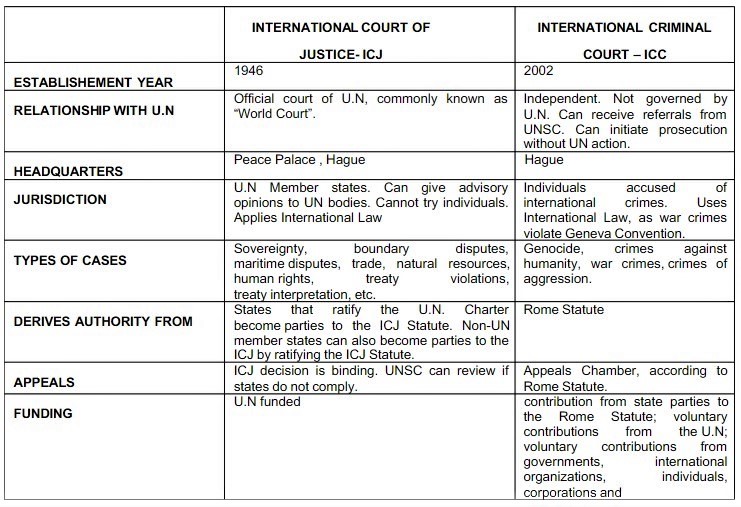
ICJ vs. ICC