Why in news?
The leaders of the world's twenty major economies gathered in Italy's Rome on Saturday for a two-day summit centred on the issues of climate change, Covid-19 and economic recovery.
What is G20?
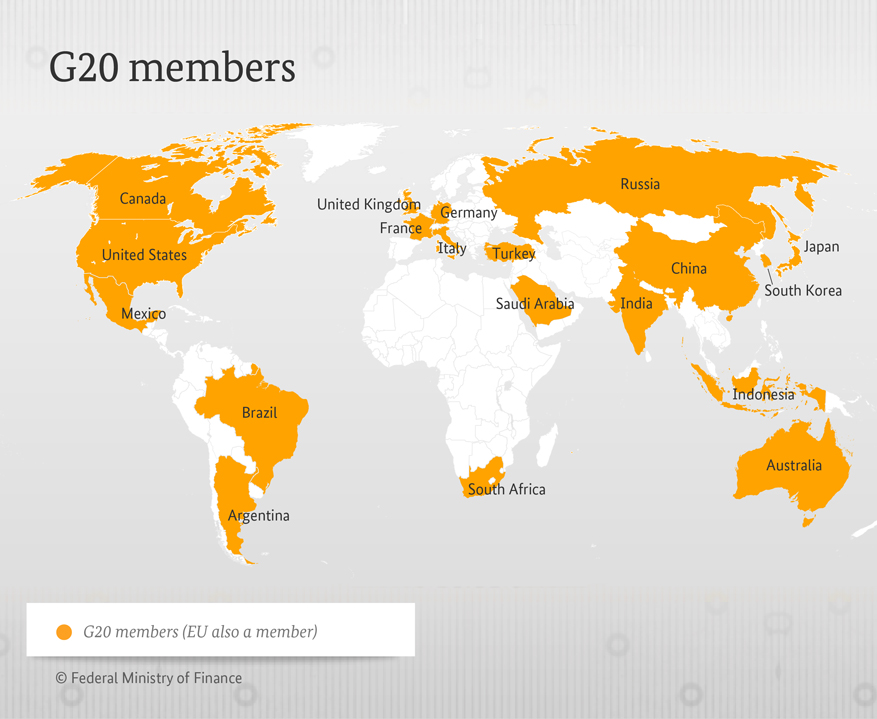
- The G20 is an international forum that brings together the world's 20 leading industrialised and emerging economies including India.
- Its members account for more than 80% of world GDP, 75% of global trade and 60% of the population of the planet.
- The forum has met every year since 1999 and includes, since 2008, a yearly Summit, with the participation of the respective Heads of State and Government.
- Ministerial meetings, Sherpa meetings (in charge of carrying out negotiations and building consensus among Leaders), working groups and special events are organized throughout the year.
How the G20 works?
- The G20 does not have a permanent secretariat.
- Its agenda and activities are established by the rotating Presidencies, in cooperation with the membership.
- A “Troika”, represented by the country that holds the Presidency, its predecessor and its successor, works to ensure continuity within the G20.
- The Troika countries are currently Saudi Arabia, Italy and Indonesia.
What is the current Rome summit about?
- The activity of the Italian Presidency has been based on three interconnected pillars of action – People, Planet and Prosperity
- The agenda included the biggest issues facing the global community, including the COVID-19 pandemic, climate change, a major tax agreement, and steps to address concerns regarding global economic growth and stability.
- At the end of two days of working sessions and side events, the G20 Leaders adopted the Rome Declaration.
- Health - To mitigate the pandemic, the focus was on vaccine production and distribution.
- The members assures support to WHO’s target of inoculating 40% or more of the global population against COVID-19 by 2021, and at least 70% by mid-2022.
- The G20 leaders were committed to boost the supply of vaccines in developing countries to overcome supply and financing constraint.
- Climate Change - The Group leaders recommitted their nations to providing $100 billion a year toward adaptation, mitigation, and green technologies, focusing on the needs of developing countries.
- Leaders for the first time acknowledged the use of carbon pricing mechanisms and incentives” as a possible tool against climate change.
- Global finance -The G20 leadership agreed to impose multinationals with a minimum 15% tax to create a more stable and fairer international tax system.
- This OECD-led reform enjoys the support of 136 countries, which account for more than 90% of global GDP, and is likely to enter into force in 2023 or after.
- Nations such as the U.S. are divided as it would impact the tech titans of Silicon Valleyon and it might face implementation delays.
- Global economy – Rising inflation, increased energy prices, and supply chain bottlenecks are affecting the world economy which is still reeling from Covid-related disruptions.
- G20 leaders ensured not to withdraw the national support measures.
- They also pledged to remain vigilant to the global challenges such as disruptions in supply chains.
- Development aid - Leaders set a new target of channelling $100bn towards poorest nations, coming from the $650bn pot made available by IMF .
- The timely, effective and coordinated action across major nations will be a ray of hope for global recovery.
References
- https://www.thehindu.com/todays-paper/tp-opinion/time-for-action/article37295541.ece
- https://www.theguardian.com/world/2021/nov/01/g20-what-did-world-leaders-agree-at-the-summit-in-rome



