Why in news?
Recent study shows that Calcium-41 can be used the same way as Carbon-14 in carbon dating, but with several advantages.
What is radio carbon dating?
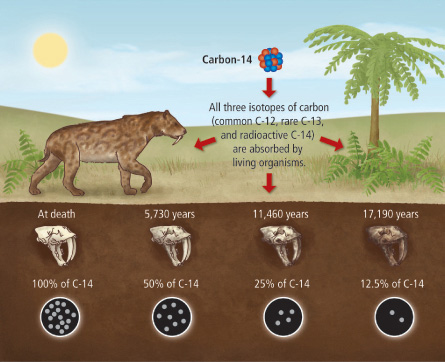
- Carbon-14 - Radiocarbon (Carbon 14) is an isotope of the element carbon that is unstable and weakly radioactive [The stable isotopes are carbon 12 and carbon 13]
- It has a half-life of 5,700 years, so the technique can’t determine the age of objects older than around 50,000 years.
- Radiocarbon dating – It is a method that provides objective age estimates for carbon-based materials that originated from living organisms.
- Plants and animals assimilate Carbon 14 from carbon dioxide throughout their lifetimes.
- When they die, they stop exchanging carbon with the biosphere and their carbon 14 content then starts to decrease at a rate determined by the law of radioactive decay.
- An age could be estimated by measuring the amount of carbon-14 present in the sample.
- There are 3 principal techniques used to measure carbon 14 content of any given sample.
- Gas proportional counting
- Liquid scintillation counting
- Accelerator mass spectrometry (Advanced method)
- The method was developed 1940s by Willard Libby, who received the Nobel Prize in Chemistry to this work in 1960.
- The issue with carbon dating was to detect carbon-14 atoms, which occur once in around 1012 carbon atoms.
What is Calcium-41?
- Calcium-41 is a rare long-lived radio-isotope of Calcium that has a half-life of 99,400 years.
- Calcium-41 is called a cosmogenic nuclide, because it is produced when cosmic rays from space smash into calcium atoms in the soil in a fission reaction, called spallation.
- It is found in the earth’s crust, opening the door to dating fossilized bones and rock.
- The issue is Calcium-41 is rarer, occurring once in around 1015 Calcium atoms.
How can the issue of detecting C-14 and CA-41 be resolved?
- Atom Trap Trace Analysis (ATTA) - Researchers at the University of Science and Technology of China pitched a technique called atom-trap trace analysis (ATTA) to spot these atoms.
- ATTA is both extremely sensitive and selective, and is based on the laser manipulation and detection of neutral atoms.
- Procedure - A sample is vaporised in an oven.
- The atoms in the vapour are laser-cooled and loaded into a cage made of light and magnetic fields.
- In ATTA, a laser’s frequency is tuned such that it imparts the same energy as required for an electron transition in Calcium-41.
- The electrons absorb and release this energy, revealing the presence of their atoms.
- Significance - It can spot one calcium-41 atom in every 10 16 calcium atoms with 12% precision in seawater.
- ATTA also avoids potassium-41 atoms, which are similar to calcium-41 atoms but lack the same electron transition.
- It can also be modified to study isotopes of some noble gases that have defied techniques developed for carbon-14, such as argon-39, krypton-81, and krypton-85.
What are the applications of ATTA and Calcium-41?
- Opens the possibility of extension to other metal isotopes
- To study how long rocks has been covered by ice
- Open avenues for exploring Earth-science applications
References
- The Hindu│About ATTA
- The Hindu│About Radio Carbon Dating
- Beta Analytic| Radiocarbon Dating



