Why in news?
The National Highway Authority of India (NHAI) has planned to award at least 8% of the targeted road development for the current fiscal through Build-Operate-Transfer (BOT) route.
What is a Build-Operate-Transfer (BOT) Contract?
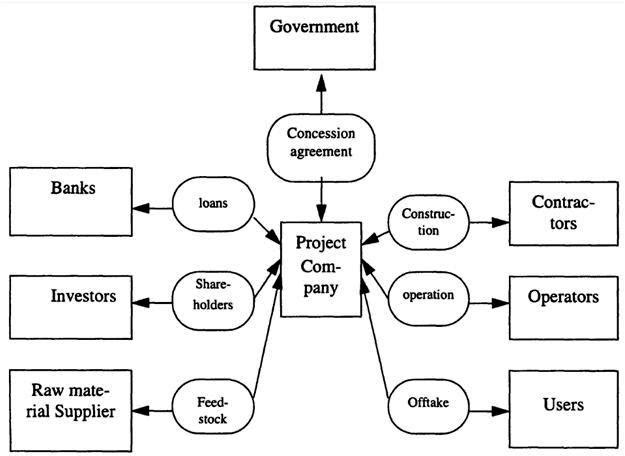
- A build-operate-transfer (BOT) is a Public Private Partnership (PPP) model used to finance large projects, typically infrastructure projects developed through public-private partnerships.
- BOT projects are normally large-scale, greenfield infrastructure projects that would otherwise be financed, built, and operated solely by the government.
- Under a build-operate-transfer (BOT) contract, an entity (usually a government) grants a concession to a private company to finance, build, and operate a project for certain period.
- After that period, the project is returned to the public entity that originally granted the concession.
What are the issues of concern?
- Recently, credit rating agency ICRA published its study of 120 BOT road projects that have defaulted during the last decade.
- The Enforcement Directorate (ED) attached assets of the promoters of Ranchi Expressway Ltd, on the charges of fraud and money laundering.
- The study by ICRA has revealed that 70% of the sample projects defaulted during the operational phase, largely on account of lower than envisaged traffic and authority-related issues.
- Only one-fourth of the projects could come out of default and nearly 16% of the projects were terminated.
What are the risks associated with BOT model?
- Risk during execution stage
- Ability of the concessionaire/sponsor to raise the requisite funding
- Timely availability of right-of-way and various approvals including environmental clearances
- Changes in design/scope of work
- Terrain conditions
- Local government or judicial interventions
- Cost-overrun
- Risks after the operationalization
- Revenue shortfall
- Flawed traffic projections which are made in the absence of any reliable historical data
- Mortality of a long-term loan
- Development of alternative routes and modes of transport
- Local political conditions
- Natural calamities
- Changes in laws
- Poor maintenance
References
- The Hindu Businessline│ It’s risky financing BOT roads
- Investopedia│ Build-Operate-Transfer Contract
- LMS Indian Economy│EPC Model
Quick facts
Engineering, Procurement and Construction (EPC) model
- This is a PPP model for the development of infrastructure projects especially highways.
- Under this model, the cost is completely borne by the government.
- Procurement of raw material and construction costs are met by the government.
- The private sector’s participation is minimum and is limited to the provision of engineering expertise.
- Issue - High financial burden for the government.
Hybrid-Annuity Model (HAM)
- HAM is a mix of the Engineering, Procurement and Construction (EPC) and Build, Operate, Transfer (BOT) models.
- HAM combines 40% EPC and 60% BOT-Annuity.
- It was introduced in 2016 to recover investments in road infrastructure projects.



