Why in News?
India has undergone five urbanisations evolving from the mercantile Harappan period to the post-independence industrial cities.
What was the first urbanization?
- Indus Valley Urbanization - First urbanisation was under the mercantile Harappans in the north-western part of India.
- Period – 2500 to 1900 BCE
- It was a vast civilisation, spread over a large geography, larger than any of the other contemporaneous ones in Egypt, China, and Mesopotamia.
- Indus Valley Civilization Cities
- Harappa and Mohenjodaro in present-day Pakistan.
- Rakhigarhi in Haryana
- Kalibangan in Rajasthan
- Dholavira and Lothal in Gujarat.
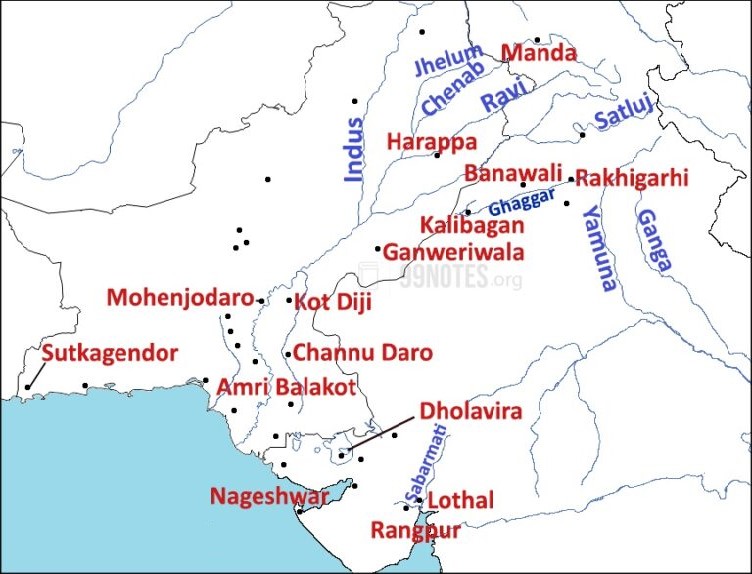
- Characteristics of Harappan Cities
- Grid Layout - The cities were meticulously planned with a grid layout, featuring wide, intersecting streets with separate entry and exit to control movement.
- Standardized Brick Construction - Buildings were built using standardized bricks in 1:2:4 ratio, suggesting a centralized system of production and distribution.
- Citadels - Many cities had fortified citadels, likely used for defense or administrative purposes.
- Drainage Systems - The cities boasted sophisticated drainage systems, including underground pipes and covered drains, to prevent flooding and maintain sanitation.
- Water Supply Systems - Wells and reservoirs were used to supply water to the city's inhabitants.
- Granaries and Warehouses - Large granaries and warehouses were found, indicating a well-organized system of food storage and distribution.
- Great Bath - Mohenjo-Daro featured a large, rectangular structure known as the Great Bath, possibly used for ritual cleansing or bathing.
- Assembly Hall - Harappa had a large, rectangular building that may have served as an assembly hall or meeting place.
- Trade and Commerce - The cities were involved in extensive trade, with evidence of long-distance trade networks
- Dholavira and Lothal were both significant centers of maritime trade.
- Art and Crafts - The Indus Valley people were skilled artisans, producing a variety of artifacts, including pottery, seals, and jewellery.
What was the second Urbanization?
- Mahajanapadas - The second urbanisation happened 1,500 years after Harappa.
- Period - 500 BCE
- Aryan Arrival - Around 1500 BCE, the Aryan or Indo-European people came from Southern Russia, through the Oxus, bringing with them horses.
- These were mostly men, intermarrying with the local women, changing the makeup of the local DNA.
- Over time, they moved further east, into the Gangetic Plain.
- Ganga plains established trade relations with the Indus plains and beyond.
- Cities - Taxila, Pataliputra, Rajagriha, Shravasti, Kashi, Kaushambi and Ujjain
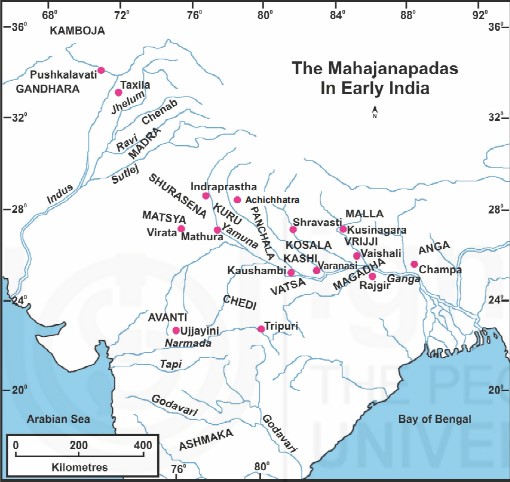
- Characteristics
- Fortified Cities - Many of these cities were fortified with walls and gates to protect them from attacks.
- Diverse Cultures - Due to their geographical locations, these cities often exhibited diverse cultural influences.
- Centralized Administration - Magadha's cities were characterized by a centralized administration, with a strong king and a well-organized bureaucracy.
- Religious Centers - Many of these cities like Kashi were important religious centers, attracting pilgrims and scholars from across the region.
- Mercantile cities - Merchant activity played a pivotal role in shaping the urban landscape of the Mahajanapada and Magadha periods due to expansin of trade networks.
- Trade Route - Cities located on major trade routes, such as Taxila, Pataliputra, and Ujjain, experienced rapid growth due to their strategic positions.
- Toll taxes became important to protect the highways.
- Emergence of New Philosophies - The rise of Buddhism and Jainism was closely intertwined with the growth of trade and mercantile activity.
- Buddhist literatures provided information about the urbanization of this period.
- First Coinage - The first punch-marked coins in India were minted by the Mahajanapadas and merchant guilds of this region.
- Fall of Trade – Around the 5th Century CE, with the fall of Rome , an important trading partner , and the invasion of the Hunas, the merchants lost their importance.
- With the Trade fell, and the Mahajanapadas began to disintegrate.
What was the third urbanization?
- Temple urbanisation - The 3rd urbanisation took place as Temple Cities across South India and Southeast Asia.
- Period – 7th to 12th Century
- By the 10th Century Chola period, full-blown temple urbanisation emerged.
- Cities – Madurai, Kancheepuram, Thanjavur, Srirangam
- Characteristics
- Temple Center - Temple was the nerve centre of political and economic activity, surrounded by markets, courtiers, and courtesans.
- Spiritual and Cultural Hubs - Temples were centers of spiritual and cultural activities, hosting religious ceremonies, festivals, and educational institutions.
- This attracted scholars, artists, and craftsmen, further contributing to the development of the city.
- Pilgrimage Centers - Temples often served as important pilgrimage sites, attracting devotees and contributed to the growth of surrounding settlements.
- Rise of Agriculture - These Cities were more agricultural than mercantile.
- After the 4th-5th Century, when export-led mercantile trade fell, agriculture and Agri based activities started gaining prominent economic activity.
- Devadana Lands - Temples often received endowments of land and other resources, which generated income through agriculture, trade, and other economic activities.
- Brahmadeya - Around the time Buddhism was slowly declining and Brahmadeya or donations to Brahmins/temples started emerging.
- Society - These temples had Brahmin priests, Kshatriya patrons, Vaishya merchants, artists, etc.
- Changes in Society - Endogamy flourished and the caste system solidified.
What was the fourth Urbanization?
- Muslim Metropolis - The 4th urbanisation is the Muslim Metropolis of Delhi sultanate and Mughal empire.
- Period - 12th to 17th Century CE.
- According to Abu-l Fazl, in 1594 there were 2837 towns of which 180 were named as larger cities.
- Cities
- Delhi sultanate – Delhi, Hisar, Hansi, Sirsa, Meerut, and Aligarh.
- Mughal Cities - Agra , Fatehpur Siki, Lahore, Sikandra, Shahjahanabad
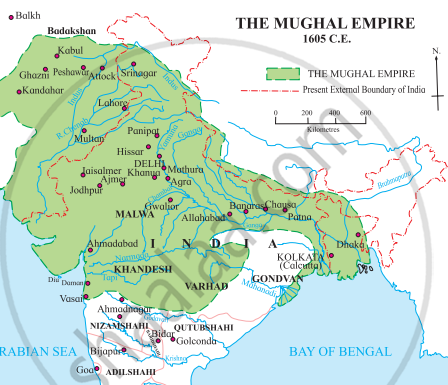
- Characteristics
- It was primarily agricultural.
- Feudal System - The courtiers were paid by giving them a share of the village wealth.
- Religious Character - Sufism, Dargahs (shrines), and Pirs became important.
- The Jama Masjid becomes a central site in these cities.
- Cultural Centers – Lahore, Agra were renowned cultural center under the Delhi Sultanate and the Mughal Empire, known for its poetry, music, and arts.
- Bazaars and Markets - Vibrant bazaars and markets catered to the needs of the population, offering a wide range of goods and services.
- Fusion of Architectural Styles - Mughal architecture often incorporated elements from Persian and Islamic styles, resulting in a unique and distinctive aesthetic.
What was the fifth Urbanization?
- Postcolonial cities – 5th urbanisation is the colonial and post-colonial cities.
- Colonial administration had created a new urban, industrial and imperial landscape.
- Period - 17th Century onwards.
- New Factors - Forces of international trade, mercantilism and capitalism now came to define the nature of society.
- Colonial Cities
- British Colonial Cities – Calcutta, Bombay, Madras, Shimla
- French Cities – Pondicherry , Mahe
- Portuguese Cities – Goa, Diu, Daman
- Dutch – Masulipatinam
- Characteristics
- Colonial cities reflected the mercantile culture of the European.
- The big coastal cities — Mumbai, Chennai, Calcutta, Kochi began as fortified settlements of the colonial powers, either the Portuguese or the Dutch or the French or the British.
- European bases - European commercial Companies had set up base in different places early during the Mughal era
- Portuguese in Panaji in 1510
- Dutch in Masulipatnam in 1605
- British in Madras in 1639
- French in Pondicherry in 1673.
- Trading Centers - With the expansion of commercial activity, towns grew around these trading centres.
- Economic Capitals - After the Battle of Plassey in 1757, expansion of trade made colonial port cities such as Madras, Calcutta and Bombay rapidly emerged as the new economic capitals.
- Hill Stations – Development hill stations Shima, Ooty were a distinctive feature of colonial urban development.
- Cultural Integration - Building with Indian and European cultural mix Indo Saracenic style was created.
- Churches, cathedrals – Bom Basilica in Goa, Santhome Church
- Administrative buildings –Fort St. George , Fort St. William.
How the cities are developed post-independence?
- Post Independence Cities – Growth of planned cities due to Industrialization and State reorganization.
- Capital Cities – New capital cities were constructed with the emergence of new States during state reorganization.
- Chandigarh - Designed by Swiss-French architect Le Corbusier.
- Bhubaneswar – It was selected to be the capital of Odisha in 1948 by integrating the temple town into its planning and the needs of modern administration.
- Gandhinagar – It was formed in 1960 as capital of Gujarat.
- Industrial Cities - With heavy industrialisation, part of India’s Five Year Plans, industrial cities like Bhilai, Jamshedpur, and Rourkela.
Reference
The Indian Express | Rise and fall of cities in India



